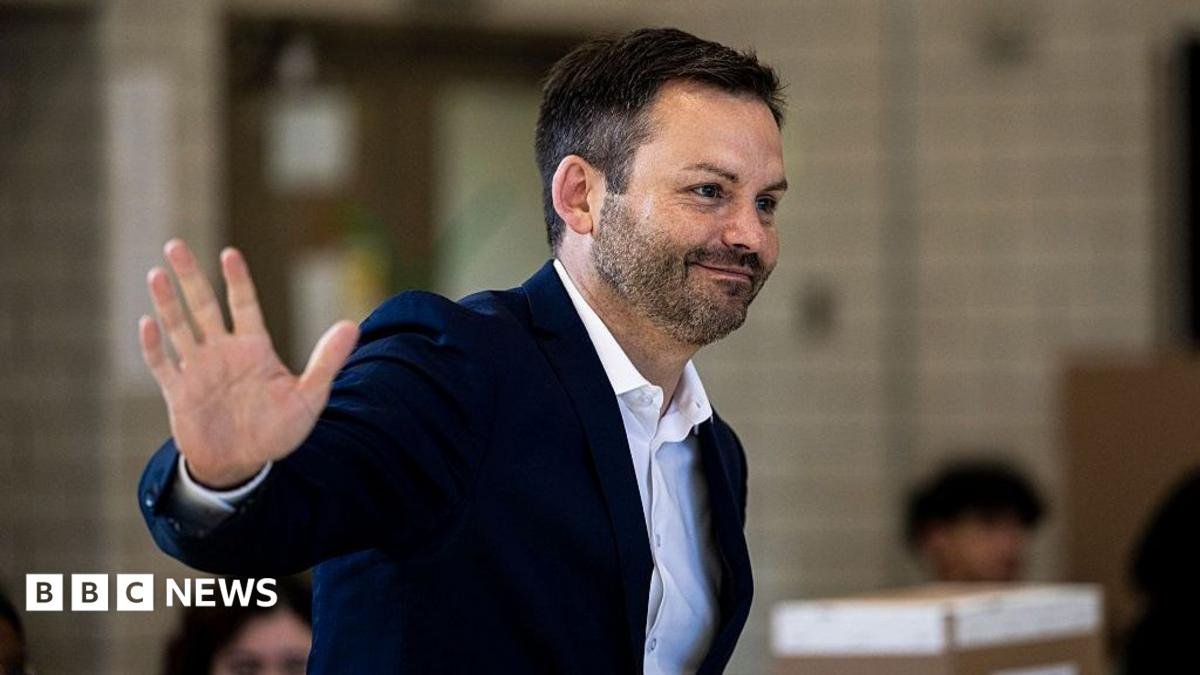

Canadian media projects the sovereigntist Parti Québécois (PQ) will secure a minority win in Monday’s provincial election in Quebec, making Paul St-Pierre Plamondon the incoming premier.
It marks the first time the PQ has been in power since 2014. It could prove to be a test for Prime Minister Mark Carney, setting up confrontations with Quebec over issues like immigration and the monarchy.
The party has also pledged to hold a referendum on Quebec’s independence, similar to an upcoming vote in province of Alberta later this month.
The majority French-speaking province has held other votes on this, in 1980 and 1995. Polls indicate only 30% of Quebecers back such a move.
Plamondon has said that vote would occur after US President Donald Trump is out of office.
Carney may find himself managing dual unity crises in different parts of the country, depending on the outcome of the separation vote in Alberta. Trump is due to leave office in roughly two years, meaning that if Plamondon keeps his pledge, a third plebiscite on independence would likely be scheduled for 2029 or 2030.
Separate from sovereignty, Plamondon has made it clear he is willing to fight Ottawa if it is seen as overstepping matters of provincial interest.
He suggested during the campaign that he was going to pressure Ottawa, external on issues like immigration, vowing to fight any increases mandated by the Carney government.
He also pledged to “abolish the monarchy in Quebec” and reroute money spent on its institutions to social services instead.
“We are going to do what we have to do to get the monarchy out of Quebec, repatriate those funds, and send them to social causes,” he told reporters in late September.
For example, Plamondon suggested defunding Quebec’s lieutenant-governor’s office – responsible for representing King Charles III in the province – saying he would instead spend that money to tackle homelessness.
Plamondon was among the Quebec lawmakers who refused to pledge allegiance to the King in 2022, paving the way for a provincial law that now makes the oath of allegiance optional.
His plan to withdraw financial support for the lieutenant-governor’s office is likely to face significant legal challenges, given the monarchy’s central role in Canada’s constitution.
Such a move would also put future Quebec laws in doubt, as one of the key roles of the lieutenant-governor is to give royal assent to new legislation.
Pressed about these hurdles, Plamondon has told reporters that he is ready for a legal battle with the federal government.
The success of the Parti Québécois on Monday is in part due to public fatigue with the previous Coalition Avenir Québec government.
Coalition Avenir Québec made safeguarding Quebec’s identity and language central to its eight years in office, but its longtime leader, François Legault, eventually lost significant support among voters.
Efforts to revive the party by replacing Legault with a new leader, outgoing Premier Christine Fréchette, were unsuccessful.
Fréchette conceded her own re-election race in Trois-Rivières shortly before 22:00 local time. She said in a speech that she would work with St-Pierre Plamondon on the transition.
“Governing Quebec is the greatest honour I have ever had,” she said. “I have Quebec tattooed on my heart.”
The Quebec Liberal Party secured the second-most seats, while the Quebec Conservative Party gained seats.
Prime Minister Carney, who leads the federal Liberal party, remains popular in Quebec, though support for him had recently dipped, external as US President Donald Trump imposed new tariffs on Canada in August, following a breakdown in trade talks.
Quebec is among the hardest hit by the latest US tariffs, with experts at global forecasting firm Oxford Economics projecting a C$2bn blow for the province.
Carney congratulated Plamondon on his victory late on Monday and vowed to work together with the party.
“Building a stronger Québec is core to our mission of building a stronger Canada,” he said in a post on social media. “I look forward to working with you to support Québec’s businesses and workers impacted by tariffs, create more good jobs, work to end homelessness, and get more homes built across Québec.”