
For the second time in a month, family members and sailors pressed top Navy officials for answers about the health and well-being of troops facing record-long deployments, such as the USS Abraham Lincoln.
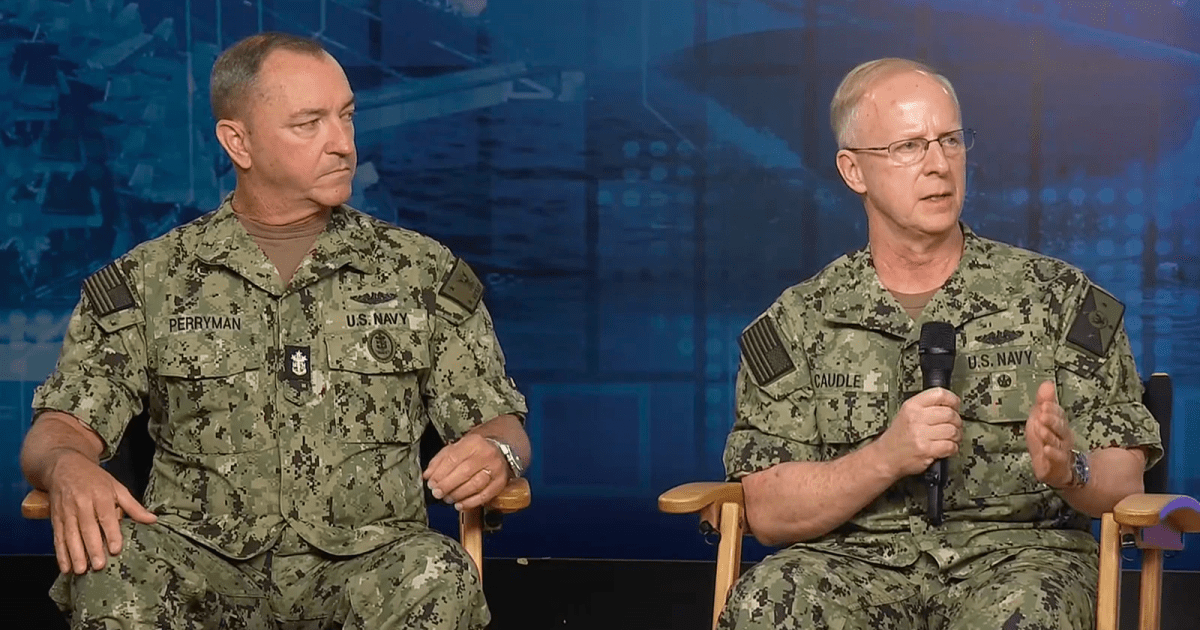
During a carefully orchestrated town hall Monday at Fort George G. Meade in Maryland, Chief of Naval Operations Adm. Daryl Caudle, the highest-ranking Naval officer, took questions about mental health among sailors, increasingly long deployments such as the one the Lincoln has faced and retention in the Navy.
Caudle acknowledged the challenges that come with lengthy tours at sea, but he said the Navy should expect more long deployments until it can build more ships.
He said the Navy is working to address the supply shortages and mental health issues that the Lincoln has faced on its tour that was repeatedly extended to fight the war with Iran.
Caudle said the Navy understands the importance of port calls that give sailors and Marines on aircraft carriers the time to “relax” and “rejuvenate,” and also get the carrier back up to speed again with needed maintenance.
The Navy is looking at what a port call in the Arabian Gulf region would look like so future carriers deployed in the region can have those opportunities the Lincoln did not have, Caudle said.
A major challenge sailors on the Lincoln had faced was not knowing when they would be back at their home port in San Diego.
“It is the uncertainty of the end date that I think is the biggest hardship,” Caudle said. “I think when sailors know how long they’re going to be away from family, they go plan their lives to that.”
A sailor in the town hall who was selected to ask a question described mental health challenges in the Navy as an “occupational hazard” and described knowing other sailors who have attempted to die by suicide, including one sailor who did die by suicide.
The sailor said the Navy has “made great strides” to help service members, but has also “stumbled occasionally,” and asked how Navy leaders plan to continue to make progress on mental health issues and ensure all sailors stay safe.
Caudle said the Navy tries to make sailors “as resilient personally as possible” during boot camp, which can help “improve warrior toughness in general.”
Operationally, the Navy works to ensure sailors have a “spectrum of care” once they get to the fleet that includes health technicians such as psychologists and psychiatrists, as well as chaplains, Caudle said.
Caudle also said he wants to strategically work to “remove friction” in sailors’ lives, helping with everyday stressors that may arise such as “daycare” or “things that we can do for your family and spouse.”
The town hall was streamed by the military on various social media platforms.
Caudle and Master Chief Petty Officer of the Navy John Perryman, the Navy’s senior enlisted member, spoke to service members and Navy spouses gathered in person inside an auditorium at Fort George G. Meade in Maryland, as well as service members joining virtually from Navy duty stations around the world, including Yokosuka, Japan; Rota, Spain; and Guam.
It is not clear how or why each specific service member was chosen to ask a question.
The measured tone of Monday’s town hall stood in stark contrast to the raucous, emotionally charged meeting on Aug. 6 in San Diego.
In that meeting, Navy leaders told family members the Lincoln would not be back home until December. Family members shouted down Acting U.S. Secretary of the Navy Hung Cao over the conditions sailors were facing aboard the ship.
Days after MS NOW reported on the boisterous confrontation and the shortages and mental strain sailors were facing, the Navy changed its plans, sending a different carrier to replace the Lincoln and turning the Lincoln toward home.
Questions about mental health
Family members of loved ones aboard aircraft carriers such as the Lincoln have expressed concerns to MS NOW for their service members’ mental health due to extended deployments and conditions aboard the carrier.
One sailor aboard the Lincoln jumped overboard in August in what his wife describes as a suicide attempt. The sailor is currently facing disciplinary charges over the attempt, which has raised questions about the military’s handling of mental health.
During Monday’s town hall, Master Chief Perryman said he is a member of the Navy’s “suicide prevention task force,” and that Navy leaders are looking at existing programs to evaluate which ones are working and which ones are not, as part of “efforts to get after some of the mental health issues in the fleet.”
Perryman noted, “We’ve been throwing a bunch of different things at mental health to try to solve them, and never really took a look at it holistically.”