
www.theguardian.com
Sadiq Khan given seat in Lords, as Starmer creates 26 new peers days before he leaves No 10
Pippa Crerar
Pippa Crerar is the Guardian’s political editor.
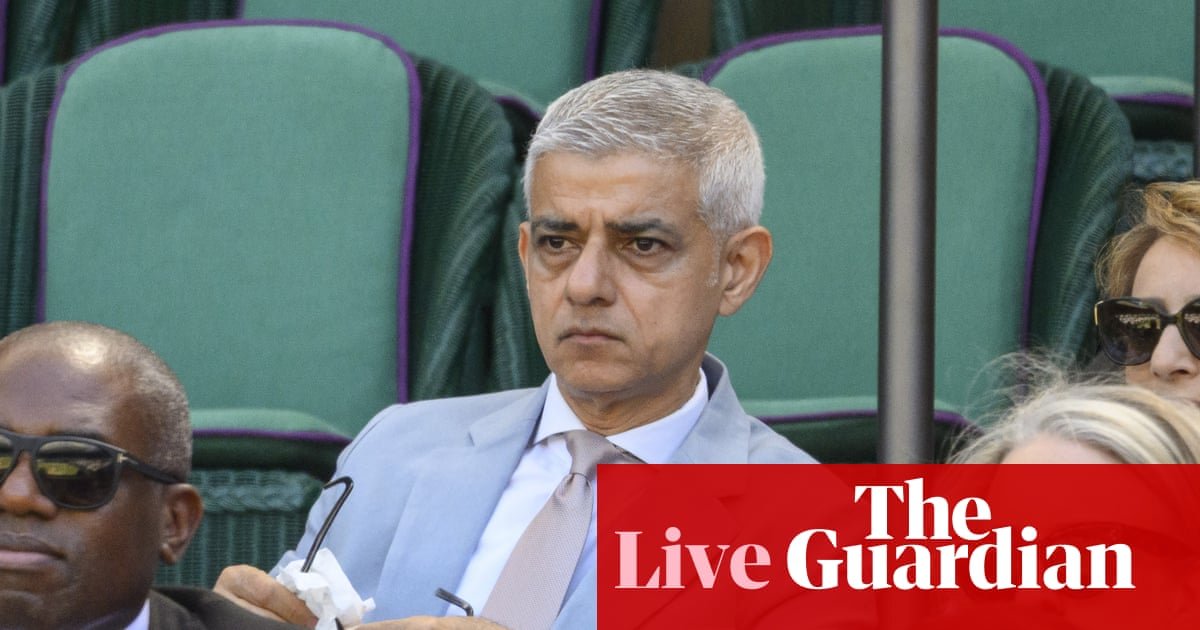
Sadiq Khan has been given a peerage by Keir Starmer just days before the prime minister stands down, potentially opening the door to one of Labour’s most high profile mayors joining Andy Burnham’s cabinet in future.
While Burnham and Khan have worked closely together over the years, the Guardian understands the London mayor has told the PM-in-waiting he has no wish to be a minister in his government right now. Sources close to the mayor said he was committed to focusing on the last two years of his current term, and has not yet announced whether he wants to seek a fourth term in 2028.
Burnham has previously called for an overhaul of the House of Lords, proposing to turn the second chamber into a ‘senate of regions and nations’, with seats for the country’s metro mayors, presumably also including London.
Downing Street sources suggested Khan’s elevation comes as part of a regular honours list, rather than being linked specifically to Starmer’s departure. But the timing is unusual, with peerages usually tied to political events and most commonly appearing in spring or autumn.
It comes after Starmer signalled last week that he could hand out resignation honours when he leaves Downing Street, despite pledging three years ago he would not do so when he eventually stood down.
The full list of 26 people getting peerages is here.
Key events

Lisa O’Carroll
Lisa O’Carroll is a senior Guardian correspondent covering post-Brexit issues.
Nick Thomas-Symonds is hoping to stay in post as EU relations minister in the new Andy Burnham cabinet.
EU diplomats also believe he has a decent chance, given that Burnham has no desire to introduce uncertainty to the repaired relations with the EU.
Speaking at an event marking his departure and retirement, the EU ambassador to the UK, Pedro Serrano, said the “remarkable … progress” in transforming the shattered relations with the UK after Brexit had been partly down to the “direct involvement” of Thomas-Symonds.
He said the next EU-UK summit would mark the conclusion of several key agreements developed under Keir Starmer.
Thomas-Symonds spoke of the “legacy of cooperation” he had built with the EU over the last three years (including when Labour was in opposition). “We look ahead to the next summit, where we continue to deliver on the issues that matter to citizens and to businesses,” he said.
And, while I’m plugging Guardian content on Andy Burnham, do read the first instalment of Daniel Boffey’s excellent long profile of Burnham. This is how it starts.
Andy Burnham had emerged victorious, but niggling doubts remained about his mandate. It was the summer of 1987 and the 17-year-old had represented Labour in a school hustings as Margaret Thatcher and Neil Kinnock were battling it out in that year’s general election.
“Andy was standing against another guy, a really nice guy who was the Conservative candidate,” said Steve Harrington, a former English teacher at St Aelred’s Catholic high school, in Newton-le-Willows, Merseyside. “Andy gave a speech, which was excellent, then the other guy came on to make his speech and Andy’s fans – unbeknown to Andy – snatched the plug out of the microphone. So they couldn’t hear what he was saying. Andy won by a landslide. Having said that, he probably would have anyway, as it was a heavily Labour area … But he was innocent, he hadn’t been involved in [the prank] and wouldn’t have been.”
If there was a whiff of illegitimacy to Burnham’s first election, his uncontested selection by the Labour party to be the UK’s next prime minister now leaves him with a particularly fraught task: create the change he has promised without clear electoral backing. He will need to outline a vision more sharply than the outgoing prime minister, Keir Starmer, defying his critics’ caricature of him as a man without principle: a “Captain Flip-flop”.
(Do read the second instalment too – but it’s not out yet.)
The latest episode of the Guardian’s Politics Weekly UK is out. It features Pippa Crerar and Kiran Stacey talking about Shabana Mahmood being lined up to be Andy Burnham’s chancellor.
MI5 lied about relations with neo-Nazi informant, watchdog says
MI5 has been reprimanded by a watchdog for lying about its relationship with a neo-Nazi informant, who had exploited his role with the spy agency to violently threaten his girlfriend. Dan Sabbagh has the story.
Tories accuse Reed of ‘gerrymandering local government for party political advantage’
The Tories have claimed that Steve Reed’s council reorganisation for England (see 1.50pm) is designed to help Labour.
James Cleverly, the shadow local government secretary, said:
The maps speak for themselves: these top-down changes are purely partisan.
Having tried and failed to cancel local elections two years running, Steve Reed is once again fiddling with democracy. His legacy will be one of taking power away from local communities, imposing an unfair funding review on councils, and gerrymandering local government for party political advantage.
As an example, the Tories said Reed was expanding the boundaries under Labour control like Exeter city council, Plymouth city council and Lincoln city council.
Ministers shelve plan to stop paying volunteer coastguards
Ministers have shelved a plan to stop paying volunteer coastguards for attending rescues.
In a written ministerial statement today, Keir Mather, a transport minister, said the government would not go ahead with a proposal to move the service to an “expenses-only volunteer model” in September in the light of the backlash the original plan provoked.
He said there would be further consultation on how to move ahead.
The Maritime and Coastguard Agency (MCA) originally took the decision to stop paying volunteers for call-outs after a court of appeal ruling said that this arrangement meant that they counted as workers in legal terms. The MCA argued that, in order to retain flexibility, it would be better to have the coastguards operating on an expenses-only basis.
Responding to the announcement, Richard Holden, the shadow transport secretary, said:
We welcome this latest U-turn from Labour, but they should never have let it get to this situation in the first place.
Our coastguard rescue officers bravely put their lives at risk day in and day out. The least they deserve is a small payment in recognition of the vital work they do.
Reed gives details of how more than 100 councils to be axed as part of unitary authority reorganisation plan for England
Steve Reed, local government secretary, has confirmed plans for councils to be reorganised in 14 areas.
The government was already committed to getting rid of the two-tier council system in place in large parts of England. This system results in people having some services provided by a big country council and other services provided by a smaller, separate district council.
Reed is introducing unitary councils instead, which will mean residents just having to vote for one council that will provide all their main local authority services. Some places already have unitary councils, but Reed is making them universal.
Today Reed announced details of how that will happen in 14 county areas.
In a statement to MPs, Reed said:
Once all decisions are taken, we will have cut the number of councils from 317 to a maximum of 173.
This will simplify and strengthen local government serving over 20 million people and reorganisation’ll also support city growth.
Reed described this as “the most ambitious programme of local government reform in a generation, replacing the inefficient two-tier system with new unitary councils so that all parts of our country are ready for devolution”.
There are further details here.
And here is the government’s list of the 14 county areas affected, and the decisions taken about how many unitary councils they will get.
1) Gloucestershire: 7 councils being reorganised into 1 unitary. This will unite the Gloucester-Cheltenham growth corridor and Golden Valley cyber cluster under one council, with reorganisation expected to deliver savings by reducing duplication across services and leadership.
2) Derby and Derbyshire: 10 councils being reorganised into 2 unitaries. This will let Derby expand in all directions while reflecting the county’s distinct north/south geographies and creating two strong partners in the East Midlands Combined County Authority.
3) Warwickshire: 6 councils being reorganised into 2 unitaries. This will allow each new council to focus on the specific needs of its communities, tackling health inequalities in the north and improving access to services for older and rural residents in the south.
4) Worcestershire: 7 councils being reorganised into 2 unitaries. This will reflect the county’s different economies and identities in the north and south, balancing scale with staying connected to communities.
5) Oxfordshire: 6 councils being reorganised into 3 unitaries. This will address Oxford’s housing constraints, better reflect the city’s economic geography, and ensure Oxford has its own seat at the table when regional powers and funding are agreed with government.
6) Hertfordshire: 11 councils being reorganised into 4 unitaries. This will reflect the county’s distinct economic areas, keeping public services organised around where people live, work and travel.
7) Leicester, Leicestershire and Rutland: 10 councils being reorganised into 2 unitaries. This will expand Leicester’s boundary to reflect how the city actually functions, unlocking around 30,000 homes and 67 hectares of employment land, and creating a stronger platform for future devolution.
8) Nottingham and Nottinghamshire: 9 councils being reorganised into 2 unitaries. This will bring most of Nottingham’s urban area under one council, supporting the Mayoral authority’s growth ambitions and creating a more balanced urban-rural mix.
9) East Sussex and Brighton and Hove: 7 councils being reorganised into 2 unitaries with boundary modifications. This will expand Brighton and Hove’s planning footprint and tax base to tackle housing unaffordability and support growth across connected communities.
10) Staffordshire and Stoke-on-Trent: 10 councils being reorganised into 2 unitaries. This will support Stoke’s growth opportunities across a natural north/south split, minimising service disruption and achieving strong financial sustainability.
11) Lancashire, Blackburn with Darwen and Blackpool: 15 councils being reorganised into 4 unitaries. This will reflect Lancashire’s diverse urban, rural and coastal communities, aligned with existing economic areas and transport links, with a clear structure for future devolution.
12) Kent and Medway: 14 councils being reorganised into 4 unitaries. This will align councils with housing markets and local need, support Medway’s growth, and maintain locally responsive services while strengthening local voices through neighbourhood committees.
13) Devon, Plymouth and Torbay: 11 councils being reorganised into 4 unitaries. This will align boundaries with economic geography to unlock housing and infrastructure growth, supporting Plymouth’s defence sector and Exeter’s expansion as key urban engines.
14) Lincolnshire, North Lincolnshire and North East Lincolnshire: 10 councils being reorganised into 4 unitaries. This will give Lincoln the space to grow while striking the best balance between urban and rural service delivery and securing Lincoln a distinct voice in devolution
Starmer announces UK investment to help deliver Swedish fighter jets to Ukraine
In Kyiv Keir Starmer has held a press conference with the Ukrainian president, Volodymyr Zelenskyy. Starmer said the mood was shifting in Russia, with Vladimir Putin being “forced to admit that his illegal invasion is causing real problems at home for him.”
Jakub Krupa has more on the Starmer visit, and the backlash Zelenskyy is facing about his decision to sack his defence minister, on his Europe live blog,
To coincide with the trip, Starmer has also announced that the UK is “investing €300m to help deliver advanced Swedish Gripen fighter jets to Ukraine, strengthening Ukraine’s ability to defend its skies from Russian attacks, while supporting thousands of highly skilled jobs across the UK.”
ITV’s political editor Robert Peston has also weighed in on Andy Burnham’s probable decision to make Shabana Mahmood his chancellor. Peston, who is unusual among political editors in having spent a lot of time covering business and economics, thinks the decision is likely to go wrong.
Here’s an extract from his post.
According to those who know Burnham’s mind, he and his transition team just want someone at Number 11 who will simply execute their will. The plan is to drive the economy from 10 Downing Street.
On this model, poor Mahmood would be a cipher for Burnham and his cabal. And she would be a fabulous cipher at that, because her revealed skill at the Home Office is to brook no opposition from officials and to drive reform.
If this is Burnham’s plan, it is hugely risky, and I suspect it would end in tears.
Burnham won’t personally have the time to micromanage the Treasury. No prime minister does.
And the Treasury, like no other department, can only be led by someone – the Chancellor – with personal expert authority and a plan. In all other circumstances, the Chancellor is led by officials.
Also I very much doubt Mahmood would allow herself to be any prime minister’s puppet or cipher in any case.
Nationalising British Steel does not mean Labour ‘going back to 1970s’, minister tells MPs
Nationalising British Steel does not mean Labour is going back to the 1970s, a minister told MPs.
Blair McDougall, a business minister, was speaking in the Commons in response to an urgent question about the British Steel announcement.
Rebecca Paul, a Conservative asked him:
Britain’s steel industry is not competitive because of high energy costs and excessive red tape.
But instead of addressing the root causes, this Labour government reverts back to its default solution of nationalisation. Why is this government so keen to take us back to the 1970s?
And McDougall replied:
I simply don’t accept the idea that we’re all going to be in flares and wearing kipper ties and going back to the 1970s simply because we have a government which is willing to intervene rather than standing by and letting people and communities fall onto the scrapheap.
The Conservatives and the Liberal Democrats, like business secretary Peter Kyle (see 9.47am), are also sounding off about the “Las Malvinas son Argentinas” banner waved by Argentinian players after they beat England in the World Cup semi-final last night.
Although it could be seen as a harmless taunt, the Conservatives have put out this statement from their shadow sports minister, Louie French.
The Falklands are British. That is not up for discussion.
Last night’s pathetic stunt by the Argentinian team was shameful and Fifa must the throw the book at them.
And Ed Davey, the Lib Dem leader, said:
In August 2024 Rodri and Álvaro Morata were rightly banned for one match for singing “Gibraltar is Spain”.
Now the Argentine players who celebrated with the “Falklands are Argentine” banner must be barred from the final.
Sienna Rodgers from the House magazine has more on the Green party reaction to Shabana Mahmood being lined up to be Andy Burnham’s chancellor.
Green Party source on briefings Ed M won’t be chancellor: “The Labour briefings on the chancellor are a gift to us. Openly highlighting they don’t want change, briefing that the bankers don’t want Miliband, surreal levels of hitting the ball over the bar.”
Ministers give further details of how proposed fair pay agreements for care sector will work
Ministers have published new details of how the proposed fair pay agreements for workers in the care sector will work.
Stephen Kinnock, the care minister, has set out the plans in a written ministerial statement. And this is how the Department of Health and Social Care explains them in a news release.
Millions of care workers in England will be represented in upcoming negotiations on pay and working conditions through a new body established to deliver the first ever fair pay agreement for adult social care.
The new adult social care negotiating body will be set up by the end of the year, bringing together trade unions and employers to negotiate on behalf of the sector.
Through the body, care providers and workers will have voting rights on key issues including pay, terms and conditions, and wider employment matters through a regular negotiation process.
The body will also have an independent chair to oversee the negotiations between employer and worker representatives, who will be appointed in early 2027.
The first fair pay agreement for the sector is due to come into force in 2028-29. The government is investing £500m to help fund it.
Peter Kyle, the business secretary, has told workers at British Steel that nationalisation should give them certainty.
On a visit to the plan in Scunthorpe this morning, he said:
I know you’ve gone through a period of real uncertainty. And I know that uncertainty here means uncertainty for the whole community and the whole town as well.
I’ve been hearing about this loud and clear, and it’s been in the forefront of my mind.
But now you have certainty.