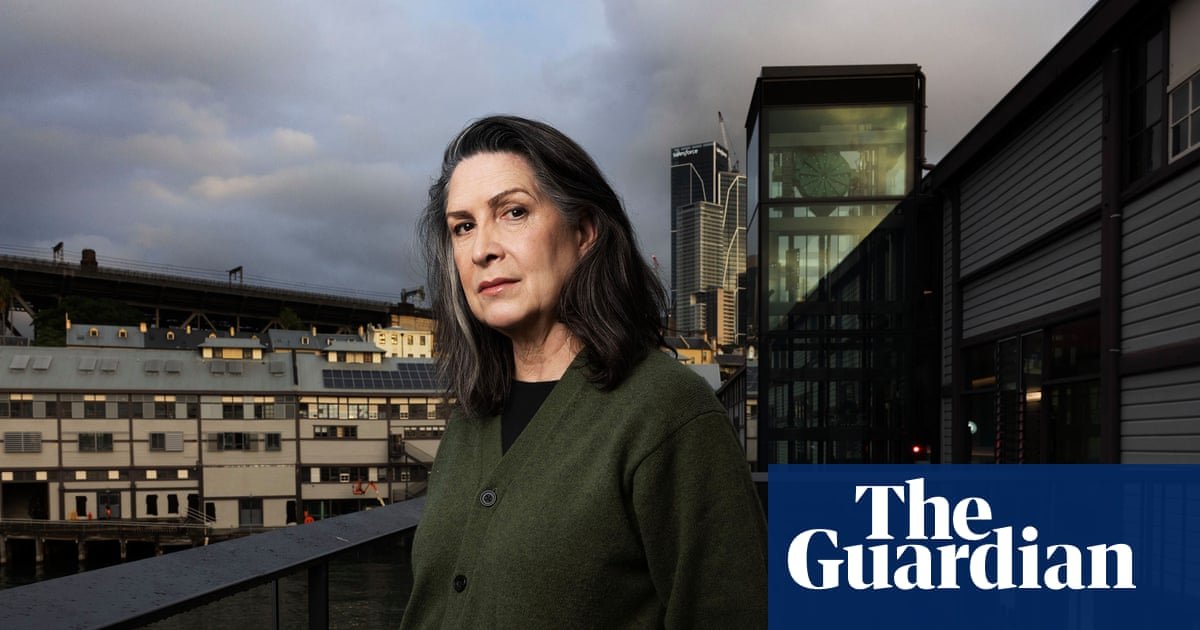

Pamela Rabe emerges from theatre rehearsals where she is playing a strict Catholic nun, the actor seeking divine order from a grey late afternoon on the wharf above Sydney’s Walsh Bay. “Do we walk – in the rain?” she asks crisply.
The clouds yield and the rain loses its nerve as the tall, formidable Rabe steps onto the steel balcony to pose with laser focus on the camera lens. Canadian-born Rabe first sought early career traction in Sydney in the late 1980s and early 90s to distinguish herself from her Melbourne acting milieu, where she was revered as an “actress with a capital A”, of whom a critic remarked, “makes strong [people] swallow hard and lesser mortals involuntarily bow”.
Whether playing a sinister jail “screw” in the television series Wentworth or a savage, sarcastic matriarch on stage in August: Osage County, Rabe leans into her imposing physicality. In person, she has a strong, charismatic presence coupled with a well-read, deadpan humour. As we wander the wooden piers towards the Harbour Bridge, I note we have lost the photographer and publicist. “Oh, I hope so,” she says with a chuckle.
Rabe, who lives with her theatre director husband, Roger Hodgman, on a semi-rural property outside Hobart, has been working steadily since migrating to Australia in 1983, most recently in Eamon Flack’s challenging stage adaptation of the ecocide thriller novel Drive Your Plow Over the Bones of the Dead at Sydney’s Belvoir St theatre. Of the play’s three-and-a-half hours, Rabe was responsible for perhaps 85% of the dialogue, playing a traumatised schoolteacher who mourns dead animals.
“I felt very proud of my brain,” Rabe says, shutting her eyes, pinching her nose and waving one hand above her head. “I’m holding my nose, I dive in, and trust that [my] brain had put that somewhere that could be accessed, then articulated with feeling and hopefully sense. To realise that my brain could still do that at 67 was very heartening.”
Rabe finds rhythm in her texts, likening the delivery of lines to a pianist or a violinist playing rapid-fire notes. She says the late neurologist Oliver Sacks is one of her favourite authors because he breaks down how we embody life experience to tell stories, notably how the ageing or amnesiac brain uses music as a bridge to memory.
I suspect Rabe is too busy to mull too much on her own ageing. She remembers now the late Ruth Cracknell – “a profound influence on my life” – whom she met when they starred in the Neil Simon play Lost in Yonkers in 1992. At the same time, Cracknell was also playing the character of Maggie, who had early dementia, in the sitcom Mother and Son. Cracknell was then 66, Rabe 33. “She was younger than I am now and she seemed ineffably old,” Rabe muses.
Today, Rabe is stepping out from rehearsals for the role of the iron-handed head nun Sister Aloysius Beauvier in John Patrick Shanley’s 2004 play Doubt: A Parable, set in 1964 at a Catholic church and school in the Bronx, New York, where Father Brendan Flynn (played by The Newsreader’s Sam Reid) is accused of abusing an altar boy.
Sister Aloysius clings to her self-perception as a moral guardian who can “smoke out incipient danger”, says Rabe, who sees resonances in this social media epoch when disagreements turn people into enemies. “The notion of ‘you’re either with me or against me’ has very much permeated our modern social culture,” she says. “We’re all hardwired to want to know what’s right and what’s wrong. [Doubt] is an argument for sitting in uncertainty, and that’s the most alive you can be.”
Doubt, Rabe says, is “something we all battle with every day” but suggests the tendency towards certainty pre-dates our social media era, recalling Americans responding to an earthquake on television decades ago. “It was like they’d all prepared for the camera. They were confidently describing something in very manageable sound bites. America has been particularly groomed to produce this [certainty], which has become more a global standard of the way we should present ourselves to the world.”
Ravenous capitalism meanwhile would undermine the Rabe family’s own certainties. Faith had been important to Rabe’s late mother, Reta, raised in a Presbyterian tradition in the central Canadian prairies. “Everyone assumes I must have been Catholic because I have seven brothers and sisters,” Rabe laughs. “No, no, it was Canada – it was just cold.”
Reta had toyed with becoming a missionary, if not a nun. “She became disillusioned because we moved to the west coast of Canada, and we’d always been very much a church-going family – just a Sunday service with our little white gloves on and dimes pressed into our hands to be put in the collection plate – but as she went to this new church, she felt that there was more interest in what financially could be brought into the congregation and to line and glam up the altar … she just went cold turkey, that was it: we weren’t going to church any more.”
At 12, Rabe saw Audrey Hepburn play Sister Luke, who is assigned to work in the Congo, in the film A Nun’s Story. Rabe says she went “back into youth clubs at my church, thinking ‘I need to investigate this more’, but then I realised it was just the costumes”.
So where does her belief now sit? “I think that’s a very personal thing,” she pauses. “I constantly grapple with the question of, are we inherently good or are we inherently evil? Do we need to admit to original sin, and constantly be atoning for it and adhering to a belief system that anchors into constant guilt and constant apology and constant reflexive actions to do with inherent badness? The idea, down deep, there is great beauty in all humans, and we just need to find the circumstances to help people realise that – I grapple with that myself all the time and in the stories I’m attempting to explore.”
Rabe makes a companionable storyteller, with a warm curiosity about her interlocutor’s own career. As we walk along Pier 2/3 now, the maritime radar across the harbour spinning in the moist, humid wind, she speaks of the importance of laughter, whether it was with her great friend and mentor Cracknell or with her mother’s side of the family.
What did the Rabe women laugh at? “My father, probably,” she says. Her late father, William, was a tall man of Ukrainian/Galician heritage and “very taciturn – a real softy, but apparently quite severe – and my mother and her family were always laughing to the point of tears”.
As the sun sets over the harbour, Rabe poses for her final photos for the day and points out the trains passing above us on the Harbour Bridge as a creative stimulus. Sydney, she says, is often noisy and beautiful; Melbourne more austere, and these environments distinctly impact the sorts of stage stories they produce.
But to decompress from all these challenging roles, it is usually shopping malls to which Rabe turns, not walking in nature.
“I’m not proud of this, and my husband, he’s quite critical of it, but I find wandering up and down the aisles of supermarkets or Officeworks very calming. I don’t know why that is; it’s not necessarily buying things,” she confides in all sincerity, momentarily seeming like one of her fiercely idiosyncratic characters.
“I say, ‘Listen, we need some laundry soap, and I think I have to go out and do a little shopping’.”