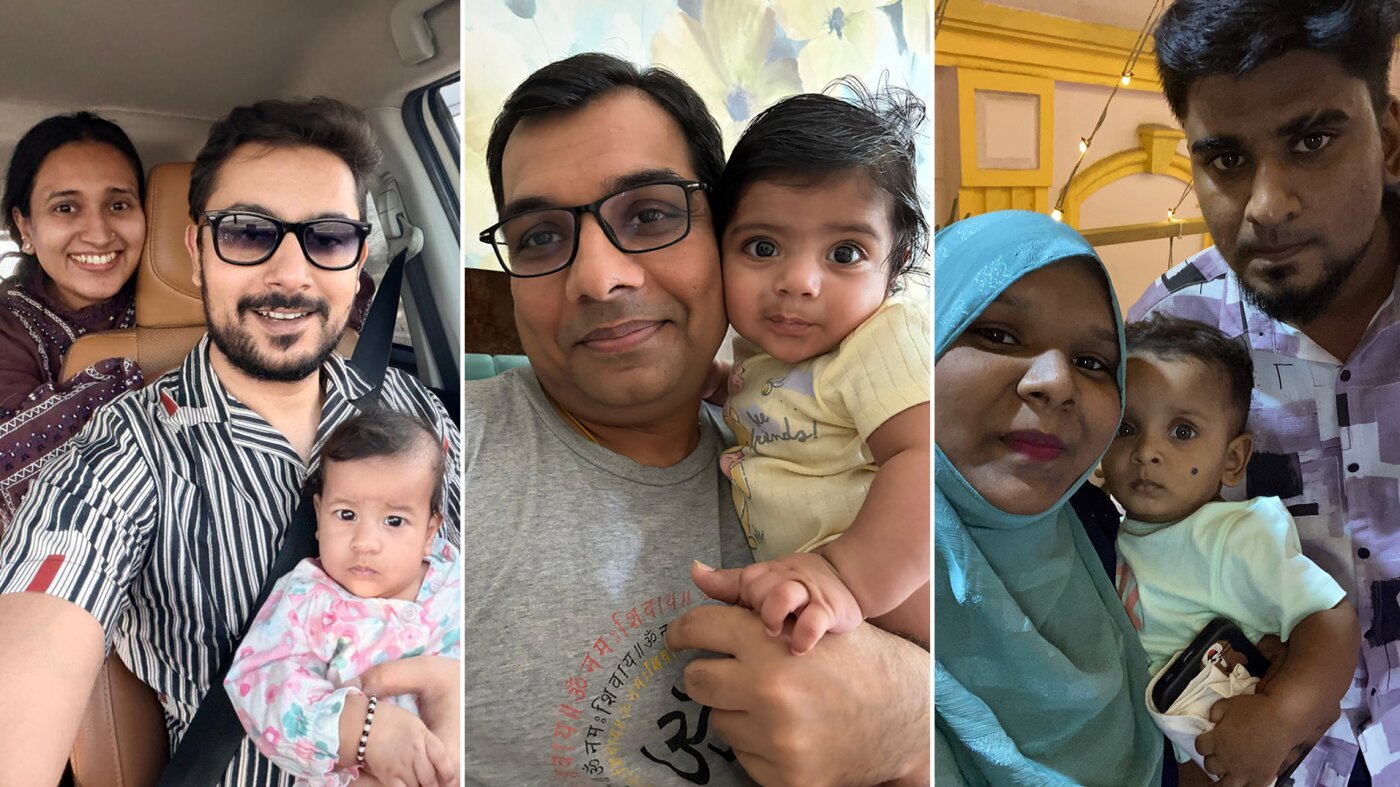

From left: Dr. Nilay Mahajan with his wife, Dr. Charu Srivasta, and their daughter, Tarini; Manik Seghal with his son, Gunagyaa; and Ajas Ahmed, his wife, Reshma, and son, Naseer.
From left: family photo; family photo; family photo
hide caption
toggle caption
From left: family photo; family photo; family photo
They had always been a team. But when his son Naseer was born in May 2025, Ajas Ahmed had never felt so helpless.
His wife had endured a difficult labor. The baby was breech and she struggled for over ten hours in pain. For a week, she lay bedridden in a hospital in Chennai, in southern India, recovering from the birth. Ahmed, a 27-year-old private chauffeur, stayed by her side.
“She needed my support. I made sure I was there for her,” he says.
Fortunately, Ahmed’s employer allowed him the time off. But long before Naseer’s birth, fatherhood had already begun reshaping his life. After his daughter, now 3, was born, he quit his job as an ambulance driver because the hours were punishing and the pressure relentless. He wanted work that would allow him to come home, spend time with his child and be present in ways his own father’s generation may not have expected of men.
Ahmed’s story reflects a central tension identified in the 2026 State of the World’s Fathers report: There’s a persistent idea that men are providers first and caregivers second.
But the report finds that men are often invested in childcare, especially in families with a small number of kids. And the researchers came up with a surprising insight from their interviews with over 5,000 fathers. As men do more hands-on childcare, they face more stress … but they find meaning in it. Nine out of ten fathers interviewed felt that caring for children is a deep source of happiness, says Taveeshi Gupta, one of the report’s lead authors this year.
“We didn’t see that one coming,” says Gary Barker, CEO of Equimundo: Center for Masculinities and Social Justice, the Washington, D.C.-based advocacy group that prepared the report and that encourages men and boys to become allies in the effort to achieve gender equality.
“A lot of our messaging has been: Men, you must do more,” he says. “And perhaps it came with a scolding — from a feminist perspective, because women’s time poverty is real, and we did need to push men to do our fair share. But the report confirmed what those of us who are fathers and involved in care were already saying: this is happiness in life.”
Not all the fathers interviewed were on board. Younger men and older men skew more to traditional gender roles, the report found in its interviews.
And hands-on dads may sometimes feel they are entering uncharted territory.
“When I was a part-time stay-at-home dad with my own daughter 28 years ago, it was obvious that the world looked at me in two ways,” Barker says. “Either I got special credit for being a competent caregiver — as if a man doing this was a superhero — when in reality I was just a bumbling caregiver like all of us are. Or I was seen as incompetent or invisible because men don’t really do this work.”
Here’s how three new dads in the patriarchal society of India are navigating their lives — and finding joy in fatherhood.
‘I’m the diaper man”
Dr. Nilay Mahajan, 36, is an orthopedic surgeon based in Bareilly, in the north Indian state of Uttar Pradesh. Since welcoming his daughter, Tarini, in February, he says fatherhood has made him more empathetic — especially toward his pediatric patients.
“The moment you hold your baby in your arms, your brain wiring changes. So do your priorities,” he says. His wife, Dr. Charu Srivastava, is a gynecologist with a demanding schedule of her own, but the couple have been finding ways to share the load.
“When I’m home, I’m the diaper man,” he jokes. At night, after his wife breastfeeds, he burps the baby and rocks her to sleep. When he has a couple of hours between surgeries, he drives home, just five minutes from the hospital, to spend that time with Tarini.
“Whenever I’m home, I try to be present in the moment — to hold, rock and feed her,” he says. “I try to support my wife when I can. If she has an emergency surgery to perform or one of her patients needs her, I take time off from my practice to accommodate that. Ideally, raising a child should never be a single person’s responsibility. It’s just too draining otherwise.”
His approach reflects a dramatic change in parenting in India, he says. As more women pursue careers, more men are becoming more aware of the need to share domestic and caregiving responsibilities.
“Fathers are more proactive now,” he says.
Growing up, however, Mahajan saw a different model. His father, a neurosurgeon, had a demanding schedule, which meant that much of the parenting fell to Mahajan’s mother.
Mahajan wants something different for his daughter. He does not want Tarini to grow up in a world with rigid gender roles.
“I have to show her through my actions, and by being supportive, that men and women can be equal partners. I want her to feel like she can do anything she sets her heart on,” he says.
‘I’m more mindful about my travel’
Manik Sehgal, 44, lives in Faridabad, about an hour from India’s capital, New Delhi.
In January, he and his wife, Manjulika Pramod, welcomed their first child — a son they named Gunagyaa. The couple first met a decade ago as colleagues when they both worked in telecommunications. Seghal, now a consultant at Deloitte, says having a baby has changed his life in ways he had not even imagined earlier. For one, it’s helped him prioritize family time.
“I used to live out of a suitcase, taking 5-6 flights a month for work,” he says. “Today, I’m more mindful about my travel, choosing to cut back whenever I can, to spend time with my family,” he says. He has taken over baby care duties after 9 p.m, often tending to his 5-month-old late at night so his wife can get some rest.
His thoughts are drifting to the environment and to other world events — through the lens of a new dad. “I’m thinking more about the air we breathe,” Seghal says. “As costs of living go up everywhere, with wars adding to inflation, pollution and climate change, I worry about the world we’re leaving behind for our kids. Suddenly, everything is personal.”
“Fathers increasingly want to care”
In the report on fathers, researchers asked men what makes a good father. In India, says researcher Gupta, there was a lot of emphasis on the provider role.
“That is a cross-cutting finding across the Global North and Global South: manhood, and what it means to be a good man or a good father, is still often tied to being a breadwinner and provider,” says Gupta.
And that’s largely because of a phenomenon called economic precarity, she says. “It refers to a generalized anxiety that no matter what you do, you may never have financial stability in your life or future.”
Economic precarity isn’t just felt by people living with poverty. Even the relatively well-off can experience it as they worry about the impact of wars, AI entering the labor force, stagnant wages and rising home prices. All this “makes stability feel out of reach,” says Gupta.
When researchers measured economic precarity among parents, their statistics show how deep it is. Welcoming a new child can change a family’s income as mothers tend to take time off. Three in four fathers interviewed for the report said they were losing sleep over their financial future. A majority felt home ownership was out of reach. More than half of fathers had taken on multiple jobs, changed jobs or were working overtime. “Economic precarity was linked to every other indicator we measured — mental health, how happy they feel about being caregivers and other life outcomes,” says Gupta.
The report does not describe caregiving itself as a burden, because their data shows that parents find joy in care. And roughly half of the fathers interviewed had young children (ages 0-7), who require more attention than older kids.
One solution the report suggests is fully paid leave for fathers — lasting as long as maternity leave. The researchers also suggest cash stipends or other social protection policies for lower-income families, and livable minimum wage guarantees.
“The message is clear: Fathers increasingly want to care, but they need societies, employers and health systems that make caregiving possible,” says Barker. And of course — “that’s the kind of support that can help mothers too.”
“Being a father means more than just earning for your family”
For Ajas, his wife’s stay in the hospital made one thing clear, even as he struggles to cope with spiraling financial pressures that come with life in a big city.
“Being a father means more than just earning for your family. It means being there for them, especially when they need you the most,” he says.
Kamala Thiagarajan is a freelance journalist based in Madurai, Southern India. She reports on global health, science and development and has been published in The New York Times, The British Medical Journal, the BBC, The Guardian and other outlets. You can find her on X @kamal_t