
As a teenager, LeRoy Chatfield took an oath with the Congregation of Christian Brothers to live a life of poverty. For the next 16 years, he hardly owned any material possessions and worked for free as a high school teacher in San Francisco and throughout some of the poorest areas in the San Joaquin Valley.
But Chatfield eventually hit a spiritual plateau that organized religion couldn’t fill.
He still believed in a life of selflessness, though. So at 31, with no money, he quit his job, left the order and joined César Chávez’s mission to organize farmworkers.
“I just feel that I can no longer work on behalf of social justice at the level of abstraction that my life as a religious teaching Brother seems to indicate,” Chatfield wrote to his superiors in a 1965 letter. “My ever increasing involvement and identification with the poor only continues to widen the gap between my obedience to religious authority and my own understanding of what my life as a Christian must entail.”
Forever dedicated to a life of service, Chatfield died of natural causes Sept. 15. He was 92.
Kate Chatfield said her father had been in cognitive decline for the last year and had fallen ill on the day of his passing. She said he died at home, surrounded by his wife and family.
“My mother was holding him,” she said over the phone.
In a phone interview, former Gov. Jerry Brown, a longtime friend of Chatfield, said the loss was immeasurable.
“This was a man with a dedicated vision to serve those who were less fortunate,” he said. “I’ve met thousands of people over my 50 years in politics and LeRoy stands tall among them.”
Chatfield’s death comes six months after the New York Times revealed allegations that Chávez had groomed and sexually abused underage girls and women within the farmworker movement over several decades.
Brown said any talk of Chávez’s alleged transgressions has no place in telling Chatfield’s life story. Chatfield left the UFW in 1973, a year after helping defeat a proposition that would’ve made specific labor strikes and boycotts unlawful.
LeRoy Chatfield, center back, says a prayer over Thanksgiving dinner with some of his clients at his Loaves & Fishes mission in 1997.
(Kim Komenich / Getty Images)
Chatfield weaved seamlessly through different social movements in California throughout his life.
He acted as a key player in Chávez’s vision, propelled climate change discussions to the forefront under Brown’s administration in the late 1970s and maintained safe spaces for Sacramento’s homeless community. He also compiled what is arguably the definitive digital archive of the United Farm Workers’ early days and sold it to the UC San Diego Library in 2013 in hopes it would be accessible to all for free.
“He is a prime example of these leaders who never wanted credit,” said Jorge Mariscal, a UC San Diego professor emeritus who helped Chatfield write “To Serve the People: My Life Organizing with Cesar Chavez and the Poor.” “That’s why no one’s heard of him, even though when you talk … to union people from those years, they almost all really respect LeRoy.”
A son of rice farmers in Northern California, Chatfield understood the plight faced by migrant families early on. His parents shipped him off to an all-boys, religious high school at 14 near Napa, where he trained to become a member of the Christian Brothers. There his life was devoid of high school hallmarks such as mingling and dating women, dances, and learning about the world through pop culture.
By 1963, Chatfield worked as a teacher at Garces Memorial High School in Bakersfield and created education programs for his students, whose families belonged to a variety of unions. One day, he traveled to Boston to attend the National Catholic Social Action Conference, where he first heard about Chávez and his efforts to organize farmworkers in Delano, merely miles away from where Chatfield worked.
He tracked Chávez down to learn more about his efforts. Education, Chatfield recalled telling Chávez, was the answer to improving the lives of farmworkers. However, Chávez disagreed. Chávez contended that families required stability before their children could take advantage of school, and a union was the first step, according to Chatfield.
Two years later, Chávez called up Chatfield and pitched him what would become his first paying gig. For a $20 salary, Chatfield brainstormed how to create co-op facilities such as clinics and pharmacies as one-stop spots for farmworkers.
“I realize that what I propose to do will strike some of you as ‘crazy’ or ‘naive’ or ‘nuts’ and maybe in two years’ time I will agree with you,” Chatfield wrote in his resignation letter from the Christian Brothers. “But right now I am convinced that Cesar Chavez and the NFWA represents a true anti-poverty program that respects the dignity and integrity of the people involved.”
Chatfield quickly became an integral part of Chávez’s inner circle and would meet his future wife, Bonnie Burns, a fellow educator, through his UFW work. Along with co-op facilities, he also purchased a plot of land in Delano to house the union’s first headquarters and learned how to handle media amid Chávez’s historic fasts.

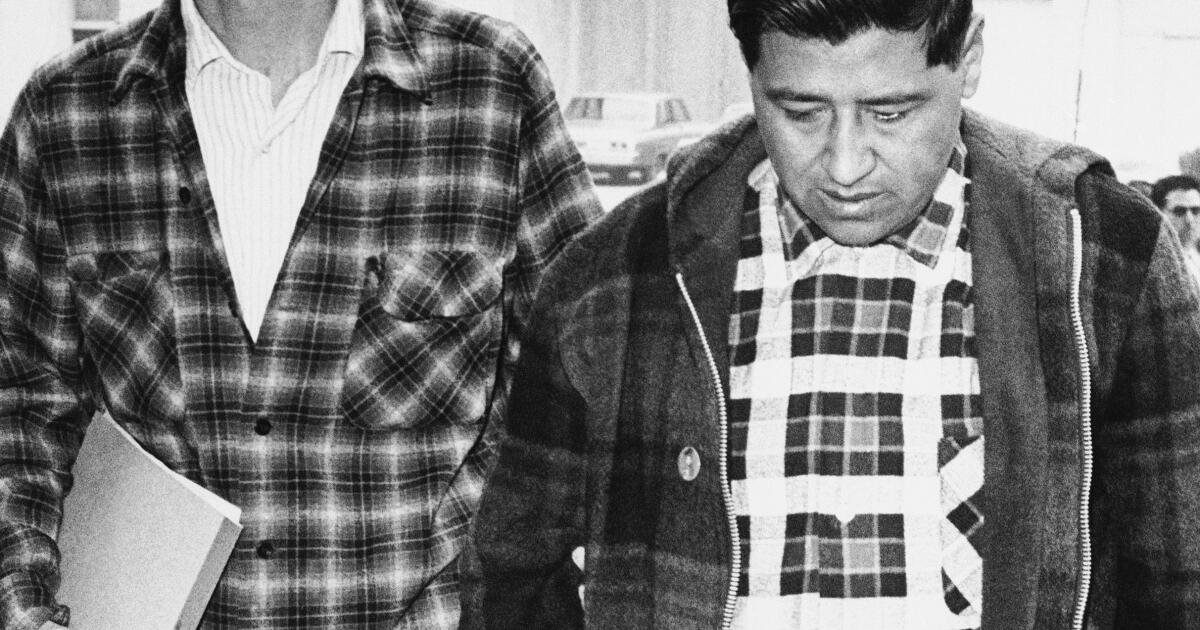
Weakened by a fast, César Chávez, head of the farmworkers union, is assisted from Kern County Superior Court in Bakersfield by Jerry Cohen, left, union attorney, and LeRoy Chatfield.
(R.L. Oliver / Los Angeles Times)
His proudest contribution was creating the framework for the union’s first medical plan. He consulted with an array of doctors throughout the Central Valley and interviewed county officials, often hitting dead ends the moment he uttered “union” or “farmworkers.”
“My work there has been halting, tentative and generally working around the fringes,” Chatfield wrote in a 1968 journal entry reflecting on the daunting task. “The reason, quite simply, is I don’t know what I’m doing. I don’t know what to do. The terminology is different and I don’t feel comfortable talking about things I have to learn at the same time.”
Chatfield took some time to tend to his family after eight exhausting years with the UFW, but jumped back into the political fray.
He gravitated toward politicians championing social justice causes, managing the first congressional campaign for Congressman Esteban Torres, himself a former labor activist. Chatfield also managed Brown’s gubernatorial campaign in Northern California and later became the inaugural director of Brown’s California Conservation Corps, an organization that spearheaded environmental projects. Within its first year and a half, Chatfield opened 18 centers throughout the state.
“He was the most successful leader of the CCC,” Brown said in an interview. “Other people came after him that did good things, but LeRoy got it up and moving. It was stalled, it didn’t get off the ground until he opened up more than two dozen residential camps. … He did that with determination and effectiveness. In fact, he did it so well legislators objected because he didn’t check in with them.”
Always pursuing the next endeavor to help the marginalized, Chatfield focused his efforts on providing food for the homeless in Sacramento. He enlisted the Rev. Wayne “Chris” Hartmire Jr., an old friend from his UFW days to stage a nonviolent fast to pressure county officials to act on a homeless shelter.
“Do we hold bars responsible for the things drunk people do on public sidewalks?” Chatfield asked the Los Angeles Times in 1997 in response to criticism from community members and some local officials who pegged his nonprofit as inconveniencing residents by helping homeless people. “How about schools? Are they held accountable for the acts of students who misbehave?”
Dorothy Smith, a board member of Loaves & Fishes, the nonprofit, said the team often described Chatfield as a five on the Enneagram, a personality test that says such people are “visionary pioneers, often ahead of their time.”
Even when the devout Christian decided to retire, he found a way to be of public service.
By 2002, Chatfield tapped into his love of documenting history. As a schoolteacher, he encouraged his students to journal daily, a habit he had practiced since he was a boy. Close colleagues and friends said Chatfield had a way with words and expressed himself most comfortably through writing. He wrote essays and conducted oral interviews with UFW greats such as Hartmire and Gilbert Padilla who were essential to the union’s success.
Chatfield hired Jennifer Szabo as his web developer early on to make the Farmworker Movement Documentation Project. Szabo didn’t know who he was and was mainly focused on doing a good job, saying: “I wasn’t even paying attention to what I was doing, what the content was, and then over time, he says, ‘Oh I was working with César Chávez.’ And I was like, ‘Wow, that’s a really big deal!’”
That effort eventually materialized into a special collection at UC San Diego.
“Thousands of people were actively involved in the Civil Rights Movement but barely a fraction of their stories were told,” Chatfield told UC San Diego. “Because so much time had passed, their stories would never be told and preserved for future generations. This fact made me realize that I too had been immersed in a similar movement, and I knew at least 50 others like myself who had been involved. I realized I was well positioned to document César Chávez’s farmworker movement and began to feel obligated to do so.”
Even in his final years, Chatfield continued to write, mainly publishing musings on Christianity and life on his online literary journal, Syndic.
In praising Chatfield, Brown recalled a gathering at his home last year. There were about 50 people, many of whom had worked on his election campaigns.
Brown said the group was walking up a hill next to his home when he took notice of Chatfield.
“He had a big stick and looked like Moses or something, walking to the promised land,” he said. “It was quite an image that is very vivid to me right now.”
LeRoy is survived by his wife, his five daughters and 10 grandchildren.
Staff writer Ruben Vives contributed to this story.