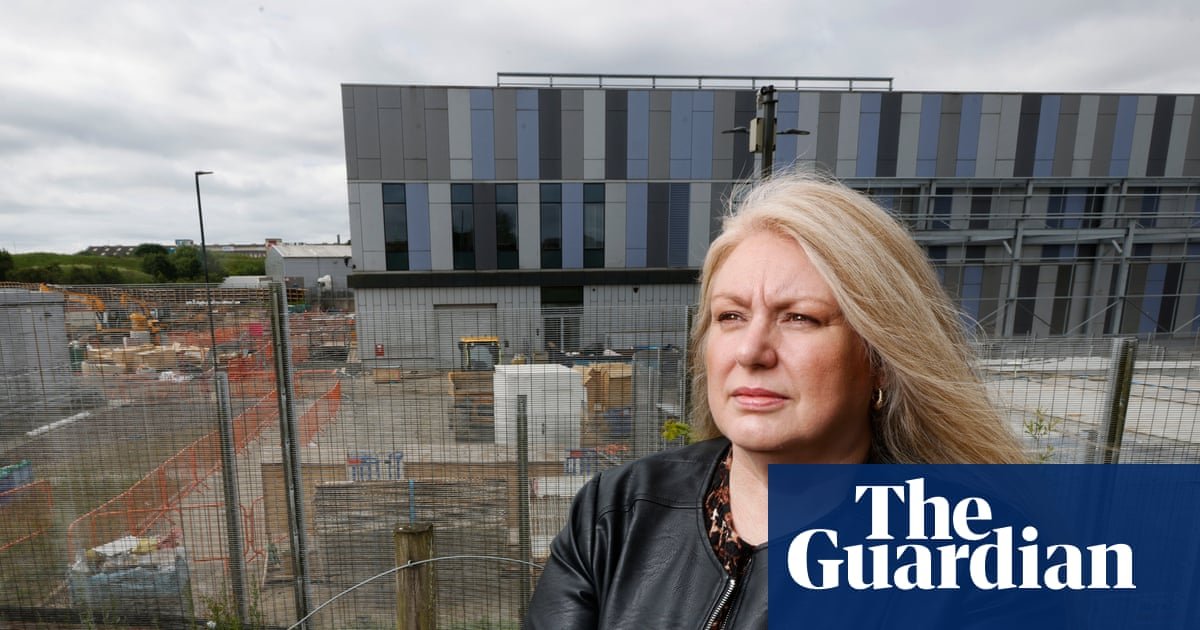

The promise was that a Scottish community would be transformed by massive investment and empowered to chase “the jobs of the future”. Instead, local people in Lanarkshire fear they may have to sell their properties and lose green belt land because of the errors of a badly planned AI datacentre complex, even as those jobs and investments never arrive.
Late last year, representatives of Oakes Energy Services began to knock on doors in Newarthill, a village east of Glasgow. In letters reviewed by the Guardian, they invited residents to individual meetings. They told them about plans for a solar farm, say local people, and made offers: free solar panels, tree planting, or even cash for their properties.
“It was a sweetener: don’t oppose this and you’ll be OK, kind of thing,” said Diane Davidson, a resident. “None of these sweeteners are enforceable, there’s nothing written down.”
Two months later, the government chose Lanarkshire as a key site for the UK’s AI plans, announcing a multibillion-pound development called an “AI growth zone”. The project is to be built by the US company CoreWeave, and DataVita, an arm of a Glasgow real-estate firm.
What will be built in Lanarkshire are AI datacentres: essentially, large buildings full of specialised silicon chips. The chips do the calculations that underpin AI models. All over the world, tech companies are ploughing hundreds of billions of dollars into building AI datacentres. They are doing this banking on the idea that AI will transform the global economy, and the datacentres will pay for themselves.
To be successful, they need to quickly put up giant infrastructure projects in communities such as Newarthill.
When the announcement came, the press release suggested a sprawling site – one that would bring “datacentres, supportive infrastructure, and a renewables park”.
Promises came with this announcement: 3,400 new “high-value” jobs and a community fund to inject “up to £543m” into local programmes over the next few years.
At first, the community was not concerned. “The datacentre itself is not much. It’s just a big imposing building,” said Davidson. Then they realised the project would require vast amounts of energy – and therefore vast amounts of land.
“The quantities it would need, it would definitely approach into our area,” Davidson said. “It was like: oh, crikey. It was just growing arms and legs the more we looked into it.”
They began to worry about Oakes Energy Services, and another company, Locogen, which recently submitted a planning application for a solar farm adjacent to the site on behalf of a larger international energy group.
A Guardian investigation has examined public plans for the AI growth zone in Lanarkshire, one key site in the government’s ambitious push to bring massive AI development to communities across Britain. It finds that these plans appear to misrepresent the government’s – and DataVita’s – actual intentions for the development of the site.
In particular, the government and DataVita publicly said the site would be powered by huge quantities of “on-site” renewable energy – until, when pressed by the Guardian, they admitted that the AI growth zone would actually connect to Britain’s straining grid.
What remains unclear is how much renewable energy the site still plans to build. DataVita has said it will have 1GW of power, supplied by energy parks connected directly to its datacentres. This would require, by conservative estimates, 44 sq km of land near its site. At present, DataVita appears to have less than a 10th of this.
There is no apparent connection between Oakes Energy Services and DataVita but the appetite of both companies for energy parks has led Davidson and others to fear the land that will make up the difference will be theirs.
Across the UK, a promised AI boom is driving a speculative rush as owners of industrial sites, investors and property developers try to cash in on promises of datacentre investment. This has led to hundreds of companies applying to build datacentres – and investors strategising on ways to turn empty land, or old industrial sites, into more productive assets.
Oakes Energy Services did not respond to a query from the Guardian. Locogen said it had nothing to do with DataVita, the developer of the AI growth zone, and was not involved in any pre-application consultations with local people. DataVita has said it has no commercial connection with Locogen or Oakes.
However, materials that DataVita submitted to the government about its plans to develop the site appear to suggest it does plan to use the surrounding area, solar farms or not, to power its datacentre. An audit done by the Scottish government, obtained under freedom of information (FoI) rules, says Datavita’s proposal “leverages the region’s strength as a renewable energy hub by proposing that available, adjacent land at both sites is used to build renewable energy parks that will feed the hyperscalers and AI innovation parks”.
Local people have pressed Datavita and the energy companies about their development plans and come back empty-handed. In a meeting in April, representatives of the energy companies refused to answer when questioned directly about who their customer was, said Meghan Gallacher, a member of the Scottish parliament who represents the region.
“I don’t believe in relation to the planning proposal that the company has been honest in relation to how it’s engaged with local residents,” she said. “There has been, in my view, some doubts in relation to the information that’s been forthcoming, the questions that they’re willing to answer.”
DataVita told the Guardian that all proposals were subject to local and national planning legislation through an open public process at every stage, and that it welcomed feedback and engagement throughout.
The Lanarkshire growth zone has reawakened old fears in Airdrie, just over four miles from Newarthill. For 10 years, local people fought a proposal to develop a community park on land owned by the daughters of the late Tory minister William Whitelaw.
In 2017, a group of prominent Scottish businesspeople announced plans to turn the site into a multimillion-pound luxury housing development called EuroPark. Among them were Graeme Souness, a former Scotland football player, and members of the Gillespie family, a local mining dynasty.
Last June, said Davidson, the community felt they had won a victory: the site’s plans were rebuffed by local authorities, and then again on appeal to the Scottish government. Now it feels that victory was temporary.
Ann Glen, a local historian and author, said: “Now we’re back here, and instead of this EuroPark, we have a datacentre.”
Davidson said: “Everybody is quite agitated and quite worried about it. Nobody is getting any benefit out of it. They are worried about their property values going down.”
The potential upsides of the Lanarkshire development for the people of Airdrie are thinner than the government has announced. The Guardian understands there is no money currently in the £543m community fund; rather, this is planned to come from DataVita revenues, if it generates them.
Meanwhile, the Scottish charity Action to Protect Rural Scotland (APRS) filed an FoI request to the government to understand how it arrived at the figure of 3,400 jobs. It found that the figure came from industry estimates for another site – Cambois in Northumberland – multiplied to account for the fact that Lanarkshire is a larger site.
APRS found those industry estimates were inflated, and suggested there was no evidence that the Lanarkshire site could directly employ hundreds of people as the press release suggests. Instead, most of the jobs the site could create would be temporary construction jobs.
“Our conclusion is that the UK government figures given in their press release could be a hundred times bigger than the probable jobs that the datacentre will create,” wrote APRS.
The Guardian understands that the Department for Science, Innovation and Technology stands by its estimate, which includes figures for roles created in the datacentre’s construction phase, its supply chain, and the wider regional economy.
The local people who are supposed to be the recipients of this promised largesse may be those who pay the steepest cost. North Lanarkshire includes some of Scotland’s most deprived regions, towns that were once centred around coal and steelworks, and that now have some of the worst health outcomes in western Europe, said Glen.
Dozens of people have expressed their fears, in online forums and on North Lanarkshire’s portal, about how the energy developments and the datacentre are proceeding, and the confusing and contradictory information being put out about the future of their land.
Glen said the entire policy around the AI growth zone was condescending to the “hardworking people” who were supposed to benefit from the project. “It’s again smoke and mirrors. Smoke and mirrors,” she said. “People thinking that – jobs – oh, phenomenal, what will it be like? A new age! But they’re being misled in a way, there’s no jobs. They don’t realise to what extent they’re being conned.”
The announcement “gives you the impression of poor aspiration. Poor aspiration. Just a job. Anything will do.”