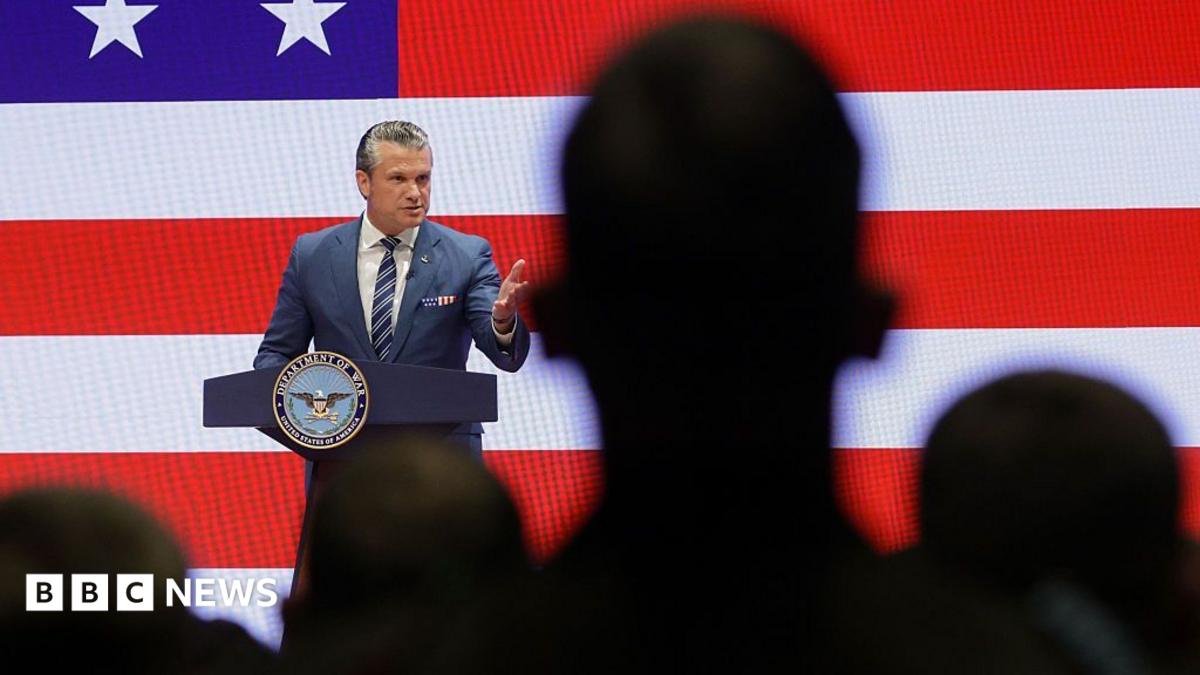

US Defence Secretary Pete Hegseth has confirmed the firing of 20% of top military leadership, while stressing a “warrior ethos”, and plans for a new base and autonomous warfare command.
In a fiery speech to top brass at Marine Corps Base Quantico in Virginia, he shared a variety of new initiatives, as well as adding to a round of personnel cuts in 2025.
There are over 800 active-duty generals and admirals across the Army, Navy, Marine Corps, Air Force and Space Force, according to the latest department tally.
When Hegseth assembled military leaders at Quantico in September 2025, he criticised the department as too “woke” and slammed leaders, saying “fat generals and admirals” is “a bad look”.
In his remarks on Wednesday, Hegseth referred to last year’s Quantico speech as Liberation Day, saying that those who were not on board with his changes, “well, they no longer work here”.
“We are no longer the woke department or the weak department,” Hegseth said, adding “no fatties” and “no wimps”.
“No weirdos, no fear. The ideological clowns are out. The patriotic cowboys are in with testosterone testing on top. Diversity is not our strength. Unity is our strength,” he said.
Hegseth also announced the creation of the Autonomous Warfare Command, aimed at easing the procurement of robotics and drones for warfare, “supercharged” with artificial intelligence.
A new Office of Religious Affairs, cadets programme partnering with US universities, and what Hegseth called “the next great American [military] base” were also announced.
The new office will “protect budgets, demand infrastructure, and strengthen religious support”, he said.
Hegseth did not mention the location or funding source for the new base, but called on US states to “bring us your best sales pitch”.
Hegseth’s firings are the latest in a broader overhaul of the US military under his leadership, seeking to insert what he calls a “war fighter ethos” into the defence department, including a rebrand, calling it the Department of War.
“Now the media calls that a purge,” Hegseth said on Wednesday. “I call it accountability, and long overdue. And frankly, the bare minimum.”
According to the BBC’s news partner, CBS News, at least 20 generals, admirals and civilian military leaders have been terminated or quit their jobs since Hegseth became defence secretary. This includes the firing of the chairman of the joint chiefs of staff and top uniformed officials in the Army, Navy and Air Force.
Federal law sets a limit to the number of general and flag officers. There is no requirement that unfilled positions be replaced.
Amid the shakeup, Hegseth also has been accused by various civil rights groups, including the NAACP and the National Women’s Law Center, of blocking the military promotions of black people and women.
George Washington University political science professor Alexander Downes highlighted these concerns to the BBC, describing Hegseth’s track record as “a little suspect”.
Downes added that while previous defence secretaries have made changes to military leadership, Hegseth’s cuts were “undoubtedly more” than these.
He hoped Hegseth would justify the firings and that they would be “based on organisational needs, not ideological agendas”.
The Pentagon has previously said it would “never consider the colour of a service member’s skin or their gender as a factor in promotions” and that “meritocracy reigns supreme” in the defence department.
Senator Mark Kelly, a Democrat from Arizona, told reporters on Tuesday that Hegseth was “in the process of purging the upper echelon of the military from its best leaders”.
“We need strong leaders. These folks have decades of experience, some of the best leadership our military has ever had. He’s getting rid of them,” Kelly said.
A report from the Congressional Research Service in May noted that there were some disadvantages of having too many senior leaders at the top.
These include the higher cost of employing top-ranked servicemembers compared to lower-ranking officers, and the potential to “slow down decision-making processes”.
Downes said it not was not necessarily good or bad to reduce the number of officers but “it all depends on why you’re doing it and what function it’s serving”.
According to Downes, the military today is roughly 50% smaller than it was in the 1960s, while the general officer count is only down roughly 30%.
He explained that the military’s structure has changed to include more combatant commands like Centcom, which directs military operations across the Middle East.
Hegseth’s trimming of the US military’s top brass also comes as the US-Israel war with Iran stretches into its seventh month, depleting ammunitions stockpiles.