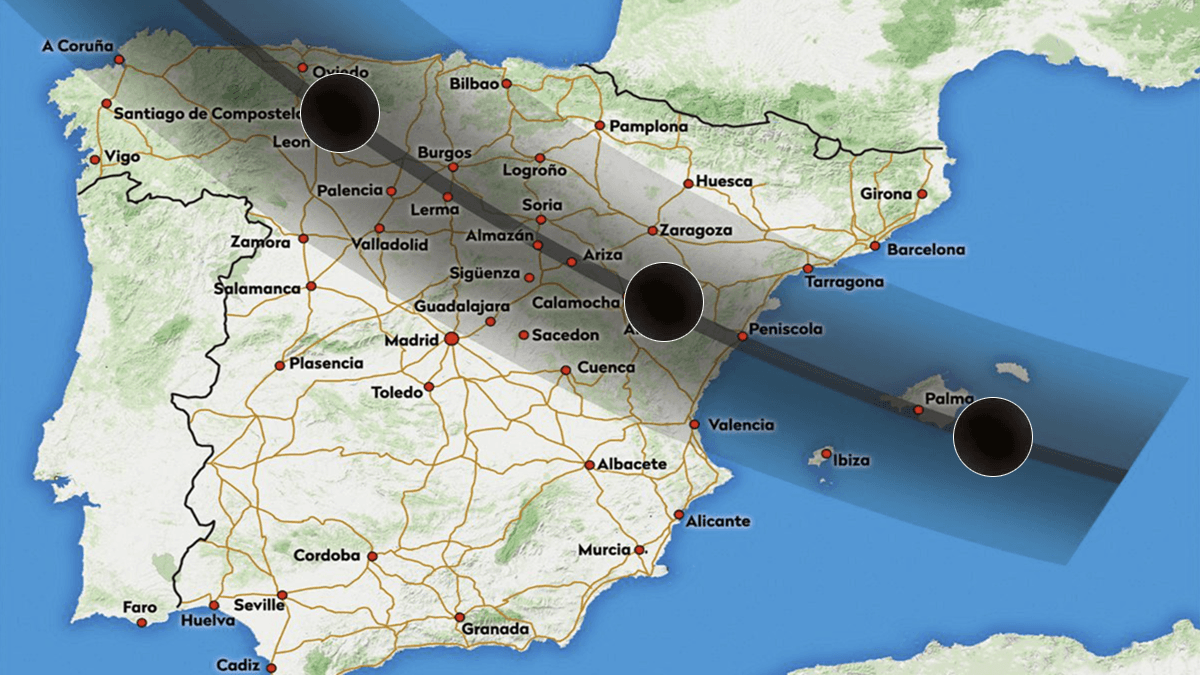

The long-awaited natural spectacle is finally here: the Total Solar Eclipse 2026. A rare total solar eclipse will sweep across Greenland, Iceland, and Spain on August 12, marking the first time the path of totality has crossed continental Europe since August 1999. This spectacular celestial alignment will deliver up to 2 minutes and 18 seconds of complete daytime darkness along a narrow, high-visibility corridor stretching from the Arctic Ocean to the Mediterranean.
At sunset, the Moon completely covers the Sun, with the path of totality traveling in a narrow path from the Balearic Islands across Spain to western Iceland and eastern Greenland.
The astronomical trajectory begins at sunrise in northern Siberia, tracking south-southwest over Greenland and skirting the western coastline of Iceland—where daytime skies will darken during peak afternoon hours. As the shadow accelerates across the Atlantic, the path of totality will directly enter northern and eastern Spain, turning afternoon daylight into twilight for millions across major cities like A Coruña, Zaragoza, and Palma de Mallorca before terminating at sunset.
The specialty with 2026’s total solar eclipse is that it coincides with the Perseid meteor shower. This means that we will be able to observe the shooting stars during the totality as well.
The August 12th total solar eclipse will also be visible from several large cities in Spain and Iceland. The path of totality, where the Moon will completely obscure the Sun, will cross the following cities:
- Palma, Spain
- Valencia, Spain
- Zaragoza, Spain
- Madrid, Spain
- Bilbao, Spain
- Reykjavik, Iceland
The cities above will be top-rated destinations for eclipse watchers. Expect millions of people to witness the eclipse from within the path of totality, making many roads and parks crowded.
Here are some tips for viewing the 2026 solar eclipse in big cities:
- Make sure to be on the path of totality: To see the total solar eclipse, you must be on the path of totality. You can use Google Maps or other tools to find the exact path and plan travel accordingly.
- Plan: Hotels and campsites near the path of totality book up quickly, so you are advised to make your reservations early.
- Check the weather: Look for the local weather office for locations with the best chance of clear skies during the eclipse.
- Get eclipse glasses: You must protect your eyes by using eclipse glasses or other approved solar filters.
- Use colanders or slotted spoons: These excellent items can create exciting shadow patterns during the eclipse.
- Find a sunny location: Make sure you have a clear view of the Sun during the eclipse; you don’t want to miss the most important few minutes of totality.
- Use a telescope: If you can access a telescope with a safe solar filter, you can get a closer view of the eclipse phases.
- Watch the live stream: If you cannot reach the path of totality, you can still watch the eclipse online. There will be plenty of live streams on YouTube.
- Share the epic event fun: Host an eclipse-watching party for your friends and family.
- Be patient: Road traffic in the cities and crowds can be a real challenge. Plan accordingly and be patient.
This event carries immense astronomical significance, as Europe has not experienced a total solar eclipse within its borders since August 11, 1999, when the shadow crossed western and central Europe. The last total solar eclipse that happened worldwide was across the United States on April 8th, 2024.
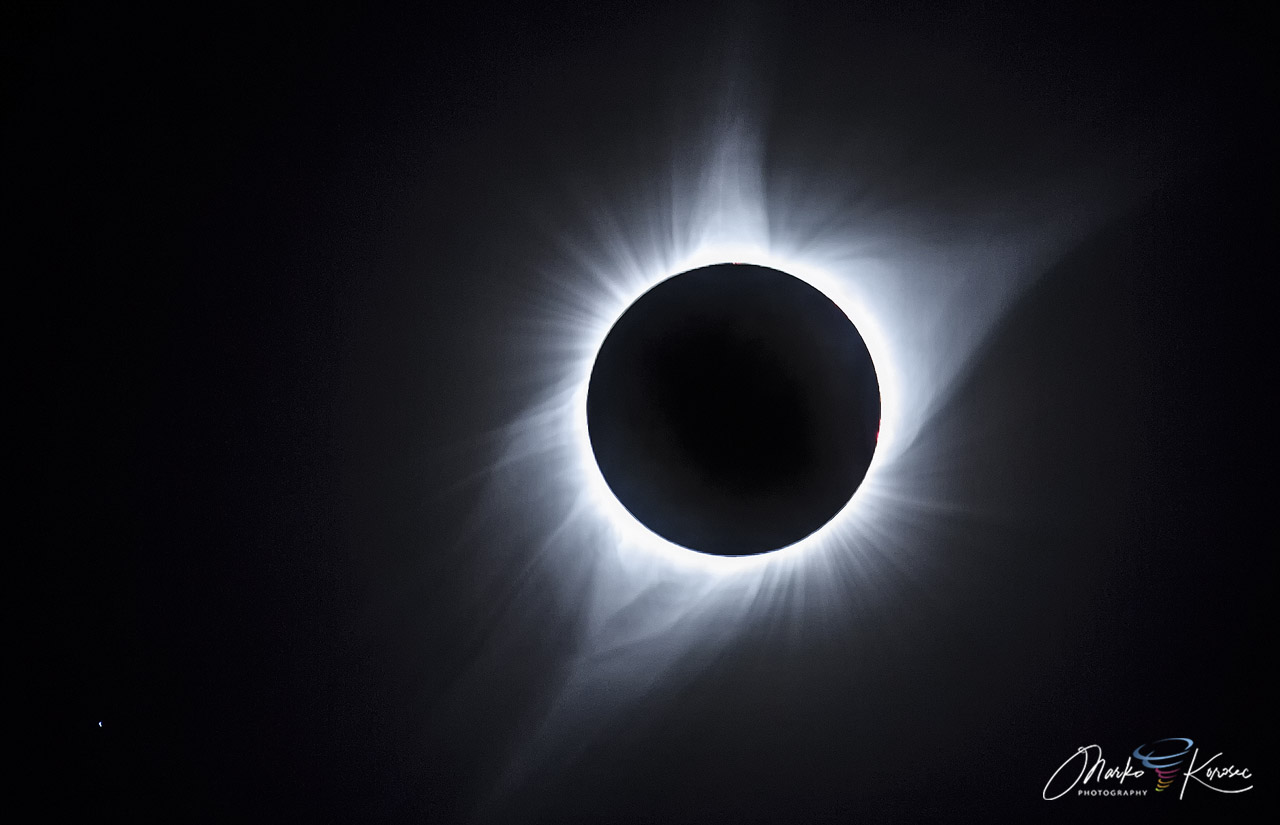
Above: Total Solar Eclipse in Wyoming, US on Aug 20th, 2017. Photo by Marko Korosec
Remember, the total solar eclipse is a rare and spectacular event – so take the time to plan and enjoy it safely!
What is the Solar Eclipse?
The total solar eclipse forms when the Sun, Moon, and Earth are aligned. This happens when the Moon passes between the Sun and Earth and completely blocks the face of the Sun, as seen from Earth. This alignment results in the Moon casting a shadow on Earth, creating a temporary darkness along the path of totality. The Moon entirely obscures the Sun in front of it.
If we want to see a total solar eclipse, the Moon, the Sun, and the Earth must all line up so that the Moon completely blocks out the Sun for viewers on part of the Earth’s surface. Below is a conceptual diagram explaining how the solar eclipse occurs.
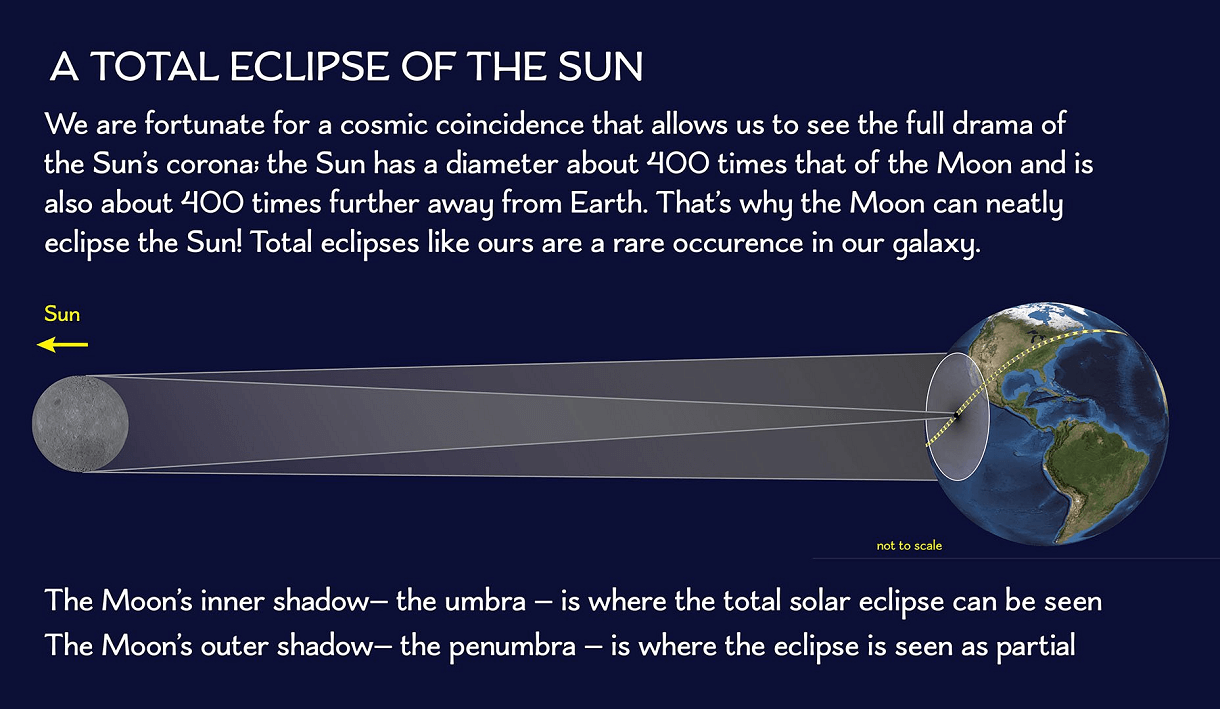
Earth residents are fortunate to be able to see total solar eclipses. As we can see from the image above, many factors need to align for an eclipse to happen. The moon needs to be just the right size and distance from Earth so that its shadow cast appears on the surface. A minor difference in the moon’s orbit wouldn’t bring the eclipse.
The inner dark circle of the Moon’s shadow, the umbra, is where the eclipse has a total phase. The outer circle, the penumbra, is where a partial eclipse occurs.
To witness the full effect of a total solar eclipse, one must be within the path of totality. The sky darkens, temperatures drop, and the Sun’s corona becomes visible.
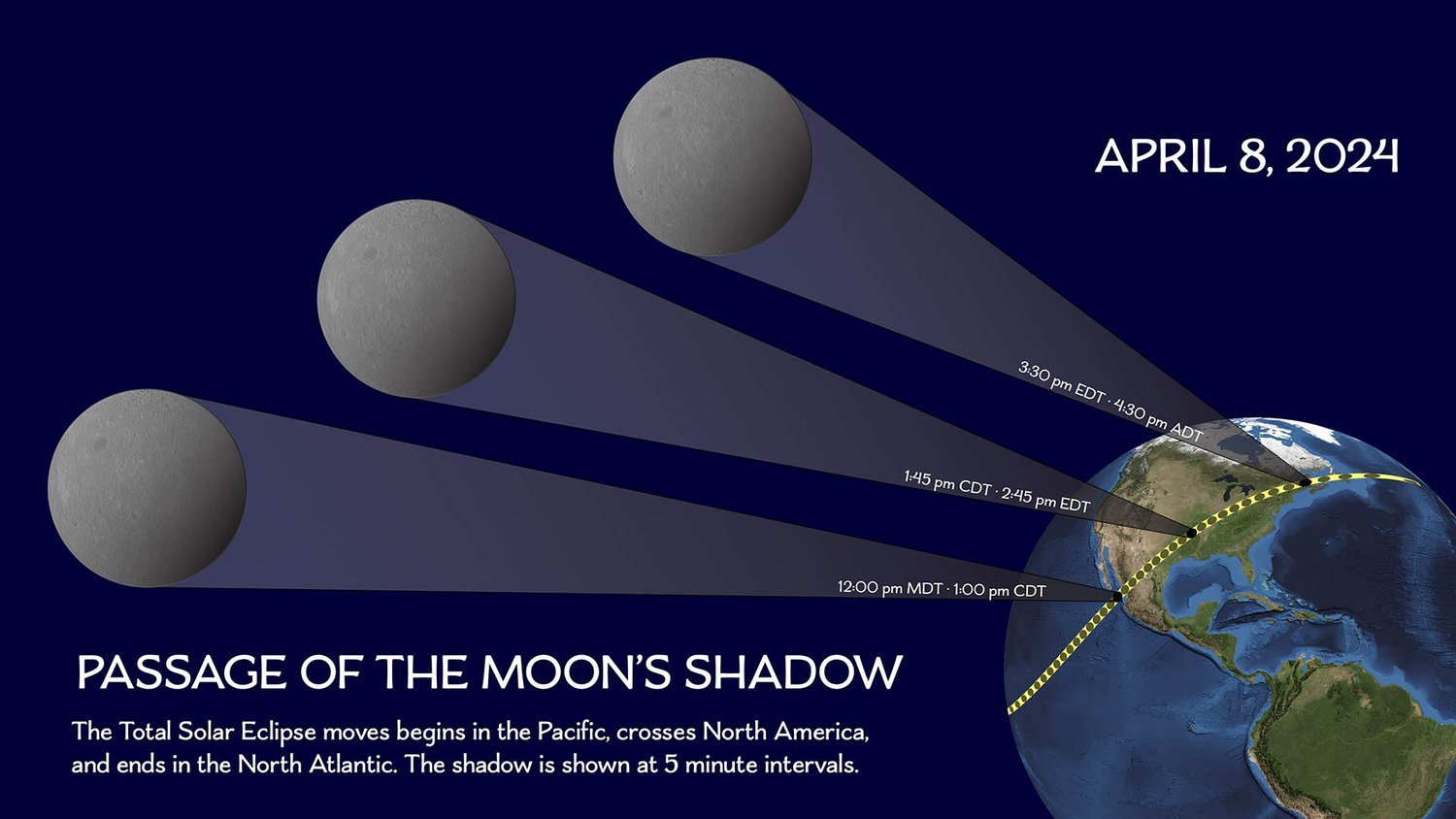
Above: April 8th passage of the Moon’s shadow across North America, with local times. Image: Great American Eclipse
This rare but spectacular celestial event offers a unique opportunity to observe the Sun’s outer atmosphere, the corona. Usually, the corona is obscured by the Sun’s brightness. Remember that it is crucial to use approved protective eyewear when viewing a solar eclipse to prevent significant eye damage.
Total solar eclipses occur about once every 18 months on average, and they are not visible from the exact location on Earth each time, which makes this event extremely rare. The path of totality, where the Moon completely covers the Sun, is only about 60-70 miles wide. The Moon’s shadow moves across the Earth at high speed along this totality path.
The main difference is that the Moon doesn’t orbit the Earth in a perfect circle. Instead, it travels in an elliptical orbit, sometimes bringing it closer to or farther from Earth.
When the Moon is in the apogee position, it is known as the Micro moon event. When the perigee occurs, it is known as the Supermoon. The Moon can be up to 15% bigger and up to 30% brighter when a supermoon occurs.
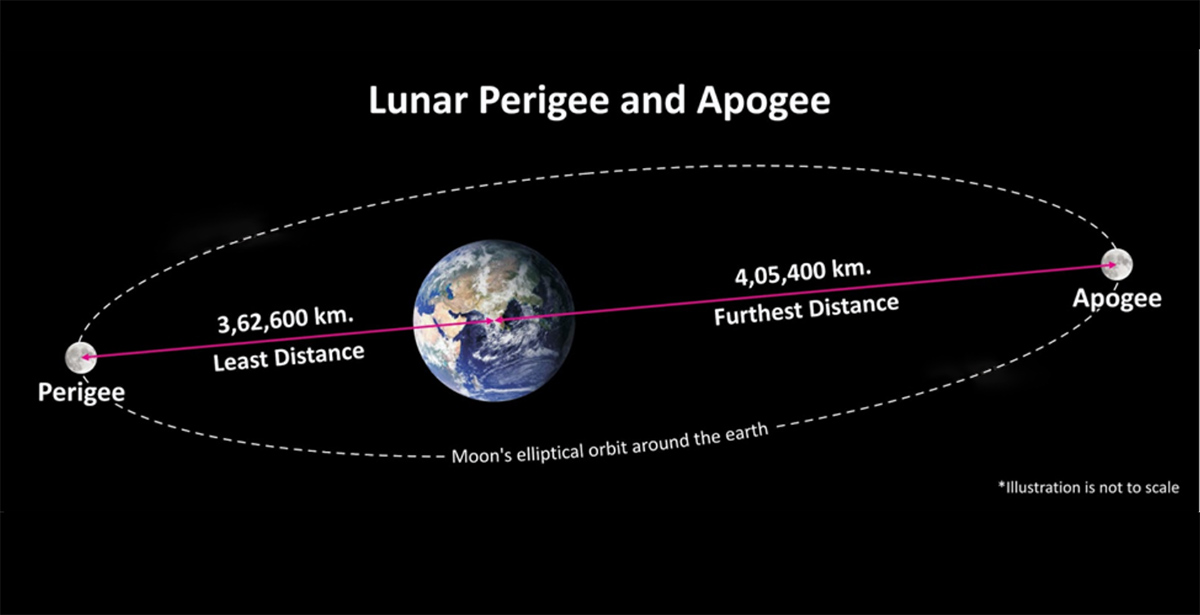
Note: Thanks to the geometry of eclipses, total solar eclipses are strongly localized and are very short-term events. Therefore, the Moon’s shadow is pretty narrow when it reaches the Earth’s surface. This means that areas where the total or annular eclipse is visible are also tiny and last only a couple of minutes at maximum.
The Moon’s umbral shadow is approximately 165 miles (267 km) across the Earth. Totality lasts about 7.5 minutes, with the shadow racing from west to east. So, the patch of fast-moving darkness across Earth’s surface only brings a swath of totality for people watching the solar eclipse within this narrow band.
For those observing outside the path of totality, the moon covers only a portion of the sun, so they will only see a partial eclipse.
Aside note: In the far future, about 600 million years from now, observers on Earth will not be able to see total solar eclipses anymore. This is because our Moon is slowly but gradually moving away from the Earth. So, at some point, the total solar eclipse will no longer be visible from the Earth’s surface, and the Moon will cover even less of the Sun’s disc.
But don’t worry—there will be plenty of solar eclipses in the coming years and decades for people living in this century.
Detailed charts for Total Solar Eclipse Path
Next, we will share details of the total solar eclipse’s path across Spain, Iceland, and Greenland.
Spain
The partial eclipse begins the moment the edge of the Moon touches the edge of the Sun; this is called the first contact. So, the first contact occurs at 19:30 CEST, local time. The totality begins at 20:26 and lasts 1 minute and 45 seconds.
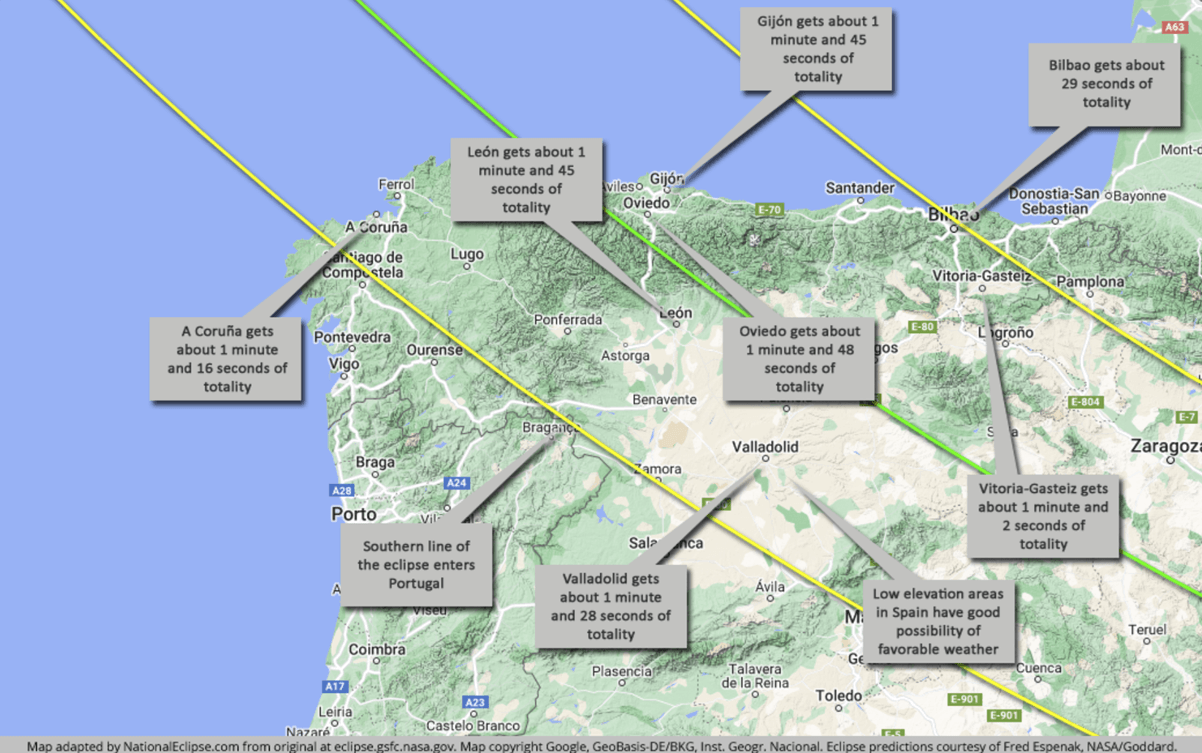
Above: Path of totality across Spain. Image: National Eclipse
As the eclipse continues southeast across Spain, the totality duration shortens to 1 minute and 36 seconds as it reaches Palma de Mallorca.
Iceland
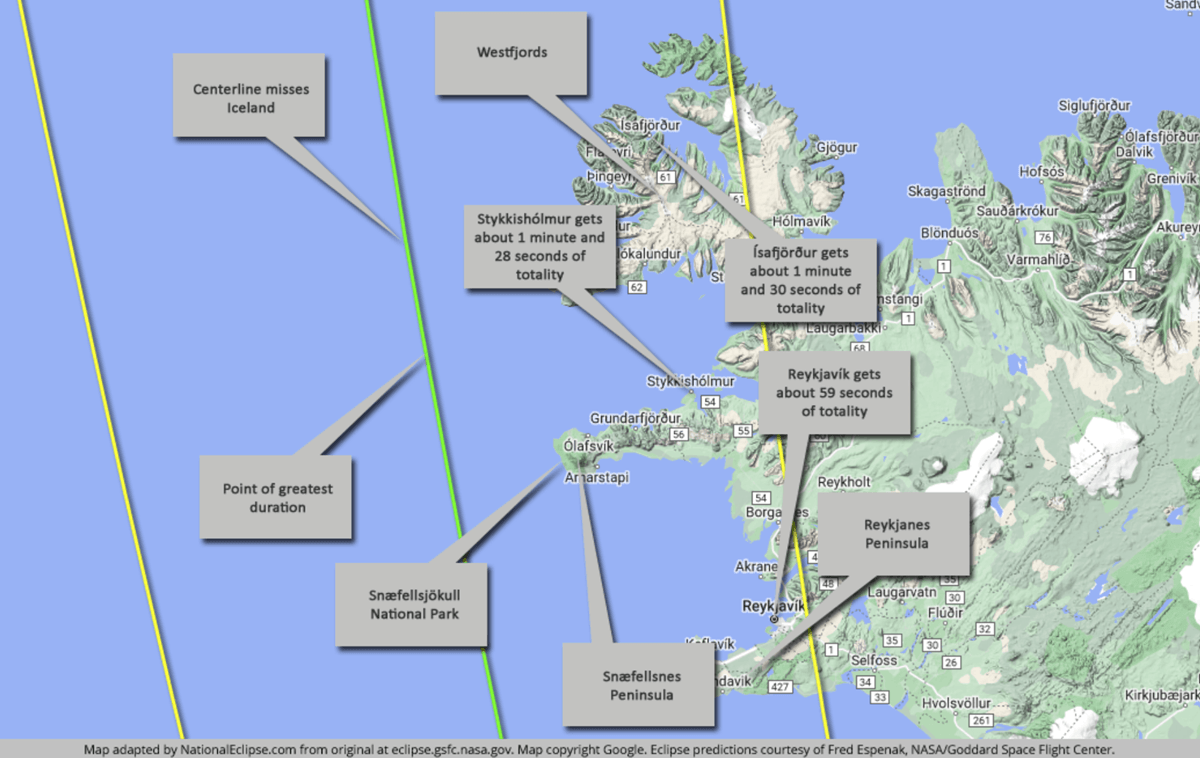
The eclipse will enter the Westfjords and continue south across western Iceland towards the capital Reykjavik. The partial eclipse begins at 16:43 local and about 4 minutes later in Reykjavik. The totality begins at 17:44 in the Westfjords and 17:48 in the capital.
The totality lasts for 1 minute and 30 seconds in the Westfjords and 59 seconds in Reykjavik, while the full eclipse lasts for 2 hours.
Above: Path of totality across Spain. Image: National Eclipse
Greenland and Russia
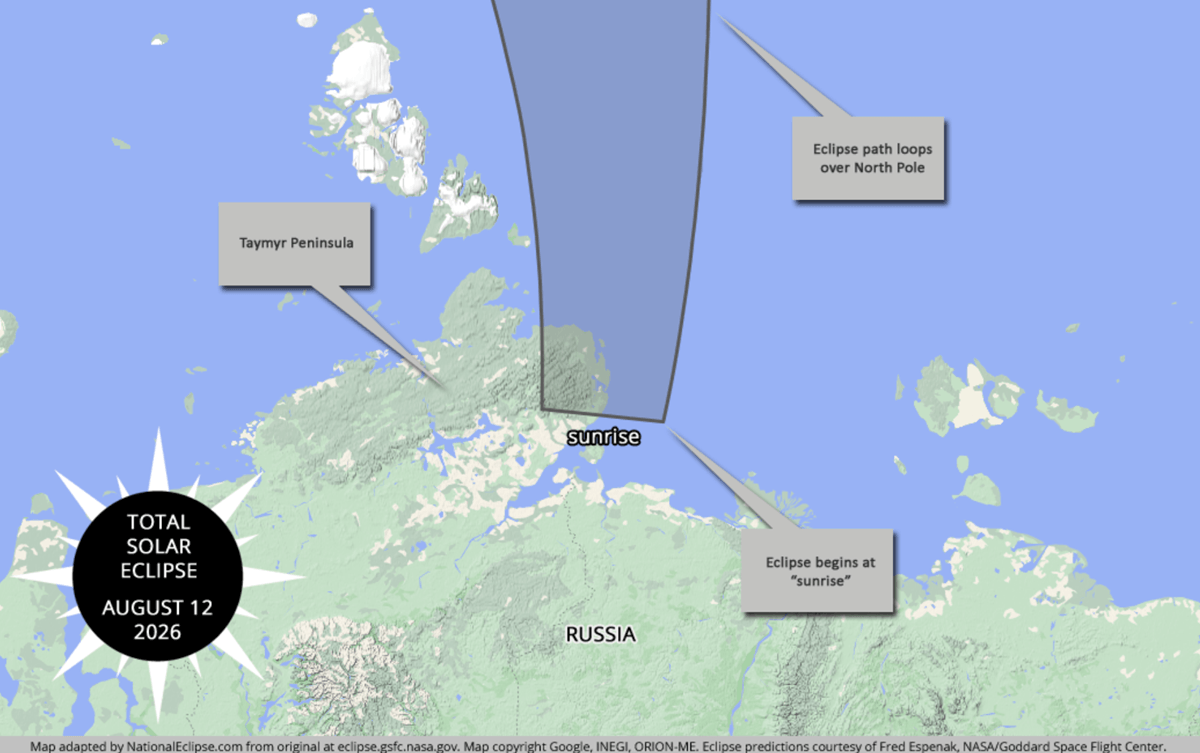
In Russia, the eclipse begins at sunrise, with totality starting at 02:02 am and lasting about 1 minute and 35 seconds. The path then travels across the North Pole before it reaches Greenland.
Above: Path of totality across Russia. Image: National Eclipse
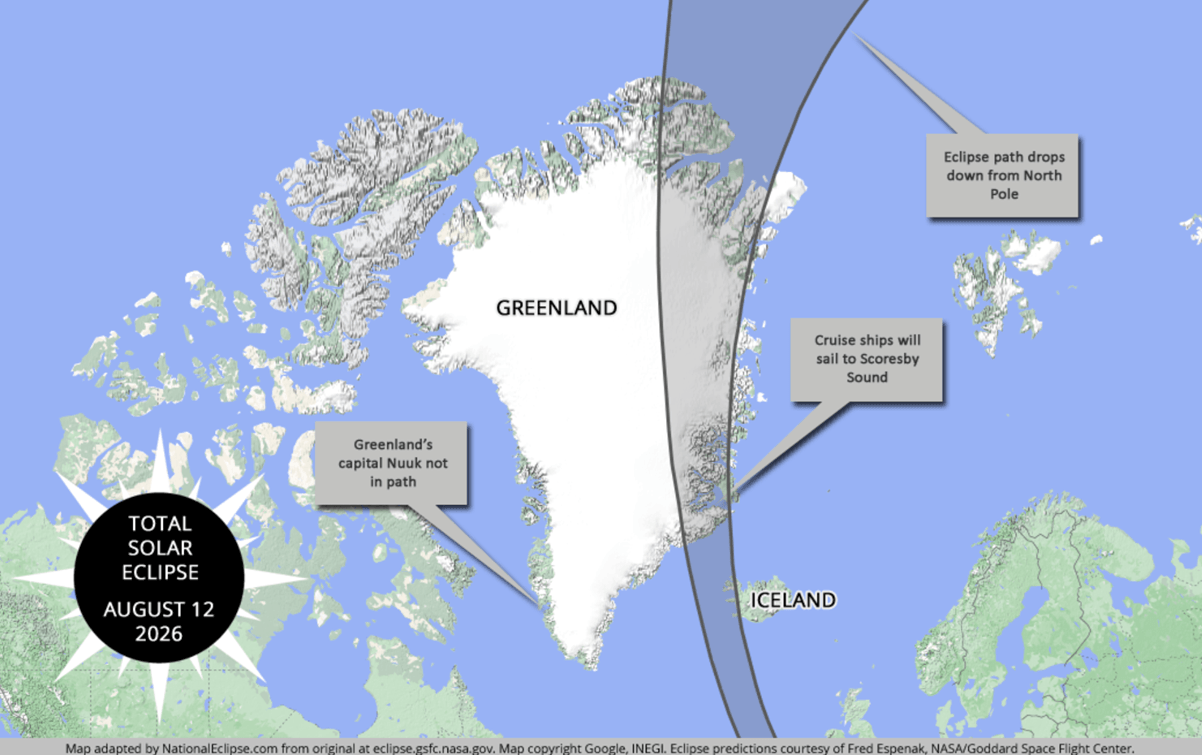
In Greenland, the totality begins at 16:14 local time in northeast Greenland and 16:38 in the southeast. The duration of totality is from 2 minutes 8 seconds on the north to 2 minutes 17 seconds on the south.
The main Greenland population is on the west, so rare locals will see it. But there will be plenty of cruise ships sailing along the southeast glaciers to observe the eclipse.
Above: Path of totality across Greenland. Image: National Eclipse
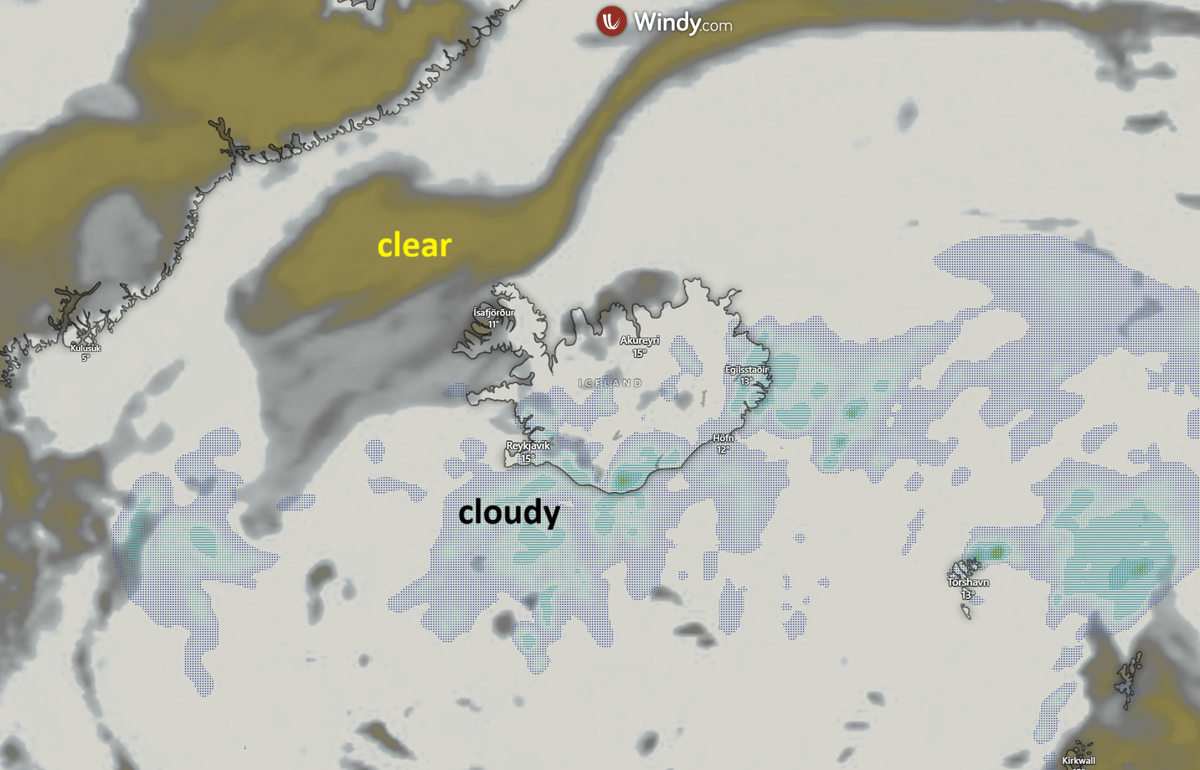
How is the weather forecast? Will the sky be clear enough to observe the eclipse, and where?
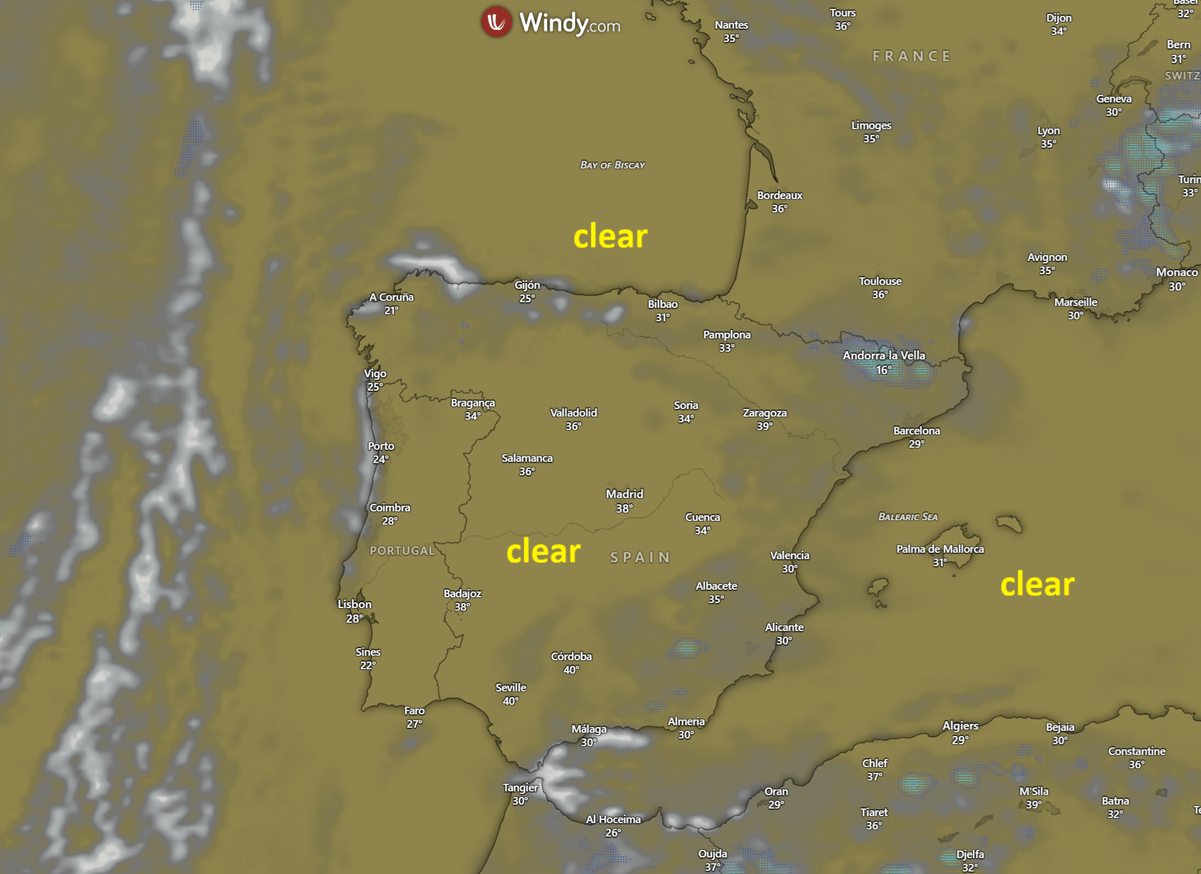
Below is the latest cloud cover weather forecast for Spain. Eclipse visibility will be very good, with summertime in Iberia offering hot, drier air masses and a lack of clouds. So the odds of clouds disturbing observation are low in many areas and cities along the totality path.
According to the latest weather model guidance, some clouds will be present across eastern Spain but will not be thick. So the observing conditions should be good to excellent.
Sadly, not very promising observations are forecast for Iceland. With the large Atlantic depression rolling in, there will likely be many clouds present across most of the country, including western Iceland where the totality path travels.
However, given the general southeast winds present across Iceland, there is a chance that the Westfjords will be clearing with downslope winds and offer some breaks in the clouds.
Here is how to photograph a solar eclipse:
Photographing the eclipse might sound challenging, but it is relatively easy. First, remember to *always* use protective solar filters for your camera, telescope, or binoculars.
Solar glasses and lens protection
Eclipse glasses will allow you to view the eclipse with your own eyes. Solar protective glasses will help you better aim your camera at the Sun. When photographing the Sun (no matter the sunspots or the partial, annular, or total eclipse), you will always need a solar filter for your camera and lens.
Note: There is ONLY a short time when the solar filter is not needed during the total eclipse. This occurs when the Moon’s disc completely obscures the Sun, and we are experiencing the totality of the solar eclipse. This is not happening this Thursday, so keep that in mind.
What kind of camera do you use?
You do not need a special or professional camera to photograph the eclipse. Every camera on the market nowadays will do it. You need protection for the camera, especially your eyes.
The main difference a camera would make is the advantage of using a crop sensor camera versus a full-frame camera. The focal length multiplier effect (typically around 1.6x) with the crop cameras results in a more extensive eclipse on the pictures at the same focal length. You are getting a bigger (closer) look at the photographed object.
Which camera lens to choose?
First, it depends on what kind of photograph you want to achieve. If you would also like to include the landscape in the photo, then it is advised to use a comprehensive or even ultra-wide lens (e.g., 14-24 mm). The Sun, however, will only be a tiny dot in your photo, but it can be a great addition to your final composition.
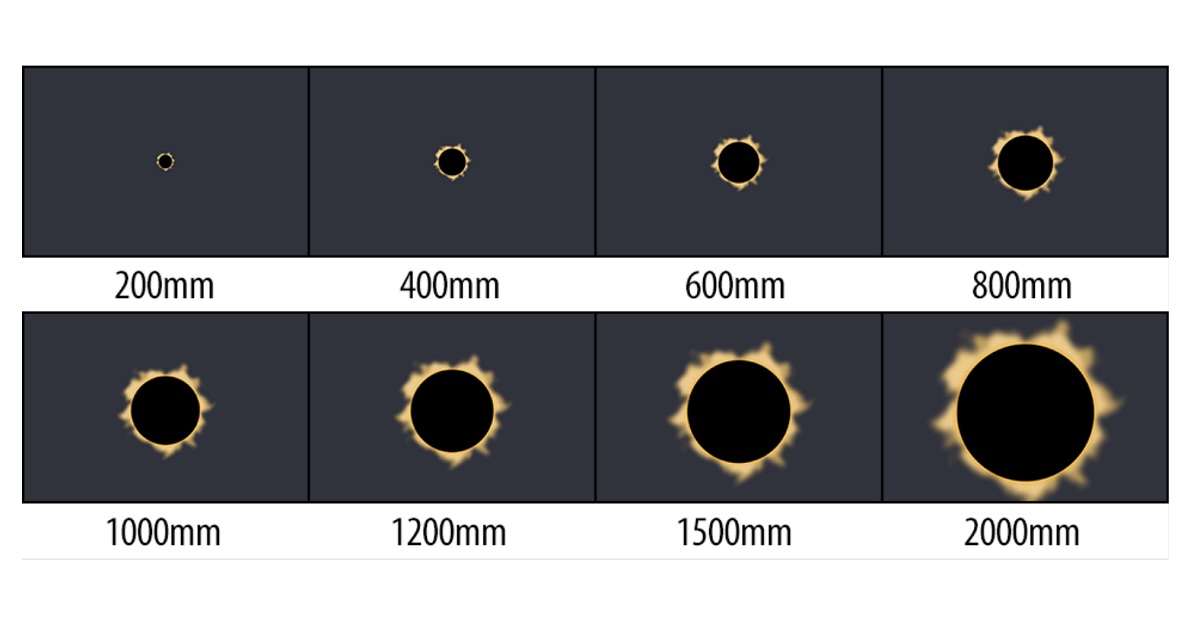
Above: The size of the eclipse depending on the focal length
You must use a zoom lens to have more detailed zoomed-in shots. A 200-600 mm lens could give you pretty good results; the longer the lens, the better—the larger the Sun will appear. Another significant challenge is capturing all the eclipse phases with the zoom lens.
Experiment differently; you should still come out with great results.
Use a tripod with a shutter release.
The Sun is very bright, so you can take photographs without putting the camera on a tripod. The shutter speeds are short (fast), so photographs shouldn’t be shaken. But it is always advised to use it—better be safe than sorry.
Use a remote shutter release when taking photographs. When the Moon obscures a large part of the Sun, it quickly gets quite dark, so shutter speeds will be longer, and you would typically use a remote shutter release to trigger your camera. You can use a remote with a cable release, electronic release, intervalometer, or mobile device.
All that helps prevent camera shake and blurring in your images. We want to have sharp photos at any time! Nothing is more frustrating than the ruined sharpness of the eclipse.
Note (although not in this case): The Sun is blocked completely when you take photos during the total eclipse. This means you are photographing in complete darkness, so a sturdy tripod is a must-have during the totality.
Final words – the Basic settings
Here are some basic settings that should normally work, although always be prepared to experiment with the settings around these basic ones. Using bracketing (taking consecutive photographs with different exposures) is helpful, too, so you can experience the proper exposure.
- Use RAW format: Avoid shooting in JPEG format. When you shoot in RAW, the photograph collects much more data, which we can use to improve post-processing work later.
- ISO sensitivity: Use a native ISO; most cameras have it at ISO 100. This will give you great-quality photographs and prevent image noise. Use higher values, e.g., 200-400 ISO only if needed, as ISO 100 is preferred given that plenty of light is still available.
- Higher F-Stop (Aperture): When photographing the eclipse, we should close the lens’s Aperture (f-stop) to f/8 or even down to f/11. These are the most preferred settings when you are also doing close-up shooting of the different solar eclipse phases.
- Shutter Speed: If we use ISO 100 and Aperture settings between f/8 and f/11, the shutter speed from 1/500s to 1/1000s will generally give the best results. Indeed, experiment with the shutter speed settings to expose the photograph correctly.
Tips on how to observe a solar eclipse safely
Never observe the Sun with an unaided eye.
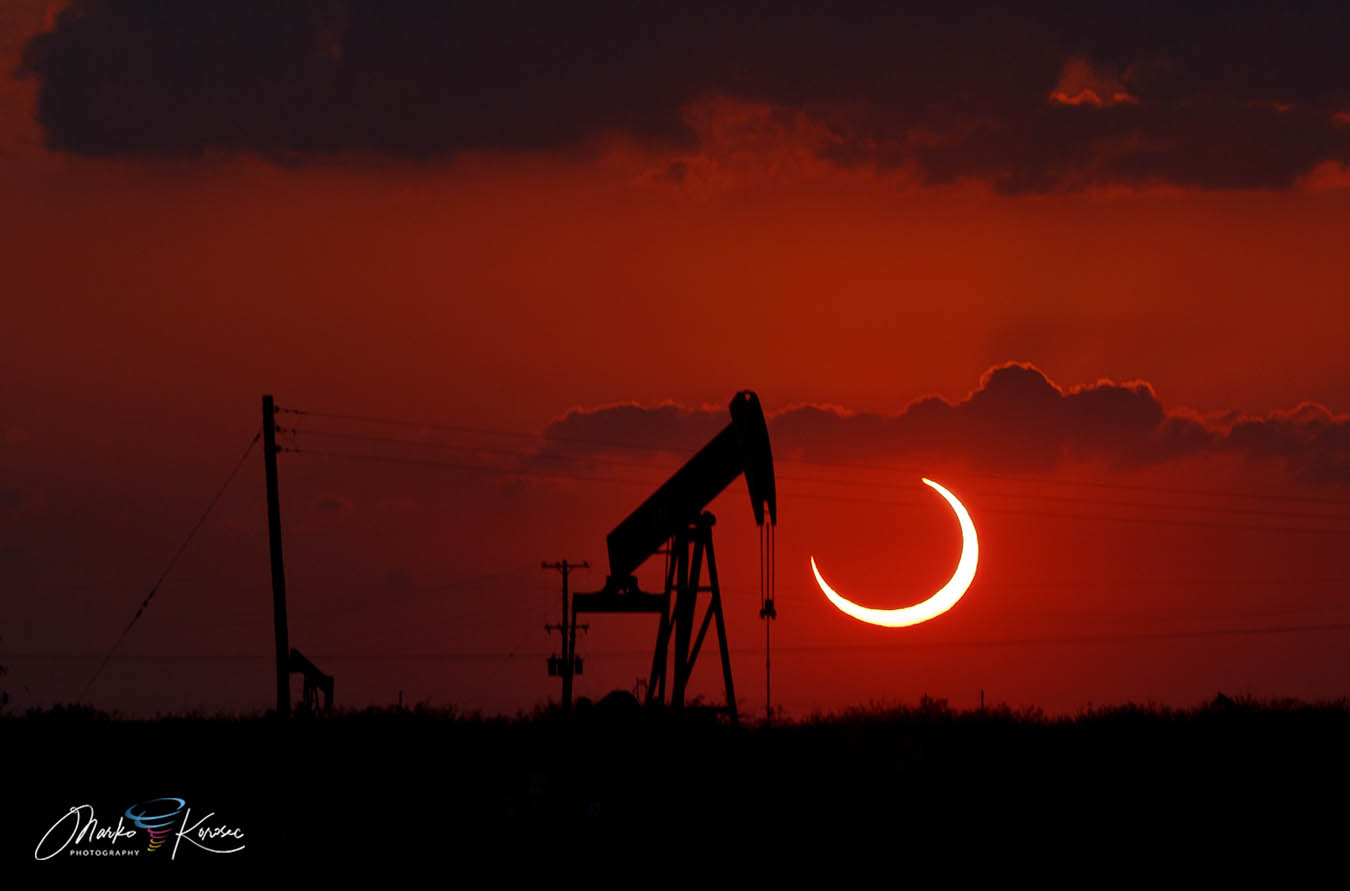
Above: A Ring Of Fire solar eclipse in Texas, May 20th, 2012. Photo by Marko Korosec
Even if you plan to observe the solar eclipse, you should buy protective solar glasses. You want to avoid messing around with the dangerous light from the Sun. The damage can happen in seconds and even make you blind if you’re unlucky. So, here are some tips on observing the event as safely as possible.
We must always use solar glasses to protect our eyes when observing the Sun, whether during full daytime or eclipse events. The solar glasses (or filters) should not have scratches, punctures, torn, or damage. If you find any of those, throw them away and buy a new one. No exceptions, seriously.
If you plan to observe the eclipse with your children, always help and supervise them while they wear solar glasses. Although it is a unique opportunity for us all, the wrong moment could damage their eyes permanently.
Also, if you usually wear glasses, put your eclipse glasses on over them. Or hold your handheld filter in front of them.
Also, do not look at the Sun through a camera, a telescope, binoculars, or any other optical device while using your eclipse glasses or handheld solar viewer. The uneclipsed or partially eclipsed Sun through an unfiltered camera, telescope, binoculars, or another optical device should never be done.
When are the next total solar eclipses?
If you are unlucky and have a cloudy day, there will, fortunately, be more opportunities in the coming years. Although you might need to travel to some parts of your country or continents, it is worth a shot to experience this unique lifetime opportunity.
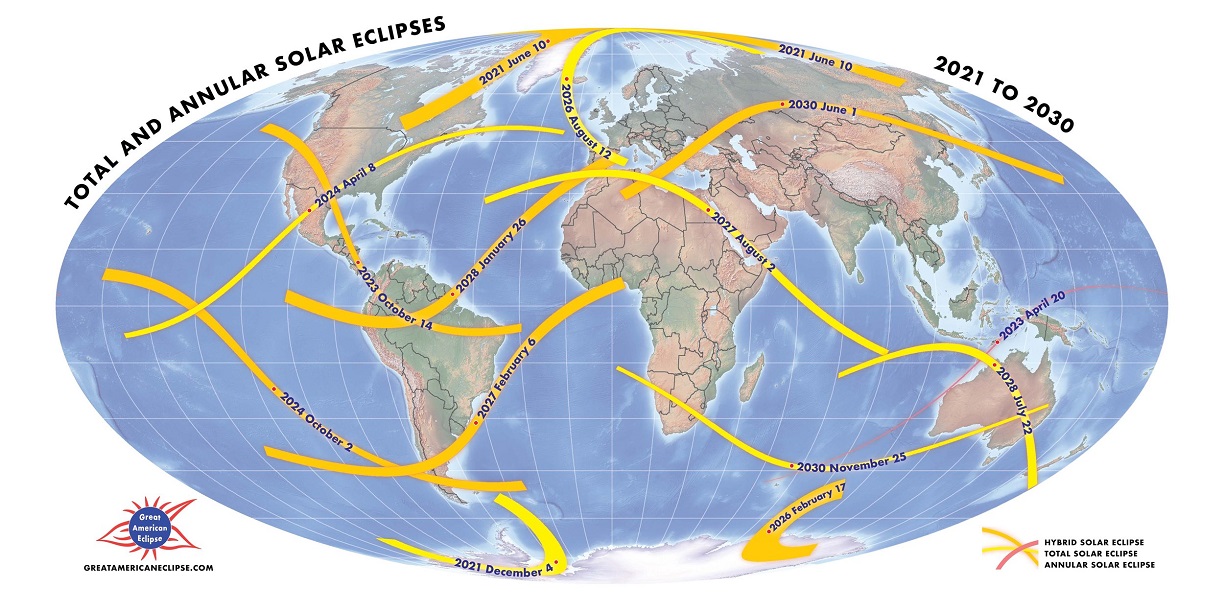
Above: Annular and Total Eclipses around the world between 2020 and 2029. Image: Timeanddate.com
The next full total Solar Eclipse will occur in northern African countries on August 2nd, 2027. The swath of totality will sweep from Gibraltar to northern Algeria, central Tunisia to northern Libya, central Egypt, and towards western Saudi Arabia and Yemen. The specialty of the 2027 eclipse is its duration, with more than 6 minutes of totality.
It is challenging for eclipses to visit the same places (or countries) worldwide. They might happen just once in a century. So, if you are dedicated to seeing one, some travel will be needed to catch the next one unless you are lucky enough to live on its exact track.
Here are the final thoughts and additional tips on observing and photographing this unique celestial show.
For those who live in Spain or Iceland, Wednesday’s total solar eclipse will be quite a spectacular event. Millions along the path of totality will see it as our Moon moves across the Sun.
Solar Eclipses occur only about twice a year, each unique. They occur in different, often remote areas, and many people travel worldwide to experience this spectacular celestial event. Total eclipses happen even more rarely, about every 18 months.
Those of us who have already experienced a solar eclipse can tell you it is such a special event that you remember it forever. When a total eclipse occurs, the Sun is completely obscured by the Moon during the daytime. But an even more spectacular and rare event is an annular solar eclipse.
See also: American eclipse on April 8th, 2024