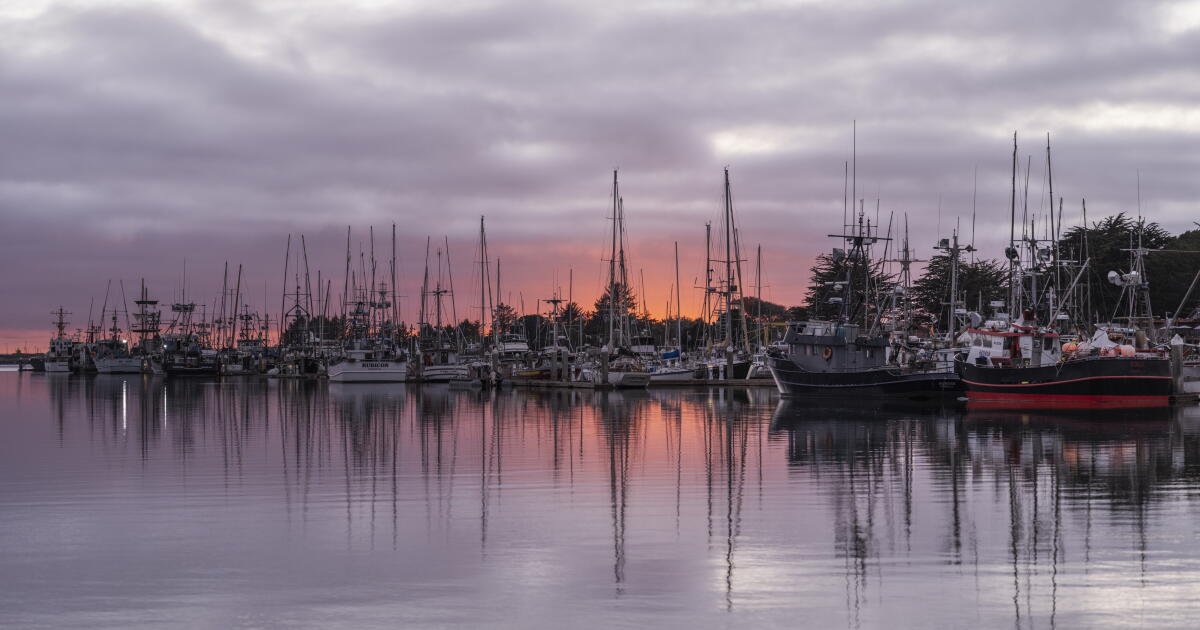

In the pre-sunrise hours on Humboldt Bay, a fishing boat called the Silver Spray encountered a powerful 18-foot wave that tore the top of the boat off, launching the four men aboard into the dark waves.
Skipper Al Burns described to The Times somersaulting underwater as the 35-foot ship sank.
It was Dec. 14, 1999, and one man would not be found following the Northern California boat tragedy. He remained a missing person until recently when a single bone washed ashore, and investigative work provided closure after three decades for the family of the California father of three.
“I had a good feeling I was going to die,” Burns said of the incident that day, when he watched as the pilothouse, where the crew steers the ship, was ripped away.
Jonathan Raxa’s body was not found after he was thrown into the water amid violent waves. After 30 years, a bone washed up about 20 miles from the site of the boat accident.
(Humboldt County Sheriff’s Office)
As he and two other crew members scrambled to grab onto debris and rafts, they realized that one of them was missing.
Jonathan Raxa, who owned the boat, was a 37-year-old family man. Raxa had stepped up his crab fishing in the days before the accident to afford an evangelical trip to his home country of Laos.
But the waves can be unforgiving in December, which is when the crab season opens. Humboldt Bay, the rugged, often cold bay that is the second-largest in California, is notorious for breakers, or massive white foam waves, that have swept people out to sea and destroyed ships like Raxa’s.
And commercial fishing is notoriously dangerous.
Hazards include vessel disasters and falls overboard, according to the U.S. Centers for Disease Control and Prevention’s National Institute for Occupational Safety and Health. The profession, in the period from 2000 to 2017, had a fatality rate more than 28 times higher than the U.S. average, the institute said.
For nearly 30 years, Raxa’s remains were nowhere to be found.
But in March 2026, a bone washed up on Centerville Beach, about 20 miles south of where the Silver Spray crashed.
Deputies with the Humboldt County Sheriff’s Office identified it as a human sacrum, the triangular bone at the base of the spine, and submitted it to a state Department of Justice system of DNA samples.
The DNA of the bone had a match — a sample obtained from Raxa’s son three decades prior. Raxa’s family was contacted, and told that their father’s case had been solved.
The Humboldt County Sheriff’s Office wrote in a statement that the case “exemplified the importance” of preserving DNA samples from family members in missing person cases. They may enable detectives to resolve cases for families even after the passage of decades.