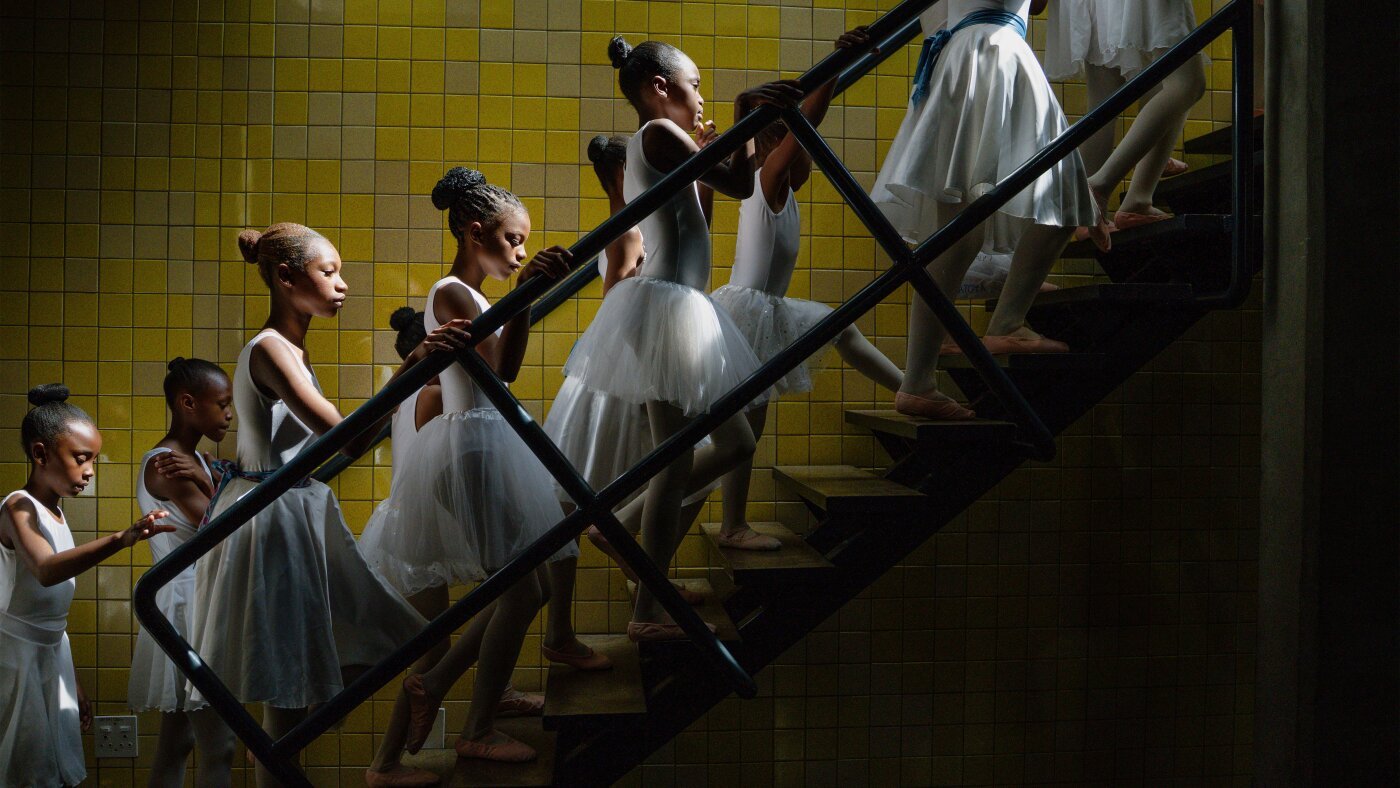

Young dancers from the Joburg Ballet School backstage at the Soweto Theatre prepare for their year-end performance. Soweto, South Africa. December 7, 2025.
Ihsaan Haffejee for GroundUp
hide caption
toggle caption
Ihsaan Haffejee for GroundUp
The winning images in the 2026 World Press Photos contest attest to a year of conflict and chaos. War, migration issues and climate upheaval dominated the news.
NPR highlighted the “photo of the year’ — Separated by ICE. It was taken by Carol Guzy of the United States for the Miami Herald and captures the pain of a family being separated in a New York court.
There were also award winners that offer hope and happiness — like that photo of young ballet students in Johannesburg, South Africa, as they pause for a reflective moment before a performance. It is all the more stirring because before Apartheid came to an end, ballet was an art form typically reserved for white South Africans.
The photographer, Ihsaan Haffejee, based in Johannesburg, says his editor had asked that photojournalists keep an eye open for good news stories. He says he took his camera to the Joburg Ballet School “year-end performance in which the young students showcase the ballet skills that they have learnt throughout the year. “Parents, friends and family attend and cheer on the young girls as they perform for a packed audience.”
Here’s a selection of photos singled out for distinction in regional categories, focusing on the countries of the Global South that our global health and development team covers.

Gulshaman visits Fatemah, whose daughter, Yasmin, was born the previous day. Waras, Shahristan district, Daikundi province, Afghanistan. July 27, 2025
Elise Blanchard for Time
hide caption
toggle caption
Elise Blanchard for Time
In Afghanistan’s remote Daikundi province, the cessation of U.S. aid has stripped many pregnant women of access to medical care, pushing them to deliver at home in a country that already has one of the world’s highest maternal mortality rates as per UNICEF data. The funding shortfall has forced the suspension or shutdown of over 400 health facilities nationwide, including small, single-midwife community clinics, where many of the staff now work without pay or basic supplies.
“I’m Afraid” is a winner in the stories category for West, Central and South Asia and was photographed by Elise Blanchard for Time. “The hardest part of covering this was to face the grief of the women who had lost their unborn children, and in one case, a man who had lost both his wife and unborn child before they could reach a clinic,” says Blanchard.
Her winning photo shows a young woman who gave birth the previous day. “At 24, [Fatemah] had already given birth at home thrice, and lost a 5-month-old child because she could not walk to a clinic on time,” says Blanchard. “She was handling a difficult marriage and facing extreme poverty. I was pained by what she went through and would continue going through but also so impressed by her strength.”

Valeria, age 5, plays behind a curtain at her aunt’s house. She is raised solely by her mother. In her region, nearly a third of households are headed exclusively by women. Los Patios, Norte de Santander, Colombia. September 10, 2025.
Ferley Ospina
hide caption
toggle caption
Ferley Ospina
A stories category winner from South America, “Name the Absence” by Ferley A. Ospina turns its lens on one of Colombia’s many single-mother households. He knows of this experience firsthand: In 1999, his father was killed in the border region of Norte de Santander.
“Many children like me grow up without a father,” he says. “It’s a very marked absence that continues through the years, and while society has normalized it, it affects the life of that child in a very profound and constant way.”
The photo of Valeria came about unexpectedly, he says. “I’d recently been turned down for several jobs and was listening to music — a bit of rock. I took my camera with me when I went to eat at my grandmother’s house. Later, I went to my aunt’s house, and there was Valeria in her room, playing on the bed and jumping all over the place.”
He took out his camera because he found it endearing to watch her play alone and felt a deep connection. “It reminded me of my own childhood, when I used to play by myself as a child. At that moment, the sun began to shine brightly, the wind picked up and the curtain fluttered violently. That’s when I was able to take that photo. I didn’t seek out the photo; the photo found me.”

Professional hunters shoot a family of elephants identified for culling. Sango Wildlife Conservancy, Savé Valley Conservancy, Zimbabwe. October 23, 2025
Halden Krog
hide caption
toggle caption
Halden Krog
“When Giants Fall” is the winner in the singles category for the region of Africa. It documents an ongoing effort to cull elephants — to kill a certain percentage of the population — in the wake of clashes between humans and the animals..
Based in Cape Town, South Africa, Halden Krog has been documenting stories of elephants for the last five years. “We had been told that the populations across Southern Africa were growing too big and too fast for the wildlife areas that were supposed to contain them,” he says.
When the news broke in newspapers in Zimbabwe that the government was planning to cull 600 elephants, Krog made contact with the conservancy. They agreed that he could witness —- and photograph — the cull. “I can honestly say no one at this cull was happy about doing it, and every action was taken to complete this gruesome task as quick and humanely as possible,” he says. “I watched grown men in tears after every shoot.”

A shepherd herds his flock of sheep on the banks of the Euphrates River. The river divides forces loyal to the new Syrian government and those who support the U.S.-backed Syrian Democratic Forces. Deir al-Zour, Syria. August 21, 2025
Nicole Tung, VII Photo, for The New York Times
hide caption
toggle caption
Nicole Tung, VII Photo, for The New York Times
Hong Kong-born photojournalist Nicole Tung’s photo for The New York Times won in the stories section for West, Central and South Asia. Her image, titled “A Syrian City Rebuilds, Still Divided,” is a symbol of hope in a conflict ridden land, says Tung. It shows a shepherd herding his flock of sheep on the banks of the River Euphrates, in the city of Deir Al Zour in Syria. A few moments after taking the photo, Tung says she heard a loud explosion in the distance. A woman and her son were injured by an unexploded bomb which they had accidentally triggered while scavenging on a dump site, she says. “That somewhat peaceful moment with the shepherd was punctuated by a harsh reality in Deir Al Zour: that the war in Syria might be over but its consequences aren’t.”

Sandra Mara Siqueira rests with her grandchildren, Micael, Davi, Ana Flávia and Vitória. Colombo, Paraná, Brazil. November 15, 2025.
Priscila Ribeiro
hide caption
toggle caption
Priscila Ribeiro
Millions of Brazilians lack safe and affordable housing, with a national shortage of 5.9 million homes forcing approximately 16.4 million people into crowded settlements. This picture, titled “Territory of Hope,” is from one of those settlements, known as the Parque dos Lagos occupation, in the city of Colombo. It’s home to 200 families who live without official access to water, sewage disposal or electricity.
Documentary photographer Priscila Ribeiro, who lives in Curitiba, Brazil, says her interest in this subject comes both from her proximity to the community portrayed and the urgency of the problem. The photograph won in the single image category from South America.
“What struck me most was the relationship between vulnerability and strength,” she says –- that moment of intimacy between the grandmother and her grandchildren.

Palestinians climb onto an aid truck as it enters the Gaza Strip via the Zikim Crossing. They’re hoping to obtain flour during what the Israeli military called a “tactical suspension” in operations to allow humanitarian aid through. Gaza. July 27, 2025.
Saber Nuraldin/EPA Images
hide caption
toggle caption
Saber Nuraldin/EPA Images
Palestinians clambered onto an aid truck as it entered the Gaza strip after Israel’s aid blockade resulted in widespread shortages of food. The truck cannot even be seen under this blanket of desperate humans.
The photographer, Saber Nuraldin was born in Gaza and has documented life there since 1997. His photo, “Emergency in Gaza,” was one of two finalists for the World Press Photo of the Year.
The photograph was taken near the Zikim crossing during one of the hardest moments he ever witnessed, he says. Hundreds of hungry people were surrounding trucks carrying flour and food, hoping to secure something for their family. “Some people were able to return with a small amount of food, others came back empty-handed, and some did not return at all due to the extreme crowding, chaos and live fire.” As he photographed hungry people struggling for food, he says his own children were at home — and hungry.

Female students attend class at their school in Pakistan, which was attacked by the Taliban on December 21, 2012 as part of a campaign to prevent girls from accessing education. This photo was taken the following year and was honored in the “long-term project” category, Khyber Pakhtunkhwa, Pakistan. June 4, 2013.
Diego Ibarra Sánchez
hide caption
toggle caption
Diego Ibarra Sánchez
“Hijacked Education” explores how conflict shapes access to education. This photograph, from Pakistan, won in the long-term project category for West, Central and South Asia.
Spanish photographer Diego Ibarra Sánchez lived in Pakistan for five years. The country shares a northwestern border with Afghanistan, and many of its tribal areas are subject to Taliban influence. “This photograph focuses on the struggle of girls learning under the shadow of the Taliban,” he says.
The aim of this work, like the project itself, is to raise questions about childhood, education, and what it means to learn under threat, he says. “I want to draw the viewer out of their comfort zone and invite reflection on whether education is a right or a privilege,” Sánchez says. “Above all, I hope to briefly catch the attention of a distracted, passing viewer — and make them pause, even for a moment.”

Newlyweds in the Philippines went ahead with their ceremony despite floods from Typhoon Wipha. Malolos, Bulacan province, Philippines. July 22, 2025.
Aaron Favila, Associated Press
hide caption
toggle caption
Aaron Favila, Associated Press
This photo for the Associated Press by Aaron Favila is titled “Wedding in the Flood.” Newlyweds Jade Rick Verdillo and Jamaica Aguilar, sharing a kiss, had been together for ten years and faced a difficult decision after Barasoain Church was flooded by Typhoon Wipha last summer: Should they cancel their wedding or proceed?
The couple carried on despite high waters, a testament to love and resilience in the face of severe weather. Located on a delta, says Favila. Bulacan province is vulnerable to more frequent and extreme floods caused by aging drainage systems, dredging projects, overextraction of groundwater and climate change.

Ghita Jhiate manages her unruly stallion. Long forbidden by her father to participate in the traditional riding event known as Tbourida, she finally realized her dream of riding alongside pioneer Zahia Aboulait in 2025. Sidi Rahal, Morocco. August 6, 2025.
Chantal Pinzi, Panos Pictures
hide caption
toggle caption
Chantal Pinzi, Panos Pictures
This photo, “Farīsāt: Gunpowder’s Daughters,” won in the stories category from the African region, depicting an early morning scene at the Sidi Rahal festival in Morocco. At this event, riders gallop in unison, firing rifles, in a choreographed performance. The tradition, known as Tbourida, dates to the 16th century but women could not participate until a ruling in 2004. Today, seven all-female troupes ride among some 300 male ones.
Describing this photo, documentary photographer Chantal Pinzi says that Ghita Jhaite’s horse was agitated after a confrontation with other stallions that caused the rider to fall. Yet Jhaite was able to bring the horse under control — a difficult feat while riding bareback. “When I saw her, I felt a huge rush of adrenaline and took the shot,” says Pinzi. “I immediately thought it was an iconic image for the story, this young woman who is completely in control.”
Kamala Thiagarajan is a freelance journalist based in Madurai, Southern India. She reports on global health, science and development and has been published in The New York Times, The British Medical Journal, the BBC, The Guardian and other outlets. You can find her on X @kamal_t