
www.theguardian.com
Badenoch says Tories want to have policies ‘for everybody’ as she defends plan to let people earning £1m to get free childcare
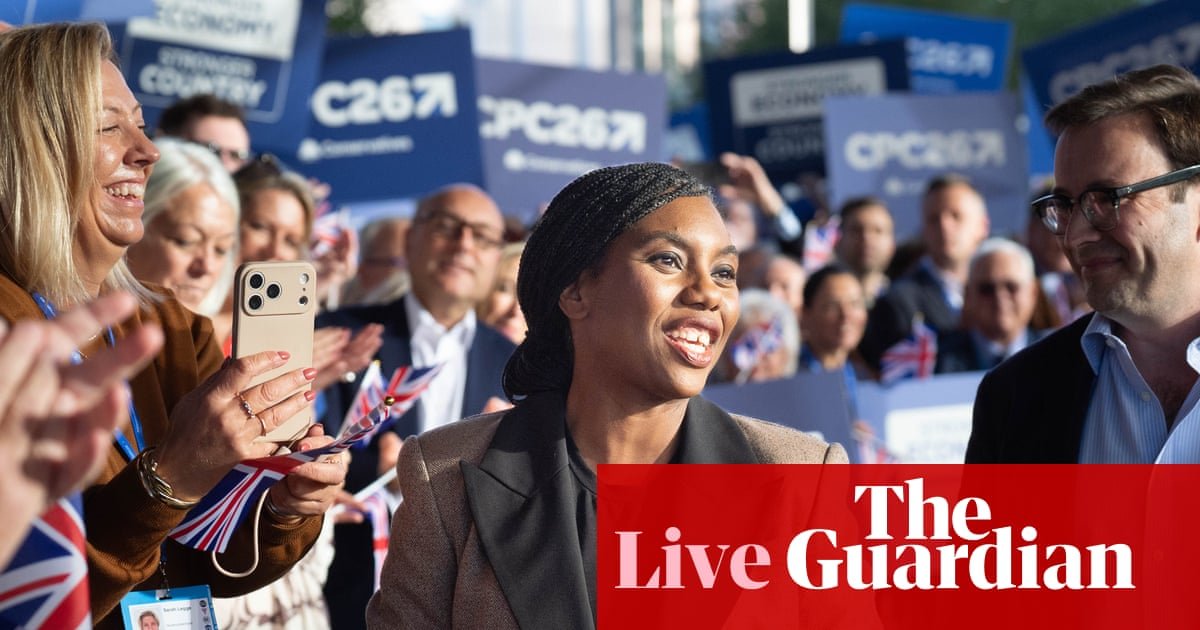
Kemi Badenoch recorded her interview with Laura Kuenssberg yesterday. It is playing out on the programme now.
In it, Badenoch defended her plan to extend free childcare to high earners. (See 9.08am.)
She said:
What we want to see is that people who work harder don’t get punished for doing so. If you earn £100 a pound over £100,000, you could lose £10,000, £20,000 worth of childcare. And we don’t want people to stop working because of that.
Asked if she would be happy for someone earning £1m to be able to get free childcare, Badenoch said it did not matter what people were earning.
But she said the policy was aimed at people caught by the cliff edge.
The kind of people that we’re really targeting [might be] a deputy headteacher who wants to become a head teacher. She goes from £85,000 to £110,000. She’s got three kids. All of a sudden she’s losing tens of thousands of pounds.
Asked why the Tories were not proposing a means test, so the very rich would not qualify, Badenoch said:
I believe that the number of people who have very small children who are earning tens of millions of pounds is negligible.
But she also said she wanted the Tory conference to show that the party had “policies for everybody, whether you don’t earn, whether you earn a little, whether you’re an a bit, whether you earn a lot”.
She went on:
We want everyone in this country to know that if you are out there working, the Conservative party has got a plan for you.
Key events
One of the highlights of the Tory conference is a spoof Bayeux Tapestry on display in the exhibition hall. Called the Birmingham Tapestry, it features Kemi Badenoch as the victor, with joke references to some of her opponents. This morning it was the most popular exhibit at the conference.
Here are three of the events it chronicles.
How ‘Zionism is racism’ motion has split Green party
Aletha Adu
Aletha Adu is a Guardian political correspondent.
Splits in the Green party over the ‘Zionism is racism’ motion being debated today have gone right to the top of the party.
Green party co-deputy leader Mothin Ali said he would “absolutely” support the proposals, which would declare the Green party anti-Zionist and state that Zionism should be treated as a form of racism.
But his fellow deputy leader, Rachel Millward, has described the proposals in their unamended form as “problematic” and said she would not support them without changes intended to protect Jewish members.
Zack Polanski, who left on Friday afternoon to campaign in the Holborn and St Pancras byelection, has sought to steer a path between the competing sides.
Polanski, who is Jewish and describes himself as anti-Zionist, has angered some senior Green colleagues by backing amendments including protections intended to ensure Jewish members are not treated differently because they belong to institutions or synagogues that identify as Zionist.
Speaking to the Guardian shortly after his leader’s speech on Friday, Polanski said the debate over Zionism was “not my priority”. He has also sought to move the argument away from defining Zionism and towards what he regards as concrete action on Israel and Palestine.
The motion has attracted significant support among the party’s rapidly expanding membership. Ali said his support was rooted in the proposals’ references to genocide, ethnic cleansing and ethno-nationalism. He said:
It talks about genocide, it talks about ethnic cleansing, it talks about ethno-nationalism. Anyone who believes in that, I think that is a racist ideology.
Millward has taken a markedly different position, stressing that the proposals originated with members rather than the leadership. “This didn’t come from leadership, it’s not part of a strategic direction,” she said, adding that there were “a lot of different opinions” within the party.
Other senior Greens, including Caroline Lucas, the former leader, and Adrian Ramsay and Carla Denyer, both former co-leaders, have also said they oppose the proposals. (See 8.42am.)
One senior Green, who declined to take a position before seeing the final wording and amendments, said they were proud that such a contentious proposal was being considered alongside 148 others, describing this as part of being a “mass movement party”.
They stressed that any vote would not necessarily represent the end of the party’s discussions on Zionism and Israel and Palestine.
Supporters hope the proposals could eventually make the Greens what some members describe as the “western world’s first major anti-Zionist party”.
The party’s Jewish membership is itself divided. Jewish Greens has declined to take an official position after surveying its members.
Of the 108 respondents who answered its question on political identity, 81% said they did not identify as Zionist. However, 53% agreed that passing the proposals could make discrimination against Jews within the Green party more likely, while 68% expressed concern about the potential impact on the party’s electoral prospects.
Badenoch likened to Thatcher by supporters as she sets out her core beliefs
According to the Conservative party, these are the core principles set out in Kemi Badenoch’s The Right Way document setting out her philosophy. The party says:
At the heart of The Right Way are a series of principles which will guide the next Conservative government:
-Wealth must be created before it can be distributed
-Freedom requires responsibility
-Rules need consequences or they will be flouted
-A government should be judged on what it achieves, not what it intended
-It should be strong where only the state can act, and restrained where people are better placed to decide for themselves
Like any author with a book to plug, Badenoch has been soliciting positive quotes from celebrity figures likely to praise it. In their news release, the Tories have published glowing endorsements for the document from three rightwing historians (Andrew Roberts, Niall Ferguson and Robert Tombs), the former Tory cabinet minister Peter Lilley, the political philosopher John Gray and the Times columnist Juliet Samuel.
Many of them implicitly or explicitly compare Badenoch to Margaret Thatcher. For example, this is from Roberts.
Kemi Badenoch has laid down the gauntlet with this concise, hard-hitting and well-researched book, with its unmistakeable echoes of Margaret Thatcher’s own personal set of beliefs. Underlying political philosophies have historically always mattered much more than mere day-to-day policy-making, because they show which politicians have a star to guide by, and thus the capacity for true statesmanship. With this book – clearly the product of profound thought – Ms Badenoch has set out the battle lines between the open, entrepreneurial economics of the future and Mr Burnham’s collectivist economics of the 1970s.
And this is from Lilley, who served in cabinet under Thatcher.
The Right Way is an immensely important document – as crucial as was Margaret Thatcher’s The Right Approach, as a stepping stone to government equipped to achieve national renewal.
This is from Megan Kenyon at the New Statesman, who is covering the ‘Zionism is racism’ debate at the Green party’s conference.
Green Party members are currently debating the zionism is racism motion in Brighton’s conference centre.
I understand the Green Party’s leader in Parliament Ellie Chowns is currently speaking against the motion on behalf of all the party’s MPs
Tories say lifting earnings cap for free childcare would cost £700m, funded by quango job cuts
In her interview on the BBC this morning, Kemi Badenoch played down the costs of her proposal to lift the earnings cap on parents eligible to claim free childcare. Asked if it was right that people earning more than £1m a year should benefit, she said the number of parents in this category with small children was negligible. (See 9.20am.)
Badenoch may be right about this, but that does not mean her policy is necessarily cheap. According to the Tories, it would cost £700m per year.
In a briefing, they point out that the free childcare policy can be worth as much as £20,000 per child in some areas.
This is how the Conservative party explains its costing.
The policy is estimated to cost £700 million per year, based on analysis from the Centre for the Analysis of Taxation of the cost of removing the cliff edge for free childcare hours. The policy announced today includes removing the cliff edge for tax-free childcare as well, meaning slightly higher costs than those cited by CenTax. (CenTax, Removing the £100,000 childcare cliff-edge: Impacts and cost of reform, 10 September 2026, link).
Other analysis has estimated that the behavioural response to the policy could be sufficient to actually make it net revenue neutral or even a small revenue raising policy. Modelling by the Centre for British Progress estimated that the policy could increase overall receipts by between £130m and £425m in 2029-30. We have cautiously taken a more conservative approach and assume a net fiscal cost. (Centre for British Progress, Rates and wrongs: fixing UK tax cliff edges and tapers, 25 March 2026, link).
The Tories say they would pay for this by cutting the number of officials working for quangos. The party is already committed to cutting the size of the civil service back down to what it was at the time of the Brexit vote in 2016, and it has already banked the money it would save from this. Now it says cutting quango staff numbers to 2016 levels would save £1.6bn by 2029-30. In line with the party’s “golden rule” for deficit reduction, half of this would go towards cutting debt, and the other half would fund the childcare pledge.
Justice secretary Alex Norris unable to say how many prisoners released early have been tagged
Alex Norris, the justice secretary, has been unable to say how many prisoners freed early from jail have been tagged, the Press Association reports. PA says:
Officials said there was a presumption that all criminals released early would be fitted with GPS tags, but Norris said it was “too soon” to have the numbers.
The first wave of releases began on Thursday, with nearly 5,000 prisoners set to be freed in stages over the next year as the Sentencing Act 2026 comes into force.
Asked how many of those released so far had been tagged, Norris told the BBC’s Sunday With Laura Kuenssberg programme: “I don’t have that figure today, it only happened on Thursday.
“You know, there can be a bit of a lag.
“We don’t have that number. But you know, we’re very candid about who’s leaving prison and when they do.”
Asked if he knew if released domestic abusers have been tagged or not, he said: “It would be too soon to know that, as it was only on Thursday.
“We’ve been talking to every victim to to offer them the chance to say what controls they’d like to see over that individual.”
He added: “I’m well aware of the past in tagging. Over the last year, performance has increased significantly.”
Here is the latest from the Green party conference, and the debate on the ‘Zionism is racism’ motion. This is from Lee Harpin from Jewish News.
So, currently a card vote taking place inside the hall on a motion that calls for toning down of some of the language of the Zionism motion in terms of what sort of solution should be found for Palestinians. Then Sam Alston of Jewish Greens will address the conference arguing the case for the passing of an amendment on safeguarding UK Jews.
David Gauke says Badenoch wrong to say contributory principle makes ditching pensions triple lock unreasonable
In her interview with Laura Kuenssberg, Kemi Badenoch argued that it would be wrong to get rid of the current version of the pensions triple lock because pensioners had contributed to the welfare system. (See 9.43am.)
She has used this line before. In posts on social media yesterday, David Gauke, the former Tory justice secretary, explained why he thought this argument was bogus.
The “contribution” argument on the triple lock is a poor. For a start, it is very hard for anyone living during their working life not to meet the contributory requirements. And in any event, this entitles you to receive a pension, not to uprating under a specific formula.
Anyone paying taxes/“making a contribution” from 1980 to 2011 did so in a period when pensions rose in line with inflation. No one can claim that they “contributed” over this period in the expectation that the state pension would rise in accordance with the triple lock.
The benefits system does to a limited extent reward people who have contributed more to the system through national insurance. Some politicians have argued that the contributory principle should be beefed up. If this is what Kemi Badenoch favours, then ironically she is aligning herself with Keir Starmer, who briefly explored this idea when he was in opposition. ThinkLabour, a Starmerite thinktank, also published a paper on the topic last year.
This is from Lee Harpin from Jewish News, who is at the Green party conference in Brighton but not allowed into the hall for the policy debate on the ‘Zionism is racism’ motion. The Greens always restrict the sessions debating policy to party members.
Inside the Brighton Centre we are now in the farcical situation whereby the hugely controversial debate on whether Zionism is racism is taking place at Greens conference. But the media is banned from covering it inside. It’s a members only thing apparently.
Greens express concern that, despite Labour’s U-turn, some suspects will still lose right to jury trial
The Greens have also described the Labour U-turn on limiting access to jury trials as a victory for their campaigning. (See 8.22am.) But they are concerned that, even under the new proposals announced today, some suspects who can currently opt for a jury trial will lose that right.
Siân Berry, the Green party’s home affairs spokesperson, said:
This is a victory for justice and fairness, and is yet another concession from the prime minister to Green pressure – as Zack said at conference: ‘vote Green and watch Labour move.’
Greens in parliament argued so hard for these clauses to be removed from the courts and tribunals bill, and my proposals to preserve jury trials and the freedom of juries to acquit, were voted down time and time again in the public bill committee I sat on. Finally, Labour has seen sense.
However we need urgent clarification from the Government on the crucial issue of precisely which cases may still have the right to jury trial removed by a judge who is given what the government calls ‘a final say’. If the reference to ‘relatively minor cases’ means all either-way offences, this still potentially removes the right to trial by jury from all protest cases and all cases of alleged theft. This would remain a major erosion of the right to jury trial through the back door.
In interviews this morning, Alex Norris, the justice secretary, has said he will give full details of the changes he is making to the bill when the Commons returns after the conference recess.
Badenoch publishes The Right Way, 100-page guide to her political philosophy
Kemi Badenoch has published a 100-page guide to her political philosophy. It is called The Right Way, and it is in part modelled on a pamphlet published by the Tories soon after Margaret Thatcher became leader in the 1970s. That one was called The Right Approach and drafted by Keith Joseph.
In her foreword, Badenoch says that the 30,000-word booklet is not a policy document; it is a statement of principle.
She explains.
In February 2026, the former head of MI6, Sir Alex Younger, addressed the Conservative parliamentary party. When I interviewed him on stage, he started with a warning: once you are in government, there is no time to construct first principles. If you have not worked out how you think before the crises arrive, you end up reacting to them one by one.
This is where the last Conservative governments went wrong, before they went wrong about anything else. We do not intend to make this mistake again. The Right Way is our answer to the challenge the now late Sir Alex Younger posed.
Good government enters office knowing how it thinks. A manifesto full of suggested policies for current, visible problems is not enough. Many problems a government ends up dealing with are not known at the time of the election. What is essential for success is a settled way of approaching the problems nobody predicted, how to recognise trade-offs, what government should do itself, what it should leave alone, and how to decide when circumstances, and indeed the world, change.
In her interview with the Times yesterday, Kemi Badenoch said she regarded Nigel Farage, the Reform UK leader, as a “grumpy grandpa”.
Asked what equivalent label she would apply to Andy Burnham and to herself, Badenoch told Laura Kuenssberg:
Andy Burnham is the cheesy uncle. I think he’s the cheesy uncle who does all the dad jokes. And what am I? Someone else has to do that. It’s very difficult.
Pressed to give an answer, she replied:
They probably see me, you know, as the no-nonsense mum. No nonsense, [that’s] probably me.
Badenoch defends arguing cheating significant problem in benefits system
Kemi Badenoch repeatedly claims the benefits system is being abused. But, when Laura Kuensseberg asked her how many people she thought were cheating the system, she did not give a figure.
Badenoch replied:
I don’t have exact figures for you, but what we have seen is an explosion in the number of people who are claiming for low-level, conditions … ADHD, anxiety. These are conditions that work would actually help them with. We are seeing because of the stopping of face-to-face assessments during Covid for understandable reasons.
People have worked out how to game the system. I don’t believe that that’s right.
When Kuenssberg pressed her again for an estimate, Badenoch could not give one. But she said her team would supply Kuenssberg with a figure later.
Kuenssberg said that, if Badenoch was talking about benefit claims being bogus, people were entitled to know if she was talking about a tiny number, or 20/30%.
Badenoch replied:
I’ll give you I’ll give you one statistic, which I saw the other day; that the increase in disability claimants has been higher in the UK than it has been in Ukraine where they’re actually at war. That cannot be possible.
We have now one in four people in our population self-reporting as disabled. That cannot be right. Something is going wrong.
Later, in the live section of the programme after the pre-recorded interview, Kuenssberg said the Tories had not given her a figure for the number of people supposedly cheating the benefits system. But she said they said almost £10bn is lost through fraud or error, and that nearly 7% of universal credit (UC) claims are fraudulent.
That is a reference to these figures from the Department for Work and Pensions. They show that fraud in the UC system was actually higher under the last government – but that can be traced back to a high spike during Covid.
Badenoch says current triple lock ‘right policy’ – but declines to say Tories will always keep it
In her BBC interview, Kemi Badenoch was asked if she could say she would never change the pensions triple lock. Laura Kuenssberg asked her if she could say she would never touch it.
Badenoch did not quite give that assurance. Instead, she replied:
The triple lock is our policy. We believe that this is the right policy for pensioners. That is what we have planned, that is what we have promised.
There is nothing that has happened that has made me change my mind. That is our policy.
Given that Andy Burnham has said that he wants to legislate to end the pensions triple lock before the next election, it is possible that the choice for Badenoch when that election happens won’t be whether or not to keep the triple lock, but whether or not to restore it to the more generous version it was before Burnham amended it.
In her interview, Badenoch also suggested that more has to be done to protect politicians. Asked about the man accused of murdering Ann Widdecombe being charged with planning a terror act against Nigel Farage, Badenoch said:
A man, an ex-IRA member, has pled guilty to threatening to kill me and he was sending messages not just to me, but also to my family members.
I just think that whether it’s Nigel Farage or even Keir Starmer who had his home firebombed, that there is a threat to politicians that is increasing and we just need to crack down on this.
Let’s build the prison spaces so that we can put people who are making these threats and threatening politicians. But what I want the public to know is that my priority really is their safety.
Badenoch rejects claims Tories regaining ‘nasty party’ reputation, saying they’re ‘common sense party’
In her BBC interview, Badenoch rejected suggestions that the Tories were regaining their “nasty party” reputation under her leadership.
She said:
It’s the common sense party. That’s what we’re doing.
And, quite frankly, if we were doing so well the old way, then why did we have such a terrible issue in 2024?
I am a classic old-school Conservative. I believe in common sense: people working hard and being rewarded for that effort.
We look after those who can’t look after themselves. Welfare should be a safety net, not a lifestyle. But this is an amazing country and I want us to look to the future and see what we can do, not just hark back to the past.
Badenoch also said her values were timeless.
Personal responsibility is not a 1980s idea. These are the things that keep us going and we need that, the principles are timeless.