
www.theguardian.com
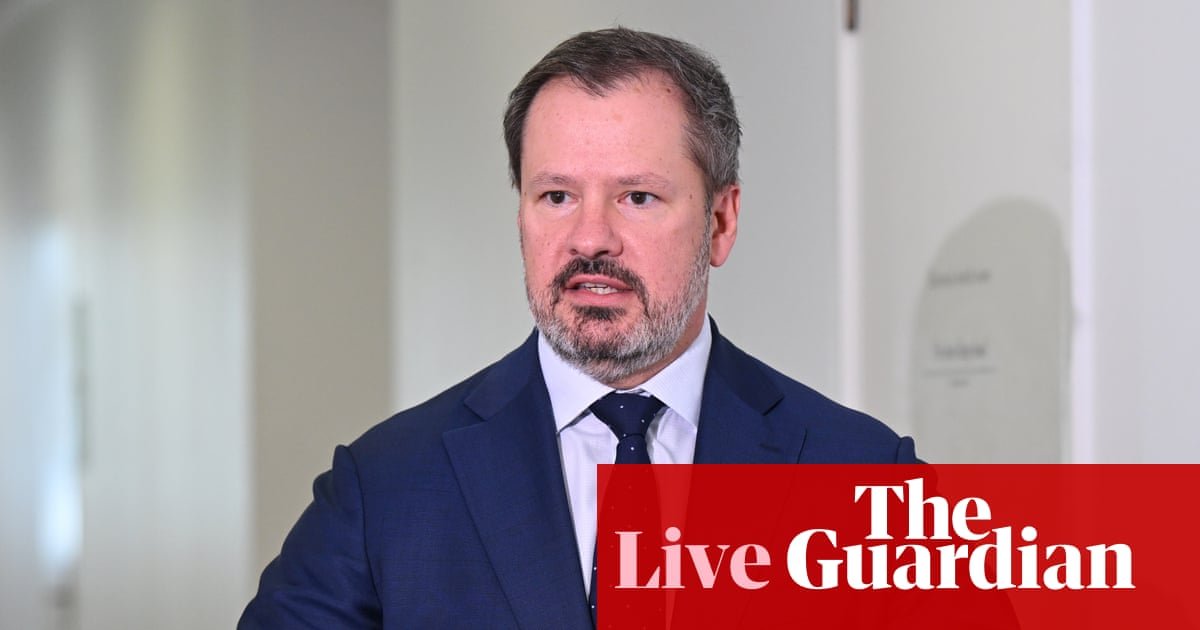
Ed Husic warns AI companies can’t be trusted to regulate themselves
Ima Caldwell
Ed Husic says the government should ‘set consistent national rules’ for AI companies.
On Sky News earlier this morning, the federal Labor MP said giving tech groups social licence is “sadly doomed to failure”.
“We tried self-regulation for … a couple of decades, found out that it didn’t work,” he said.
None of these firms will go one out from the other to bring in guardrails to limit the risks, because their investors will ask questions about, well, why are you doing this when others are working without guardrails?
So it really is incumbent on governments to set consistent national rules that protect Australians who already distrust AI from the toughest, hardest risks of generative AI.

The prime minister, Anthony Albanese, is scheduled to deliver a highly anticipated speech in Sydney tomorrow to address growing concerns around social licence and the necessary policy guardrails for AI, datacentres and the ability of big tech to profit from Australian intellectual property.
Key events

Caitlin Cassidy
Universities ‘don’t want to take a risk’ to act on antisemitism, royal commission hears
Jeremy Suss says the way the Australasian Union of Jewish Students (AUJS) operates is not akin to other student groups, pointing to “alarming” levels of security risk assessments and incident cataloguing used at an “alarming rate”.
He tells the royal commission into antisemitism:
It is a new constant task to be walking students through the difficult processes of following up from their awful experiences on campus … We very often found that universities have not dealt with incidents in a productive or meaningful way. We have many students that have waited months to hear back from incidents. Sometimes they are outwardly dismissed after that. Sometimes they never hear back.
Suss took up the role at the end of 2025, coinciding with the Bondi terror attack. He said it added a “very alarming” and “urgent” layer:
Suddenly I was stepping into an organisation whose members … whose loved ones were there, who were shaken and who were in deep distress as we all were … I think this role has shown me that above all, these universities are institutions that don’t want to take a risk.
At every point where there’s any political or reputational cost that may happen in taking action on antisemitism, they’ve waited for legal advice, they’ve waited for external review, or at times when that when public pressure reaches a point that that they can’t delay any longer, that’s only when we’ll see change.
Caitlin Cassidy
President of Australasian Union of Jewish Students says undergraduates arrive on campus with a ‘strong sense of apprehension’
The president of the Australasian Union of Jewish Students (AUJS), Jeremy Suss, says a large part of his role in Jewish student groups has been “trying to console” first-year students who arrive on campuses with a “strong sense of apprehension”.
He told the royal commission that many students had “heard stories” from family and friends as well as seeing “confronting” incidents reported in the media about antisemitism in universities.
Suss attends Monash University and said he had a “productive relationship” with the chancellery, which he said was “rare” on other campuses. But he wasn’t immune to hostility on campus. He pointed to a Jewish event for Sukkot holidays at Monash, which included a small vigil commemorating 7 October 2023.
He said afterwards, four individuals approached him and began questioning him “quite aggressively”, including talking about “killing or exiling all of Israel’s population” and saying “we see all of you at your lunches every week”.
I found it incredibly confronting … I ensured members at our AUJS events were no longer packing up on their own.
Ed Husic warns AI companies can’t be trusted to regulate themselves

Ima Caldwell
Ed Husic says the government should ‘set consistent national rules’ for AI companies.
On Sky News earlier this morning, the federal Labor MP said giving tech groups social licence is “sadly doomed to failure”.
“We tried self-regulation for … a couple of decades, found out that it didn’t work,” he said.
None of these firms will go one out from the other to bring in guardrails to limit the risks, because their investors will ask questions about, well, why are you doing this when others are working without guardrails?
So it really is incumbent on governments to set consistent national rules that protect Australians who already distrust AI from the toughest, hardest risks of generative AI.
The prime minister, Anthony Albanese, is scheduled to deliver a highly anticipated speech in Sydney tomorrow to address growing concerns around social licence and the necessary policy guardrails for AI, datacentres and the ability of big tech to profit from Australian intellectual property.
Caitlin Cassidy
Dennis Altman says he’s ‘more afraid of neo-Nazis’ than pro-Palestine protestors
Prof Dennis Altman has critiqued universities for moving to “shut down discussion” of Israel-Palestine and said he was more afraid of “neo-Nazis” than pro-Palestine protestors. He told the royal commission:
I think that the biggest problem of the universities is they have actually not found ways of encouraging … respectful debate … The tendency has been the opposite. It’s been to shut down discussion. And that I think in turn promotes all sorts of conspiratorial stories.
He also lamented the push to ban the phrase “from the river to the sea”, which he didn’t believe meant “Jewish Israelis should be expelled or should not have full rights as citizens in that country”. Asked whether he didn’t doubt it caused “deep hurt and even fear”, he replied:
I’m not sure that in a liberal democracy we ought to be banning things because somebody might be hurt or offended. My greatest fear as a Jew about safety is the rise of neo-Nazis … that to me is much more offensive and scary.
On Steven Prawler’s case, which we heard about earlier, Altman said he was “surprised” it hadn’t been dealt with adequately, noting the direct attack of an individual was “clearly going beyond what I would see as acceptable”.
He said the best path forward was to build bridges between Jewish and Palestinian communities, adding: “I do regret that the antisemitism envoy seems not very interested in pursuing that.”
Social cohesion demands that all groups come out of their narrow focus and reach across.
Caitlin Cassidy
Dennis Altman tells royal commission that not all Jewish people are ‘blanket supporters of Israel’
Author, activist and academic at La Trobe University, Prof Dennis Altman, has rejected the idea that “all Jews are blanket supporters of Israel” in a pushback against some commentary that has been heard at the royal commission.
Altman, appearing as a witness, said people make assumptions about his stance on the conflict in the Middle East because he is Jewish, but to him, “Israel is a foreign country and I don’t feel any sense of allegiance to it”.
We hear from a number of mainstream Jewish organisations a constant sense that as Jews we are somehow the citizens of Israel. And of course there is some truth to that … But I think the way in which this fosters antisemitism is that it creates the impression that all Jews are blanket supporters of Israel and are unsympathetic and sometimes even unaware of the situation of Palestinians in Gaza and the West Bank.
He referred to the prime minister’s description of President Herzog as the “head of state” of the Jewish community pressing: “He is not my head of state.” He says he has been “discomforted” by the difficulty to acknowledge Israeli trauma at pro-Palestine protests and, equally, how mainstream Jewish organisations have failed to recognise the trauma of Palestinians.
My sense that what we most need in this country at the moment on this issue is a mutual recognition that people are hurting … If we can’t have an honest discussion in which people can talk about the complexities of the Israeli-Palestinian situation, we are fostering greater division and greater ignorance.
Caitlin Cassidy
‘Where’s the deterrence’ University of Melbourne academic questions after expulsion of students overturned
Prof Steven Prawer has told the royal commission into antisemitism that the expulsion of two students at the University of Melbourne for occupying his office was overturned.
On 5 May, he was told the protesters had been identified but he couldn’t be told who they were because of privacy and confidentiality requirements. Prawer hired a private investigator to attempt to identify some of the protesters as he feared “Hamas connections”.
He said the university’s disciplinary process was “very opaque” and he didn’t hear the students had been expelled until it reached the media in June. He was then informed by the university that the students were appealing their suspension. It was later overturned by the academic board, which Prawer was told “in strict confidence”. A one-year suspension was put in place instead.
Prawer said the students were “still masked even today by our systems”.
I still don’t know who they are. I think for my protection also, I should know who these people are … The community needs to hear loudly and clearly that the university tolerates dissent but it doesn’t tolerate misbehaviour … Where’s the deterrence?
Since a university sit-in and the occupation of Prawer’s office, indoor protests at the UoM have been banned.

Josh Taylor
Triple zero inquiry to ‘get to truth’ on Telstra outage, chair says
As we reported on Saturday, Telstra executives are due to appear before the Senate inquiry into triple zero this Friday on last week’s national outage.
The chair of the committee, Greens senator Sarah Hanson Young said on her podcast released today that the committee will probe whether Telstra had failed to replace a piece of equipment that should have been replaced years ago, and this led to the outage.
She said:
If it is in fact true, then it really begs the question: how can a company that banked $2.3bn in profit last year not keep its equipment up to date, and has ended up costing the entire country billions, potentially billions of dollars more because of the massive failure?
Hanson Young said Friday’s hearing will be about “getting to the truth, holding Telstra to account and making sure that we don’t keep accepting a system that leaves Australians vulnerable”.
Hanson Young said consideration should be given to nationalising the triple zero system, which is currently run by Telstra.
It’s a political choice to force these companies to put their consumers first and public safety first, rather than just their profits.
Caitlin Cassidy
University of Melbourne academic says he was subject to ‘highly personal’ attack
Prof Steven Prawer says he still doesn’t know the identities of the people who occupied his office. He was eventually escorted to safety by security and police were called. They accused the protesters of trespassing and they left his office. Stickers were left in his room, including text reading “your work will break your soul before it breaks the resistance” with an inverted red triangle. Prawner continues:
Hamas puts that triangle to indicate this is a target. It’s like X marks the spot … This clearly was a highly personal attack … Highly directed by persons that are unknown to me. It is an implication that my work as a physicist and as an academic was somehow selling my soul to the devil.
The following day, the vice-chancellor issued a statement condemning the intrusion as a line being crossed. Subsequently, around 150 university employees and affiliates signed a petition maintaining sit-ins were a legitimate form of protest and the students shouldn’t be disciplined. Prawer says when students protested the vice-chancellor, “he is paid for that” and “well protected”:
When there are 50 students on the lawn protesting and surrounded by security staff, they don’t pose an imminent threat to an individual. When there are 20 students in an office with an individual, the equation is completely different. You’re surrounded, you’re numbered.
One might say that it’s legitimate for people to protest at the seat of power. In my case, they were protesting against someone who I think was a soft target.

Sarah Basford Canales
Angus Taylor says he wouldn’t meet far-right activist Tommy Robinson after Pauline Hanson stunt
The opposition leader, Angus Taylor, says he wouldn’t meet with UK far-right activist and convicted criminal, Tommy Robinson, after Pauline Hanson joined the incendiary figure for a street-walk in London last week.
Robinson, whose real name is Stephen Yaxley-Lennon, is an anti-Islamic, far-right political activist, known for his role in major UK anti-immigration marches, and is a vocal supporter of Russia, including its invasion of Ukraine.
The 43-year-old was given a five-year stalking protection order and has twice been convicted for contempt of court. He was jailed in 2024 for repeating false claims about a 15-year-old Syrian refugee in defiance of a court injunction.
Hanson joined Yaxley-Lennon for a podcast to be released soon as part of her “fact-finding” mission, which looks more like a scavenger hunt for the UK’s most controversial right-wing influencers so far.
Taylor told 2GB earlier this morning he wouldn’t visit the UK, or meet with Yaxley-Lennon, but was hesitant to launch any personal attacks against the One Nation leader.
I’m not going to give other people advice or other political parties advice on what they should do. But I’m saying that’s not my focus. I’ve got no intention or plan to meet with Tommy Robinson …
The struggling Liberal leader did, however, attack One Nation’s policies, warning they would “create a debt crisis in this country”.
Read more:
Alan Jones has charges reduced after two complainants withdraw

Amanda Meade
Alan Jones is now facing 22 charges involving six complainants after two dropped out ahead of the 85-year-old’s criminal trial next month.
Judge Glenn Walsh told a pre-trial hearing today that the claims against the former broadcaster have been withdrawn and dismissed.
The case against the former 2GB and Sky News Australia host will be heard at a marathon trial expected to run from 4 August until the end of the year.
The court heard this morning that there are three prosecution witnesses who have refused to give police a statement. The prosecution is asking the court to compel the three witnesses to give evidence before the trial, in what is known as Basha hearing.
Jones has maintained his innocence on all charges since the allegations were made in 2024.
Kat Wong
Man arrested after allegedly ordering Melbourne kidnapping, arson and home invasion
A Victorian man has been arrested after he allegedly ordered others to commit an arson attack, a home invasion and a mistaken-identity kidnapping. Police will allege the man is high-ranking within an organised criminal syndicate linked to an offshore leader.
The 20-year-old Essendon man was taken into custody by Victorian police on Tuesday.
Police have accused him of using encrypted apps to task offenders with a variety of jobs.
On 14 April, a man was kidnapped in the inner-Melbourne suburb of Malvern after a number of men turned up at his door just after 9pm.
Police were told as he answered the door, the group entered the home, assaulted him and forced him into a waiting vehicle, before he was later dropped off at a hospital with non-life threatening injuries.
Police believe the men had turned up at the wrong address while attempting to carry out a targeted kidnapping.
The 20-year-old is also believed to have ordered an attempted aggravated home invasion in Doncaster on 28 April, and an attempted arson attack on a hospitality venue in Southbank on 27 April, when two boys were seen putting on balaclavas and latex gloves.
Their vehicle, parked nearby, contained jerry cans and a sledgehammer.
The police investigation remains ongoing.