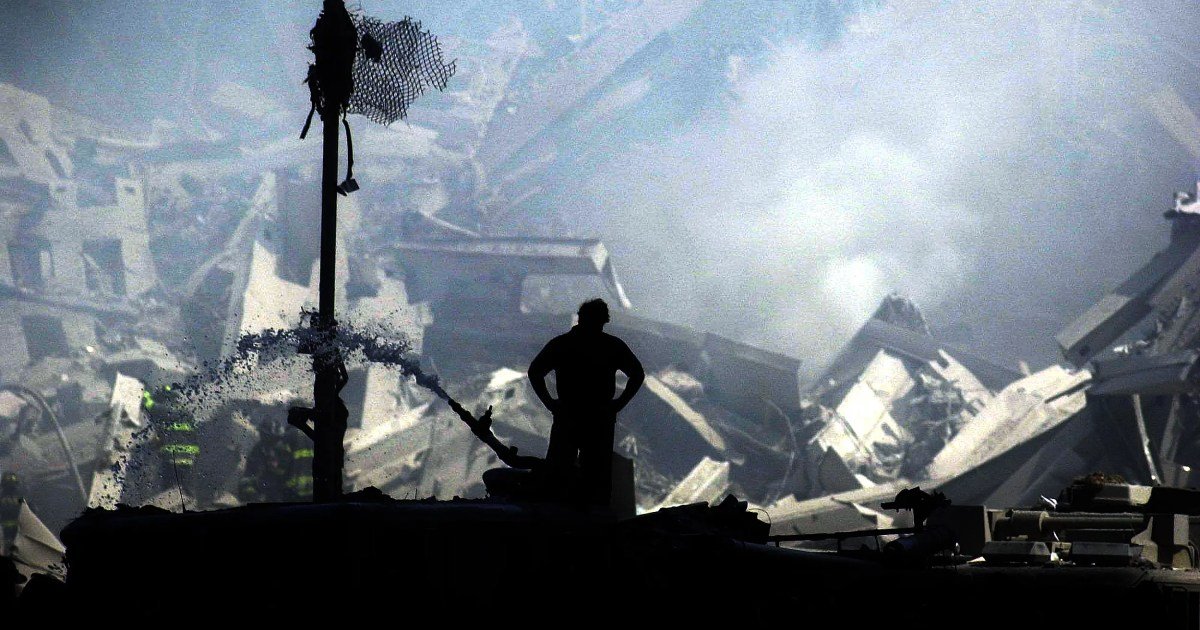

Americans are still wrestling with the legacy of 9/11. For those who lived it, some images are seared into their memory. The smoldering towers. The dust-choked streets. Bodies falling from buildings.
For the more than 100 million Americans born after 2001, they have to rely on the grainy footage and harrowing recollections of others to feel the effects of that day.
But for a subset of Americans, the day is even more visceral.
Tens of thousands of Americans lost spouses, parents and siblings in the 9/11 attacks. Nearly 3,000 children lost their parents. More than two million American service members served in the wars that followed 9/11 — over 7,000 died and more than 53,000 were wounded. Tens of thousands of U.S. government employees and contractors served overseas in the wake of the attacks.
Three Americans whose lives irrevocably changed a quarter century ago today — a son who lost his father, a Marine who fought in Afghanistan and Iraq, and a CIA officer who hunted Osama bin Laden — shared their thoughts.
Each suffered. Each responded uniquely. All see vital lessons for the future.
The son
Brett Eagleson was 15 when his father, Bruce Eagleson, died doing what he had always taught his three sons to do — putting others first.
A vice president at the Westfield Group real estate firm, Bruce, then 53, was working temporarily on the 17th floor of the South Tower of the World Trade Center.
“My dad spoke to my brother Kyle on his cell phone after both planes had hit,” Eagleson told MS NOW. “My dad said, ‘I’m in the lobby, I’m leaving as soon as i can do everything I can do, I’m going to get out.’”
Bruce Eagleson was last seen by colleagues heading back up to the 17th floor to retrieve walk-talkies that he planned to distribute to firefighters for the rescue effort.
“That was the last anybody ever spoke to him,” Brett said.
Twenty-five years later, Brett, now 40, with three children of his own, is part of a group of families that has waged a two-decade-long legal battle to force the U.S. and Saudi Arabia to release documents regarding its potential ties to the 9/11 attack.
The Saudi government has denied that it had prior knowledge of the attacks or played any role in them. And the Bush, Obama, Trump and Biden administrations have fought lawsuits filed by the families requesting the documents, citing a longstanding international legal principle that civil lawsuits cannot be filed against foreign governments.
“Families have asked both past and current administrations to release the records that will help expose the full truth,” Eagleson said.
In August, Eagleson and the other families achieved a major legal victory. New York federal judge George Daniels ruled that the family’s lawyers had obtained evidence that showed a “high probability” that two Saudi nationals had “roles in the hijackers’ plans.”
It’s unclear whether the trial will reveal proof that the Saudi government knew of the attack beforehand or that the two Saudis aided in it. Eagleson said the values his father taught motivate him.
“My dad was really big on paying it forward,” Eagleson said. “He was always saying ‘pay it forward’ and always do the right thing. It will pay off.”
The Marine
Daniel Socci was in his college dorm room the morning of 9/11. A freshman at Villanova University outside Philadelphia, he had arrived on campus a week earlier from Bayside, Queens, in New York City — excited for college after graduating from Regis High School.
When he and his roommate heard about an attack in New York, they turned on the TV. “My roommate and I watched the second plane hit,” he recalled. “We were just watching the news in our dorm room.”
Socci and his roommate made a pledge to each other that day: They would enlist in the Marines and go fight whoever carried out the attack. They enlisted in a program that allows college students to complete their education and then attend the Marine Corps Officer Candidate School between their junior and senior years.
“We thought we were going to miss everything,” he said. “We thought by the time we hit the field, everything will be over.”
It was not.
After Socci graduated from Villanova, he became a Marine lieutenant and served two tours in Iraq and Afghanistan. He recalls each seven-month deployment vividly and very differently.
Socci commanded a platoon of 50 Marines in Iraq during President George W. Bush’s 2007 U.S. troop surge. Based in Saqlawiyah, a town of 25,000 people in Anbar province roughly 10 miles from Fallujah, they came under constant attack.
“When we got there, there were quite a bit of significant contacts with the enemy,” he said. “Snipers and IEDs.”
Over the months that followed, however, Sunni tribal leaders and former Iraqi military officers in the “Awakening” movement began to fight alongside U.S. troops against Al Qaeda in Iraq.
“From the beginning of our deployment to the end of our deployment, it was like night and day,” Socci recalled. By the time his unit was rotating out, “our Marines were out patrolling and we didn’t take significant casualties.”

After U.S. troop surge ended and Socci returned to the U.S., then-Prime Minister Nouri-al Maliki declined to integrate Sunni Awakening fighters into the Iraqi security forces. Heavy fighting resumed but Socci felt like his deployment made an impact.
“We just felt like, ‘Wow, we really made a difference,” he said. “The future is theirs to write.”
In 2008, Socci and his Marine battalion deployed to Helmand province in southern Afghanistan. His experience there was completely different.
He commanded Marines tasked with training Afghan security forces, many of whom he felt were more loyal to their tribe than the central government. “We ended up doing a lot more fighting and a lot less training,” he said. “The Afghan police were pursuing the goals of their police chief.”

Over time, that training mission did not match the reality on ground.
“There it was a more nebulous mission of training the Afghan security forces,” Socci said. “I think we were not pursuing clearly defined goals.”
After an eight-month tour, Socci returned to the U.S. from Afghanistan, went to grad school, married, had three children and bought his childhood home in Bayside, Queens, from his father.
More articles
Twenty-five years later, he believes one lesson he learned in Iraq and Afghanistan stands out: Using the U.S. military to “nation-build” is doomed to failure.
“It was difficult to connect what we were doing on the ground with any clear tactical or strategic objectives,” he said, looking back on Afghanistan. “It’s hard to draw a straight line from that — 9/11 — to building an Afghan National Army and an Afghan national government.”
Seeing the Taliban return to power in Kabul frustrates him, but he focuses on what U.S. service members achieved in dismantling Al Qaeda’s terror network and preventing more major attacks.
He worries that cynicism and partisanship are distorting Americans’ sense of service, unity and purpose.
“The value of their sacrifice should not be diminished,” Socci said, referring to the 7,000 service members who died. “We never did have another 9/11.”
The CIA operative
Ed Bogan joined the CIA a year before the 9/11 attacks. He declined to say how he was recruited but little in his background suggested a future in espionage.
Raised in New Jersey, Bogan was a sponsored amateur skateboarder. “Not quite good enough to get a salary but good enough to get free gear,” he said.
For college, he attended LaSalle University in Philadelphia and majored in philosophy. After he graduated, Bogan helped run an educational and leadership development program in the mayor’s office in Philadelphia for two years.

Bogan then enrolled in law school at Temple University. After his second year in law school, Bogan spent the summer working at the U.S. embassy in Athens.
While he was there, Al Qaeda bombed the U.S. embassies in Kenya and Tanzania, killing 224 people, including 12 Americans.
“I watched colleagues who knew people in those posts reacting. It all happened on a work day, and had a huge impact on me,” he recalled. It confirmed he wanted more than an international career, he said. “I wanted to go after terrorists.”
After he earned a law degree in 1999 and an LL.M. in taxation in 2000, he joined the CIA, seeing it as a path toward both an international career and public service.
After the 9/11 attacks, Bogan was sent to Afghanistan and Pakistan to help arrest or kill Al Qaeda members. He believes the failure of the U.S. to respond to a series of Al Qaeda attacks before 9/11 emboldened the group.
“They hit us on the ground,” he said, referring to the attacks on the U.S. embassies in Kenya and Tanzania.
“They hit us on the sea,” he said, referring to the attack on the USS Cole that killed 17 sailors in Yemen.
“And they hit us in the air at home,” he said, referring to the 9/11 attacks. “You can’t not respond to 9/11.”
Bogan unflinchingly defends his role in the capture and killing of Al Qaeda members. “I worked with hundreds and hundreds of people that didn’t stop working until we got done what needed to be done.”
He argues that removing experienced Al Qaeda leaders weakened the group. “You can’t recreate experience,” he said. “Experience matters.”
Bogan declined to go into detail but said his efforts included helping find bin Laden.
Before the raid that killed the Al Qaeda leader in 2011, U.S. officials were unsure that bin Laden, in fact, was in the house that Navy SEALs raided. He praised U.S. officials for taking that risk.
The following year, Bogan was awarded the CIA’s Distinguished Intelligence Medal and the Director of National Intelligence’s Intelligence Award.
His lesson 25 years later is that the U.S. must respond when attacked.
“It’s 2026 and counterterrorism isn’t the top discussion in the world,” he said. “You have a pulverized and atomized threat. There could be a resurgence but I don’t see any other way we could have reacted.”
He expressed no regrets.
“I’m proud of what we did,” he said. “We took them down.”

David Rohde is the senior national security reporter for MS NOW and a two-time winner of the Pulitzer Prize for International Reporting. Previously he was the senior executive editor for national security and law for NBC News.