
www.theguardian.com
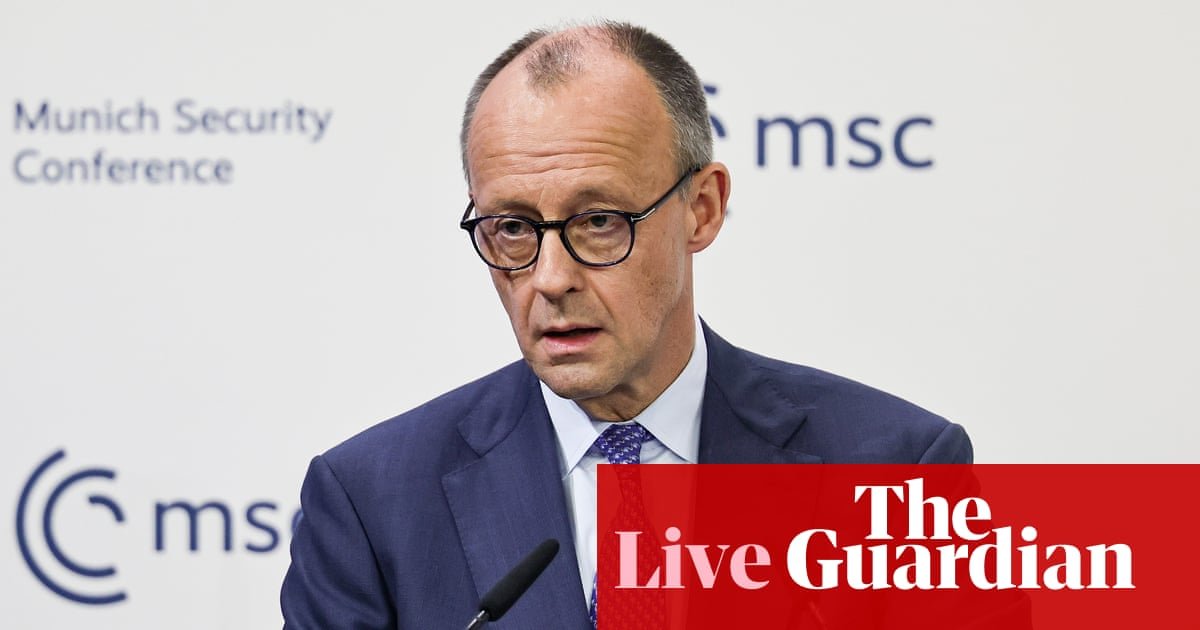
‘In era of great power rivalry, even US will not be powerful to go alone’, Merz says
Merz then turns to English and addresses the US delegation directly with a very powerful rebuke to the US.
He says that for generations, “the trust among allies, partners, and friends made Nato the strongest alliance of all times. “Europe knows deeply how precious this is,” he adds.
But he then warns:
In the era of great power rivalry, even the United States will not be powerful enough to go it alone.
He adds:
“Dear friends, being a part of Nato is not only Europe’s competitive advantage, it’s also the United States competitive advantage. So let’s repair and revive transatlantic trust together. We, the Europeans, are doing our part.”
Key events
-
US under Trump ‘returning world from the brink,’ Waltz insists as he rejects criticism
-
Trump will ‘do for UN what he’s done for Nato’ over last decade, US Waltz says
-
Merz’s speech will set tone of Munich talks on reshaping US relations – snap analysis
-
Merz’s Hungary comments will spark reaction – snap analysis
-
‘I don’t want to lose you,’ Germany’s Merz tells EU candidate countries
-
Russia not yet willing to talk seriously about Ukraine, Merz warns
-
Europe needs to resolve its ‘self-inflicted’ dependency on US to rebalance transatlantic relations
-
‘In era of great power rivalry, even US will not be powerful to go alone’, Merz says
-
Merz rebukes US criticism of Europe
-
‘If Europe is torn apart, we are torn apart,’ Merz talks on EU alliances
-
Merz calls for discussion on EU’s ‘mutual assistance’ clause
-
‘Big power politics’ in Europe is not an option for Germany, Merz says
-
‘Turn switch in our minds’ to make Europe superpower and face chaos of new world order, Merz says
-
World order as we know it ‘no longer exists,’ Germany’s Merz warns
-
MSC’s Ischinger puts leaders on spot as he lists pointed ‘serious’ questions
-
Munich Security Conference gets under way
-
‘Ladies and gentlemen, please take your seats now’
-
Nato’s Rutte expects Rubio to press Europeans to ‘take more leadership role’ in alliance
-
Zelenskyy welcomes first joint Ukrainian-Germany drone manufacturing line
-
Focus on Ukraine with Zelenskyy, foreign minister Sybiha attending side events
-
German chancellor Merz arrives ahead of his Munich speech
-
What does Europe’s future look like? – Q&A with Jon Henley
-
‘No shah, no mullah’ Iran protest outside Munich conference
-
US Rubio expected to speak with Danish, Greenlandic leaders on sidelines of Munich conference
-
Key events of the day
-
What to expect from 2026 Munich Security Conference? – video
-
Nato’s Rutte talks up ‘shift in mindset’ among leaders as he warns against falling for Russian propaganda
-
EU’s von der Leyen, Nato’s Rutte arrive for talks in Munich
-
We only see tip of iceberg as Munich becomes place to do business this weekend – snap analysis
-
Rubio lands at Munich airport ahead of key speech
-
Europeans ‘want honesty, want to know where we are going’, Rubio says ahead of Munich speech
-
Morning opening: World order ‘under destruction’
-
Opening Summary
EU’s Kallas slightly pushes back on that brag from Waltz, as she says that “it is very good that you want to reform the international order,” but points out that international organisations should be operating based on equality of states.
She also points out that, despite what Waltz claimed, Trump’s Board of Peace is only UN-backed in its narrower, Gaza-focused and time-limited mission.
Waltz kind of takes some of these points, but expresses his frustration with the lack of action as “the US has historically paid more than 180 countries combined” when it comes to the UN, and “I have to look at mechanics, doctors, nurses, firefighters … struggling to get their kids to school, and yet I have UN officials flying business class around the world.”
He says “no one was doing it” when it comes to reforming international bodies, but “talked about it endlessly, [with] strongly worded letters.”
He repeats his earlier line saying that “what I’m hearing outside forums like this, privately, is thank you for American leadership.”
US under Trump ‘returning world from the brink,’ Waltz insists as he rejects criticism
Waltz also completely rejects the suggestion that the world is “under destruction,” as the MSC report put it.
He says:
“I have to push back on the premise the world on the brink, which I think was the name of this, of this panel.
We are returning the world from the brink where it was 18 months ago, between Ukraine, Gaza, Iran …, Houthis shutting down the Suez canal, the refugee crisis in South America, and on and on.
So I just if you focus on the facts and the results, and if we have to reform multilateralism that hasn’t been reformed frankly in 80 years, then I think that should be welcomed by the world.”
He then amazingly pulls out a blue “Make UN great again” cap and gifts it to the moderator, The Economist’s editor in chief Zanny Minton Beddoes, who puts it safely on a side table.
(If no one wants it, I will take it, no worries, it’s the sort of political geeky thing that we wear at Europe Live HQ.)
Trump will ‘do for UN what he’s done for Nato’ over last decade, US Waltz says
US ambassador to UN Mike Waltz is addressing some of these points now.
He says that the UN needs to be put “on a diet” as “everyone agrees that reform was needed.”
“We are pushing hard for the UN to go back to basics, to that peacemaking and peacekeeping function that was core to its founding,” he says.
He says Trump will do to the UN what he is doing to Nato, pushing it to act and get its house in order.
Earlier, he also claimed that the US active posture in the western hemisphere – which he calls leadership and says was demonstrated in Venezuela – is being welcomed by a lot of countries.
Meanwhile, the EU’s foreign policy chief Kaja Kallas is now on the main stage, speaking alongside Saudi foreign minister, Colombian defence minister, and US’s UN ambassador.
She kind of shares Merz’s diagnosis that the world order as we know it is over, stating that it was built to prevent wars – and that’s clearly not working as we see around the world.
She says the one missing thing is accountability, as countries sign up to the UN charter, but face no real accountability for breaking the rules.
Merz’s speech will set tone of Munich talks on reshaping US relations – snap analysis
Jakub Krupa
in Munich
And overall, that was a very strong speech from Merz.
You can see why he wanted to open the conference to set the tone of discussions.
His direct appeal to reset transatlantic relationship, but setting healthy boundaries on respect (14:19, 14:21, 14:24) will probably dominate conversations in the next two days.
Merz’s Hungary comments will spark reaction – snap analysis

Jakub Krupa
in Munich
Merz’s comments on Hungary – first his swipe on Orbán’s visit to Moscow, and then on enlargement – will no doubt spark an angry reaction from Budapest.
Particularly the latter comment is very telling – a clear reference to the parliamentary election in April – as that’s probably as close as he can get to endorsing the Hungarian opposition.
Expect a strong response from Orbán, who will no doubt decry this as “foreign interference” in the Hungarian elections.
By the way, these comments, too, have a US angle: the US secretary of state, Marco Rubio, will be flying to Hungary from Munich.
Merz has made it quite clear he would not want the US to support or endorse Orbán as he thinks his actions run against Europe’s interest.
(The US president, Donald Trump, publicly backed Orbán just last week.)
‘I don’t want to lose you,’ Germany’s Merz tells EU candidate countries
Merz also goes into a discussion on the EU’s enlargement prospects, including Montenegro, whose president asked the question.
He admits that he is “feeling more and more uncomfortable” with the EU’s inability to make meaningful progress on the accession process.
“We have to reopen a new strategy, how to bring these countries closer to the European Union. I don’t want to lose you,” he says.
He acknowledges there is “an elephant in the room” as the process requires unanimity and Hungary continues to block any process, “but we have to overcome that.”
He appears to point to Hungarian parliamentary elections in April, saying that “after the election which will take place in April hopefully will be able to open the next chapters and bring you closer and closer to the EU.”
Russia not yet willing to talk seriously about Ukraine, Merz warns
In the Q&A, Merz gets asked about Russia.
He starts with a swipe on Hungary’s Viktor Orbán, telling a story of “a prime minister” from the EU who travelled to Moscow with no mandate, “achieved nothing,” and a week later Ukraine suffered some of “the heaviest attacks on civil infrastructure.”
“So if it makes sense to talk, we are willing to talk. But as you can see with the American side, Russia is not yet willing to talk seriously.”
He says the war will “only end when Russia is at least economically, and potentially militarily, exhausted.”
“We are approaching this time … but we are not yet there,” he says.
He adds:
“Russia has to give up this terrible war against Ukraine, and we have to do everything what is needed to bring them to the point where they see no further advantages for them to continue this terrible war.”
Merz also says that Europe can look to new trade and political partners globally, as “partnership is not an absolute term here; it doesn’t require full convergence of all values and interests.”
He names Canada, Japan, Turkey, India, Brazil, South Africa, the Gulf states and others.
He ends with a stark warning:
“We Germans know a world in which might makes right would be a dark place. Our country has gone down this path in the 20th century until the bitter and dreadful end.”
That’s why, he says, a different response is needed this time round.
He gets decent applause for his speech, as we go into the Q&A.
Europe needs to resolve its ‘self-inflicted’ dependency on US to rebalance transatlantic relations
Going back to German, Merz acknowledges some European errors too, as he says “no one forced us into this excessive dependency on the United States in which we have found ourselves recently.”
“This dependence was self inflicted, but we now cast off this state as soon as we can,” he says.
He says that will be through strengthening the European pillar of Nato.
He says:
“I suppose that we may have differing opinions more often than in the past, we will [have to] negotiate about the right way forward, and maybe have to argue about it.
But if we do this with new strength, new respect and self-respect, it will be to the benefit of both sides.”
He says the first signs of that showed up in a recent confrontation with the US over Greenland, as he backs Denmark’s Frederiksen and says she has “unlimited” European solidarity.
‘In era of great power rivalry, even US will not be powerful to go alone’, Merz says
Merz then turns to English and addresses the US delegation directly with a very powerful rebuke to the US.
He says that for generations, “the trust among allies, partners, and friends made Nato the strongest alliance of all times. “Europe knows deeply how precious this is,” he adds.
But he then warns:
In the era of great power rivalry, even the United States will not be powerful enough to go it alone.
He adds:
“Dear friends, being a part of Nato is not only Europe’s competitive advantage, it’s also the United States competitive advantage. So let’s repair and revive transatlantic trust together. We, the Europeans, are doing our part.”