

When the UEFA Champions League playoff round kicks off this week, there will be only one Premier League team competing. Newcastle United travel to Baku on Wednesday to take on the reigning Azerbaijani champs, Qarabag FK.
For almost everyone, reaching the playoff round is a success. The defending champs of both the Eredivisie and Serie A didn’t make the playoffs — they were eliminated from the league phase, as were two clubs from LaLiga, another Dutch club, a German club, and a French club. Both finalists from last year’s Champions League, Inter Milan and Paris Saint-Germain, didn’t do well enough in the league phase to skip straight ahead to the round of 16, so they are in the playoffs, and so too are Real Madrid, Atlético Madrid, Borussia Dortmund, and Juventus.
The purpose of the league phase is primarily to avoid elimination — unless you play in the Premier League.
Arsenal finished first in the league phase of the Champions League, winning eight of eight matches. Liverpool finished third, Tottenham Hotspur fourth, Chelsea sixth, and Manchester City eighth. Put another way, here’s where the eight clubs who earned a bye to the round of 16 come from:
• Germany: 1
• Spain: 1
• Portugal: 1
• England: 5
What’s even more striking: four of the five Premier League sides to finish in the top eight averaged more points per game in the Champions League than they do in their domestic league. Liverpool are sixth in England, third in Europe. Tottenham just fired their manager, they’re five points clear of the relegation places in England, and they finished fourth in the first stage of the tournament that theoretically features all of the best teams in the world.
It almost seems like the Champions League is easier for English teams than the Premier League — and that’s because it is. Here are the five main reasons.
– Premier League superlatives: 25 best/worst players at different skills
– Which clubs sign the best players for each position and why?
– Premier League’s 50 worst transfers of all time: Who is No. 1?
1. Premier League teams are richer than most of the teams in the Champions League
A couple of weeks ago, Deloitte released their Money League, which ranks the 30 richest soccer clubs in the world by revenue. Here’s how many clubs each country had on the list:
• Portugal: 1
• France: 1
• Turkey: 2
• Spain: 3
• Italy: 4
• Germany: 4
• England: 15
The Premier League has the richest broadcasting deals — by far — and it has more equitably distributed those revenues from top to bottom than any of the other Big Five leagues in Europe. The result is what you see above.
Now, revenue doesn’t have a one-to-one correlation with success — West Ham United are 20th in the Money League, for example — but on a broad scale and over a long enough time frame, the richest teams are going to be the best teams for obvious reasons.
2. Premier League teams have more talent than most of the teams in the Champions League
While reliable wage data is hard to come by, studies have shown that the estimated squad transfer values from Transfermarkt are a pretty solid proxy for how much a team pays its players. And how much a team pays its players is a pretty reliable proxy for how talented those players are, too.
Here’s how the top 25 teams in estimated market value distribute across the world’s soccer leagues:
• France: 1
• Portugal: 2
• Italy: 3
• Spain: 3
• Germany: 3
• England: 13
And as I wrote about last month when trying to explain the parity in the Premier League this season:
“Per analysis by Futi’s John Muller, the Big Six employed 29% of Transfermarkt’s estimated 300 most valuable players in the world back during the 2014-15 season, while just 7% were employed by other teams in England and 64% played elsewhere in Europe. Fast forward 10 years, and the Big Six’s share of the world’s best players has remained stable at 29%, but the rest of the Premier League’s hold on top talent has nearly tripled: up to 18%.“
Most of the best soccer players in the world are playing in the Premier League — and a lot of them aren’t playing in the Champions League.
3. Premier League teams are better than most of the teams in the Champions League
The Club Elo ratings have data that goes as far back as the 1920s, and the system is a simple historical record: two teams play, and rating points get awarded or subtracted based on the location of the match and the final score.
The current Elo rankings line up quite closely with the Transfermarkt estimations — even though the rankings don’t care about how much a team pays its players or how good we think they are. The purely result-based rankings divvy up the top 25 spots by league as such:
• France: 1
• Portugal: 2
• Spain: 3
• Germany: 3
• Italy: 4
• England: 12
While Elo is more of a backward-looking model, we can also use the betting markets to see how we might project team strength going forward. There are people whose financial livelihoods depend on estimating how good a given soccer team is compared to all of the other soccer teams, and the site PitchRank cross-references weekly betting odds to tell us what those people think.
Bayer Leverkusen are the eighth-highest seeded team among the 16 Champions League playoff clubs — right around average. At PitchRank, there are 11 Premier League teams rated higher than Leverkusen. If we take Benfica, the lowest-seeded team remaining in the Champions League, then there are 16 Premier League sides rated higher.
If there were a 36-team competition that included the best teams in the world, regardless of what league they play in, then close to half of them might come from the Premier League.
4. Premier League teams get easier schedules than all of the other Champions League teams
If we use the Club Elo ratings as a rough estimation of team strength, then here’s how the Premier League sides all rate out compared to everyone else in the Champions League:
• Arsenal: 1st
• Manchester City: 2nd
• Liverpool: 5th
• Chelsea: 8th
• Newcastle: 10th
• Tottenham: 16th
Per UEFA rules, teams from the same country can’t play each other in the league phase of the Champions League. So, Tottenham, for example, can’t draw five of the top 10 teams in the tournament. And sure enough: Opta’s strength-of-schedule rating says that Spurs had the easiest draw of any team. The same ratings say Liverpool had the fourth-easiest schedule, Chelsea the fifth easiest, and Man City the seventh easiest.
This doesn’t mean that Premier League teams can’t have tough draws — Arsenal’s was roughly average in difficulty, while Newcastle’s was among the five hardest — but instead it means that, on average, Premier League teams are going to have easier draws than teams from any other big league.
Of course, there’s a bit of circular logic at play here in terms of league-strength arguments: Premier League teams get easy schedules! But Premier League teams only have easy schedules because they don’t have to play other Premier League teams!
But this is why the top-eight numbers look so stark: Premier League teams are already way better, on average, than teams in any other league. And then the Premier League teams in the Champions League get to play against easier schedules, on average, than anyone else.
5. The Premier League is more physically demanding than the Champions League
Before Newcastle’s final league-phase match against PSG, Anthony Gordon was asked about the difference between playing in the Premier League and the Champions League.
“In the Champions League, teams are much more open,” he said. “They all try and play. It’s less transitional. In the Premier League, it’s become more physical than I’ve ever known it to be. It’s like a basketball game at times. It’s so relentless, physically. There’s not much control; it’s a running game. It’s about duels — who wins the duels wins the game.
“The Champions League is a bit more of an older style of game. It’s a bit more football-based. Teams come and try and play proper football. In the Premier League now you’re seeing a lot more throw-ins, set pieces. It’s become a lot slower and more set piece-based.”
There are two obvious ways we can support this with some evidence. The first is just by looking at the number of long throw-ins per game — both in the Champions League and in the Premier League this year and last year.
In the Premier League last season, per Gradient Sports data, the average game featured 1.22 long throws. And that’s basically what we’ve seen in the Champions League so far, about 1.23 per game. But in the Premier League this year? Teams are combining for 3.59 long throws per game. That’s a massive year-over-year change.
In a recent study on the set piece revolution in England, the analyst Michael Caley found that Premier League teams are launching 45% of their throw-ins from attacking areas into the box, while the average over the previous four seasons was just 17%.
Similarly, there is an increased emphasis on just fighting for balls in the air — or, as Gordon put it, duels. When he says teams in Europe “try and play football,” he means that they try to work the ball upfield through passing combinations on the ground. In the Premier League this year, much of what happens on the field is determined by who gets to a ball in the air first — or who gets to the ball after someone else gets to the ball in the air.
In England, teams are combining to attempt 110 aerial challenges per game this season. That’s up massively from last season’s numbers — 86.6 per game — and an even bigger departure from what we see in the Champions League: 77.3 per game.
Sure enough, there were four teams in the Champions League league phase with a set piece expected goal differential of plus-2 or better — and they all came from the Premier League. In fact, all six Premier League teams rated in the top 10 for set piece performance:
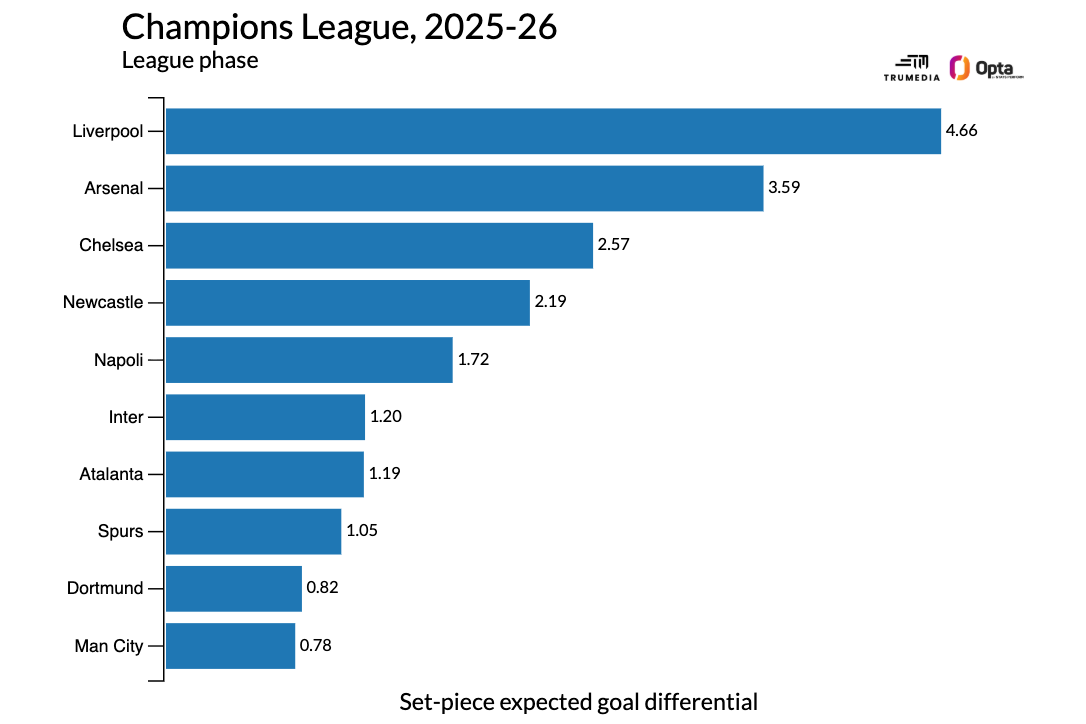
Perhaps there’s no better example of how different things are in the Premier League and the Champions League than the team that won the Premier League last season.
As you can see above, Liverpool were a dominant set piece force in the Champions League league phase. But in the Premier League, well, not so much:
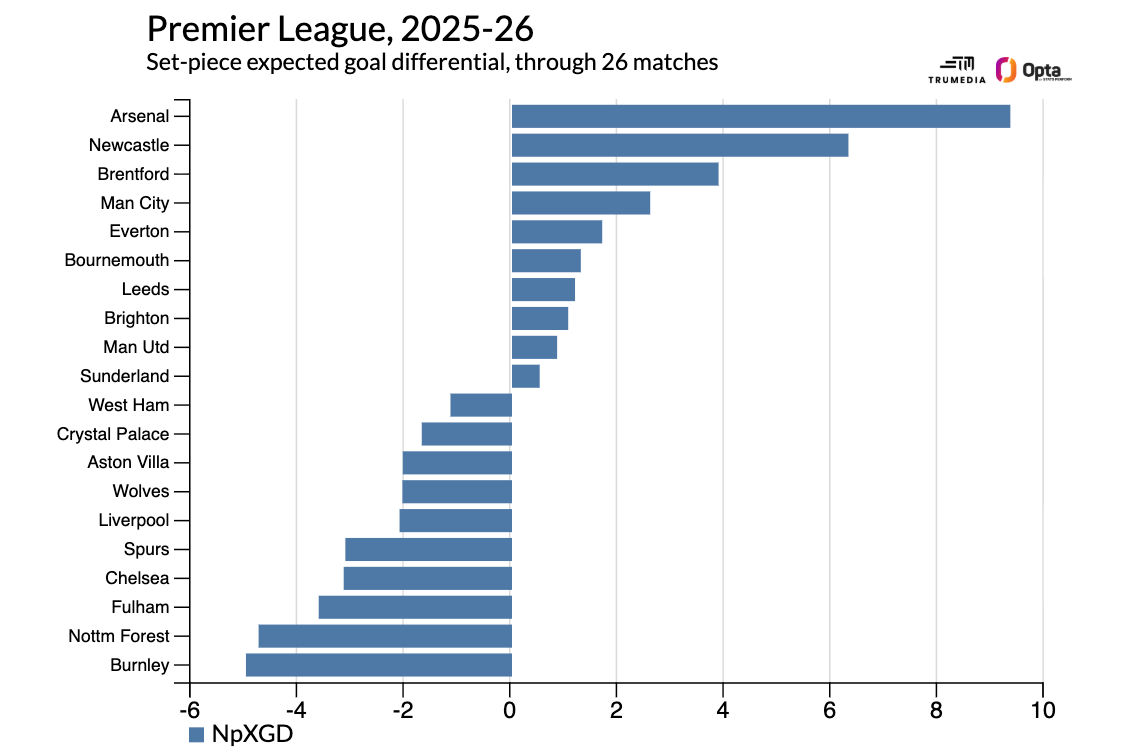
Put more simply, Liverpool led the Champions League with a plus-8 goal differential from set pieces — and they’re second-to-last in the Premier League with a minus-6 goal differential from set pieces. Not only can Liverpool dominate the less physical opponents of Europe with set pieces, but they’re also able to play the football that Gordon refers to on top of it. In England, they’re completing 86.3% of their passes outside of the attacking third, while in Europe that number is all the way up at 90%.
The financial and tactical trends of world soccer, then, have converged in a way that exacerbates an already large gap between the best teams in Europe’s best leagues.
While, in the past, it was true that Premier League teams were more physical than teams in other leagues, those other leagues had their own kind of technical, tactical and skill-based advantages. But now Premier League teams are pulling the most valuable strategic lever (set pieces) way more aggressively than the rest of the world, their players are much more physical, and since the teams have so much money now, their players are as skilled if not more skilled than the players in every other league, too. Throw in the rule-based quirk that prevents them from playing each other, and you get five Premier League teams automatically qualifying for the Round of 16.
And as for the one team stuck in the playoff? Remember that set piece chart from the Champions League, the one where Newcastle ranked fourth behind Liverpool, Arsenal, and Chelsea? If we expanded it out to all 36 teams in the league phase, Qarabag would be dead last.
You can guess what’s going to happen over their next two matches. It’ll probably look a lot like what happened over the first eight.