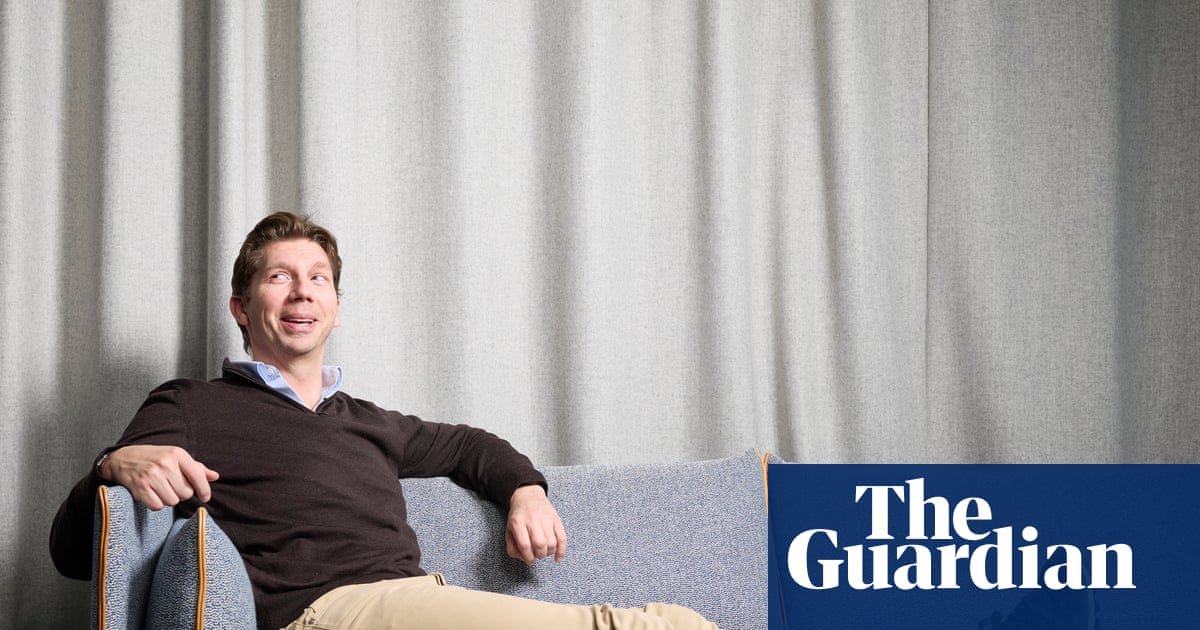

“I didn’t realise it until I saw the notice,” James Vowles says of last month’s third anniversary of his arrival at Williams as their team principal. On a rainy afternoon he smiles wryly in his London office. “I probably should have allowed myself a moment to reflect but you are too caught up in the work. That reality defines Formula One.”
Vowles is one of the most interesting men in F1 and not just because, as the director of strategy, he helped two of his past teams win nine constructors’ championships, including eight drivers’ titles. He will soon reveal a reflective side to his character and touch on the adversity he overcame at the outset of his career. His relish for a challenge in pure racing terms is already obvious because in 2022 he left Mercedes, who had finished second in the championship, for Williams, after they ended that season in 10th and last place.
At the end of 2025, after his third campaign, Williams rose to fifth with two podium finishes. Now, as a new season begins in Melbourne on Sunday, the ambitious and determined Vowles leads Williams into their next stage of development as they try to break into the top four teams on the grid.
But the 46-year-old knows that last season’s jump from ninth to fifth was “much, much easier” than his new aim. “In my experience there’s an exponential difficulty in going from fifth to fourth, fourth to second, second to first and then first to dominating. Each is a huge step forward.”
It’s extremely unlikely that Williams will crack the top four in the foreseeable future and this season started with a setback when their car was not ready for testing in Barcelona last month. Vowles is a disarming communicator and so when I ask him what happened he says: “It’s a really sensible question. I’ll even add to that – why weren’t you ready given you put so much effort last year into [preparing for] 2026? But the time it takes from developing an idea and making it tangible still takes longer at Williams than for a benchmark team. We’re changing our process, procedures and systems in order to get there. We stressed before that it was just about achievable but with some risk. If something went wrong, it would cause delay.”
That embarrassment occurred and Williams were the only one of 11 teams not to arrive in Barcelona for crucial testing as F1 adjusts to sweeping new regulations which mean that a car requires an entirely new chassis and engine. Williams had to settle for a week on the simulator at their Oxfordshire base before joining the rest of the F1 circus for the second round of testing in Bahrain.
Vowles stresses that the mood was lifted by the fact that Williams completed the third highest mileage in Bahrain. “Even though we missed Barcelona, we had the agility to turn it around. Doing a week’s worth of simulated work in the UK is not the same as on-track testing but it still meant we hit Bahrain in a way that we were doing the same mileage or more than pretty much any other team.”
Surely it was tricky when he had to break the news about Barcelona to everyone in the team – from the drivers to factory staff? “I spoke to them the same way I’m talking to you now. I prefer to be straight and say this is what happened and this is what we’re doing about it. Morale gets hurt if you have no plan of action or no awareness of how you got there.
“The drivers impressed me because there’s nothing like going on the track and learning from driving live. But Alex [Albon] immediately said: ‘I’m by your side. Tell me what I can do.’ Carlos [Sainz] said: ‘It’s disappointing but here’s what we’ll do in the meantime and we’ll be ready for Bahrain.’ It was very positive.”
Williams still start the season on the back foot. “What I have seen post-Bahrain is that we have to find performance,” Vowles concedes. “We’re not at the level we hoped to be which was to be annoying the top four teams. It’s a surprise because that was the ambition, the drive, the direction. But we have plans for Melbourne and beyond.
“In some cases we have to take bold decisions that will cost us in the short term, but provide for the long term. We’re still finding out where we have big problems. The bits that we have left are the real in-depth items that will take us time to find and fix.”
Williams have made huge progress under Vowles – so does he have the leeway to absorb short-term pain if it ensures long-term development? “100%. My board and I talk daily and there’s an incredible alignment. Even if we’re not where we want to be right now, we’ll keep taking the pain because it’s the right thing for the business.”
That willingness to confront difficulty defines Vowles. More than 25 years ago, without any contacts in Formula One, he began the long, hard slog into an elite and mysterious world. He wrote a clever letter to all 11 F1 teams to ask them how, as a recent graduate in mathematics and computer science, he could learn more about their business. Williams were one of two teams to answer him constructively and he immediately set about following their advice by taking a second degree, in engineering, while doing part-time work for various race teams.
Such commitment brought serious consequences. “I was £42,000 in debt which was massive in the 1990s and early 2000s,” Vowles says. “But I remember vividly being in Walsall, lying on a bed that the owner of a team gave me. That bed was part of the deal. I read until midnight and felt such contentment because I was doing everything that I loved. I wasn’t fearful for a second and never doubted myself.”
He broke into F1 with British American Racing in 2001 and remained with the team throughout its transition to Honda and then Brawn, the unsponsored outfit which shocked the sport by winning the constructors’ championship and the drivers’ title for Jenson Button. Vowles was Brawn’s inspirational race strategist in their only season in 2009.
How did he feel when trying to maintain team morale while his staff were uncertain if they would be paid? “Privileged. I was aware of the information before the team and I don’t think it’s difficult to hold morale when I was very confident we’d find a solution. Not a single person left in that period.”
His extraordinary work meant that he was snapped up by Mercedes in 2010. Vowles recalls: “It was then that [Mercedes team principal] Toto Wolff said: ‘You’re going to have to change a lot, but you can make it.’”
Wolff and Vowles share an exacting attention to detail with deep emotional intelligence. “It’s why Toto and I gel because we’re very similar. Those that have had some hardship realise that there are bigger things than a racing car. It doesn’t mean that I’m not driven to achieve but you understand bigger problems in life.”
In our 2024 interview Wolff discussed the adversity he faced as a boy and the subsequent depression which still stalks him. What adversity has Vowles overcome? “I’m not ready to tell the world yet. But they’re pretty tear-jerking throughout my youth and even later on in life. There were several.”
Would he feel vulnerable revealing those challenges? A visibly moved Vowles shakes his head. “No, it’s because it would bring in many other individuals. I want to make sure that they’re on the journey as well. Toto knows my entire story, as do a few key people. But I don’t want the world thinking anything more than I deserve my position. It’s nothing to do with the history behind it. There are some things in my experience that make you weaker or stronger. You can choose the direction and for me, 100%, each made me stronger. Painful but stronger.”
Vowles once said he “destroyed” a long-term relationship because he was so consumed by his work that he paid little attention to his partner – and that he often saw his family only at Christmas. “That’s all correct but those are not the bad moments. It’s much worse than that.”
Vowles is now happily married to the eminent surgeon Rachel Rolph and they have two children – a two-and-a-half-year-old daughter and eight-month-old son. “It’s such a pleasure to be with them but this morning I left before my daughter woke up and this evening I’ll get home when she’s already asleep. The good news is my son doesn’t sleep at all so I see him quite frequently.”
He grins before becoming more serious. “It’s the life choice I’ve made, and Rachel’s on board with it.”
How did he meet Rachel? “Online. I wish I could tell you some romantic story, but the problem I had, all the way back to 2018, was being recognised for [work], not who I really am underneath. That’s not what I was looking for. Rachel hadn’t a clue what Formula One was and that was perfect. That’s what I was looking for – someone who fell in love for me. She’s also absolutely brilliant. Oxford University, double first, UCL first. A very clever cookie, but driven, like I am. Terrible sense of humour, but everything else is good.”
Vowles laughs. But he will soon be on his way to Melbourne where, he admits, the gap between the top four teams and the rest of the field has widened. “Did I predict that 12 months ago? No. But I think there is enough strength in us now as a team that we’ll be able to close that down. It’ll take time but we will do it. That wasn’t the case three years ago.”
I ask him for his predictions for the big four. “Mercedes have done an outstanding job in every single area. It reminds me of the Mercedes when I was there and they will be the ones to beat. I’m impressed with McLaren because they brought updates right to the end, but still ended up in a situation where they developed a fairly good car fairly quickly. Ferrari have the ability to be in that top three region and I think Red Bull’s probably the fourth of four.”
McLaren, not too long ago, were ahead of just Williams at the foot of the constructors’ championship. Yet they have won back-to-back titles and, last year, Lando Norris became world champion for McLaren. “They are inspirational,” Vowles says, “and show that it’s entirely achievable. They had a better starting point than we did but what they’ve done is absolutely brilliant in winning multiple championships. It’s absolutely the case that I look up to them and use their journey to gently tap into my own.”
Williams are still a long way from such exalted heights but, considering Vowels’ outstanding achievement amid great difficulty, I ask one last question. Could Williams match McLaren and win a world championship in the next five years?
“It’s a reasonable time-frame,” Vowles says. He pauses and then, with real intent, he adds: “I’ll look you in the eyes and happily say, yes, we will.”