
www.theguardian.com
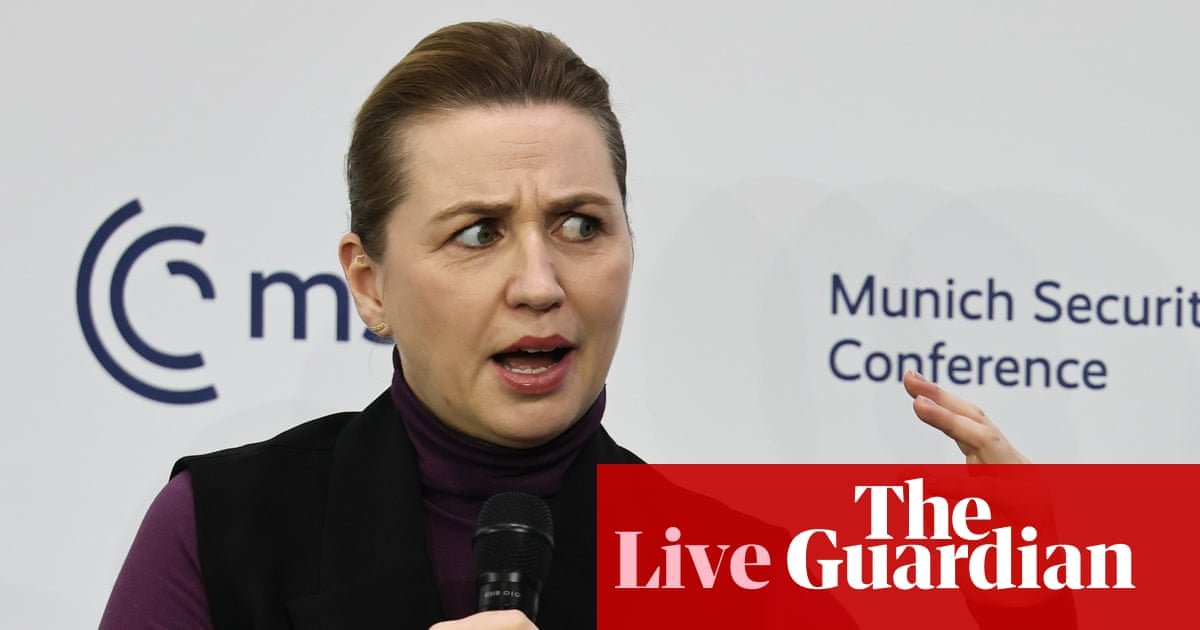
Pressure on Greenland is ‘totally unacceptable,’ Danish PM says
Frederiksen gets asked (again) if Trump is still interested in acquiring Greenland, and she confirms that “unfortunately, the desire is the same”.
She says “it is something we, of course, talk a lot about”, and she adds that “the pressure on Greenland is totally unacceptable”.
“We are talking about threats, but as you Jens-Frederik often say, the people of Greenland have never been threatened before by anyone, so that pressure is unacceptable,” she says.
She says Denmark is willing to work with the US, but “there are, of course, things that you cannot compromise on” including the respect of other state’s sovereignty and territorial integrity.
She says Denmark will not compromise on that, but suggests there are other points that can be discussed, including a revision of the 1951 defence agreement with the US, which she syas offers a “very easy” way for the US to “have a stronger footprint in Greenland”.
“We don’t think it’s over. We now have a working group, we will try to see if we can find a solution, and … we will do whatever we can, but of course there are red lines that will not be crossed,” she says.
Key events
-
Munich Security Conference day 2 – in pictures
-
Zelenskyy spoke with US envoys Witkoff, Kushner ahead of next round of talks
-
Zelenskyy spoke with Rubio discussing Russian attacks, diplomatic peace process
-
Europe needs to be able to respond to several crises simultaneously, Danish PM says
-
US threats on Greenland ‘damage’ Nato, Germany’s Pistorius says
-
‘Outrageous’ to see Greenlandic people feel unsafe because of ally’s behaviour, Greenlandic PM says
-
Pressure on Greenland is ‘totally unacceptable,’ Danish PM says
-
Packed room for early evening session on Arctic security
-
Zelenskyy ‘still in conflict with US about lot of final aspects of deal’ – Guardian’s Patrick Wintour on Ukraine talks
-
Russia changing its chief negotiator ahead of Geneva talks could be delaying tactic, Zelenskyy says
-
‘A conditional offer to cooperate with Europe’ – Guardian’s Patrick Wintour on EU-US relations after Rubio’s speech
-
Ending Ukraine war is ‘about who will crack first’, Poland’s Sikorski says
-
Poland’s Sikorski says Europe should get seat at Ukraine peace talks
-
‘Ball in Putin’s court’ to move on Ukraine talks, as he’s ‘dragging out’ talks, Pistorius says
-
‘Russia is driven by raw power, revisionism and egoism,’ Germany’s Pistorius warns
-
‘Nato is becoming more European so that it can remain transatlantic,’ Germany’s Pistorius says
-
Anything that questions transatlantic relationship or threaten allies undermines Nato, Frederiksen says in apparent rebuke to Trump
-
If Putin was serious about peace, he wouldn’t be attacking Ukraine’s energy infrastructure, Danish PM says
-
Imperialism and expansion is in Putin and Russia’s DNA, Stubb warns
-
US interest in taking over over Greenland not over, Danish PM says
-
Spain’s Sanchez says he opposes nuclear rearmament
-
Navalny’s poisoning shows ‘Putin is prepared to use chemical weapon against his own people,’ French minister warns
-
‘Now there is proof: Putin killed Alexei with chemical weapon,’ Navalnaya says
-
Extraordinary moment as UK confirms Navalny was poisoned by Russia two years on – snap analysis
-
Alexei Navalny was poisoned, UK says, blaming Russia for his death
-
Zelenskyy says he feels ‘little bit’ of US pressure, but there are limits to compromises he can offer
-
‘Illusion’ to think dividing Ukraine could prevent further war, Zelenskyy warns, drawing comparisons with 1938 Munich agreement
-
‘We can stand up to Russia,’ Zelenskyy urges leaders
-
‘None of our people chose to be heroes,’ Zelenskyy says
-
Russia loses 156 soldiers per kilometer of Ukraine, Zelenskyy says, as he takes swipe at Hungary’s Orbán
-
‘Our unity is best interceptor against Russia’s aggressive plans,’ Zelenskyy says
-
Iranian regime ‘must be stopped immediately,’ Zelenskyy says
-
Risk we face evolve and get worse as war goes on, Zelenskyy warns
-
Zelenskyy shows impact of Russian strikes on Ukraine
-
Rubio tells Europe US wants renewed alliance, but on Trump’s terms – analysis
-
Starmer hits pro-European tones in urgent speech on unity in uncertain times – snap analysis
-
Starmer says change in EU-UK relations is of ‘some urgency’ amid Ukraine war
-
Von der Leyen, Starmer welcome Rubio’s ‘reassuring’ speech
-
Starmer warns against ‘peddlers of easy answers’ on ‘extremes of left and right’
-
Starmer says UK needs look to ‘move closer’ to EU single market
-
Adversaries must know that in crisis, they could be confronted by combined nuclear strength, Macron says hinting at cooperation with France
-
Starmer hints at more cooperation to boost Europe’s defence
-
Starmer defends US alliance, but says Europe must take ‘primary responsibility’ for its defence to strengthen alliance, Starmer says
-
Munich conference applauds Starmer’s break with Brexit years Britain
-
‘Solidity of peace is softening,’ Starmer warns, as he points to ‘warning signs’ from Russia
-
Europe needs to ‘recaliberate’ its security strategy to respond to challenges, von der Leyen says
-
’10 years from Brexit, our futures are as bound as ever,’ von der Leyen says, as she calls for closer relations with UK
-
Europe going through ‘awakening’ in response to changing global landscape, von der Leyen says
-
Europe experiences ‘shock therapy’ on security as it wakes up from decades of lull, von der Leyen says
-
Von der Leyen calls for ‘more independent’ Europe in response to global crises
-
China hopes for settlement of Ukraine war, and Europe should be involved, Wang Yi says
-
Rubio love bombs Europe in style, while issuing stark warnings on substance, and it seemed to work – snap analysis
-
Talks ‘narrowed’ issues on Ukraine, but hardest questions remain unanswered for now, Rubio says
-
End of transatlantic era ‘not our goal nor our wish,’ Rubio says
-
US does not want allies to ‘rationalise broken status quo’ but face it and fix it, Rubio says
-
US not interested in being ‘caretakers of west’s managed decline’, Rubio says in urgent call to reject ‘decline’
-
UN, international bodies need to be urgently reformed as ‘we do not live in perfect world,’ Rubio says
-
Rubio takes aim at deindustrialisation, mass migration as risks to Europe
-
US ‘little direct and urgent in counsel,’ because ‘we care deeply,’ Rubio says
-
Rubio talks about postwar delusion mistakes made ‘together’ by Europe and US
-
Postwar triumph led to ‘dangerous delusion’ on end of history, Rubio says
-
Starmer’s Munich speech alongside EU’s von der Leyen part of rapidly evolving post-Brexit relations – snap analysis
-
Morning opening: What will the US say?
Munich Security Conference day 2 – in pictures
Zelenskyy spoke with US envoys Witkoff, Kushner ahead of next round of talks
As expected (18:00), Zelenskyy also spoke with US envoys Steve Witkoff and Jared Kushner, ahead of next week’s trilateral talks in Gevena.
In a short statement, he said they “discusses some developments following the meetings in Abu Dhabi,” but noted that “not everything can be disclosed over the phone.”
He also debriefed them on his meeting with Rubio, and thanked again for the US support for Ukraine.
Zelenskyy spoke with Rubio discussing Russian attacks, diplomatic peace process
More importantly, before coming to the dinner, Zelenskyy also met with the US secretary of state Marco Rubio.
In a brief statement on Telegram, the Ukrainian president said he informed Rubio “about the situation on the frontline, ongoing Russian attacks, and the consequences of the [Russian] attacks on the energy system”.
He said the pair also “discussed in detail the diplomatic process and trilateral meetings” including the upcoming meeting in Geneva next week.
It’s a pretty standard statement; let’s see what, if anything, we are going to get from the US side.
Jakub Krupa
in Munich
At the award event, Zelenskyy delivered a short, courteous speech, thanking several European leaders by first name for their support, and saying the Ukrainian people – on whose behalf he collected the award – will know them well and remember their support.
He’s not staying for the dinner, though – seems that he’s not done with the government business for tonight.

Jakub Krupa
in Munich
Ukraine’s Volodymyr Zelenskyy is at the Munich Residence, where he is due to receive the Ewald von Kleist Award for 2026 shortly.
In a brief statement to the press, standing alongside Bavaria’s Markus Söder and the MSC chair Wolfgang Ischinger as well as Poland’s prime minister Donald Tusk, he thanks Germany for its continuing support, saying it is now the largest donor of help to the wartorn country.
He also says that he was glad to visit the joint German-Ukrainian drone production facility yesterday, where he received the first produced drone. He says it is “already on the battlefield”.
Poland’s Tusk, who will deliver laudatory remarks at the ceremony later, said that “for Ukraine, there is no prize, even Nobel peace prize is not enough” for what it suffered during the Russian aggression.
He adds:
“Some say that Ukraine should be grateful for everything. The truth is, exactly the opposite: the rest of us should be grateful to you.”
Europe needs to be able to respond to several crises simultaneously, Danish PM says
In a pretty stark warning, Denmark’s Frederiksen says that Europe radically needs to step up its ability “to tackle more crises at the same time, because the old world is not coming back.”
“Forget about tackling one crisis [at a time]. We have to be able to tackle all of them at the same time,” she says.
“I’m sorry to say, I think it’s a part of the strategy from different parts of the world right now to throw as many conflicts as many discussions, as many tweets, as many messages as possible on the table at the same time, so everybody is running around like a chicken without head,” she says.
That’s why Europe needs to find out to approach these issues in a more strategic way, she says.
That concludes this panel.
US threats on Greenland ‘damage’ Nato, Germany’s Pistorius says
German defence minister Boris Pistorius joins in condemnations of US aggressive policy towards Greenland, as he says:
“[That] the biggest ally of the [Nato] alliance threatens and questions the territorial sovereignty and integrity of another ally – this is incredible and damages the alliance … which has been the most successful alliance in the history of mankind.”
‘Outrageous’ to see Greenlandic people feel unsafe because of ally’s behaviour, Greenlandic PM says
Greenlandic prime minister Nielsen says picks up the issue of pressure on the Greenlandic people.
“If I think about my people, we are so proud. We live in a harsh environment, we are resilient, we live in a land where nobody was able to live for many, many, many years. There’s a reason why we are the ones left,” he says to some laughs in the room.
He says there is a broader principle at stake here, about whether it is legitimate to make other territories “a puzzle in a big game” of global powers.
“What would prevent, if they did that, the US, Russia and China to split up the world in three big blocks? … it’s outrageous,” he says.
He picks up on Frederiksen’s comments:
“The paradox is that the Greenlandic people have never felt threatened, and 1771100531 the first time they feel unsafe for real, [it is] … with an ally talked about acquiring them, buying them and so on. It’s outrageous,” he says.
Pressure on Greenland is ‘totally unacceptable,’ Danish PM says
Frederiksen gets asked (again) if Trump is still interested in acquiring Greenland, and she confirms that “unfortunately, the desire is the same”.
She says “it is something we, of course, talk a lot about”, and she adds that “the pressure on Greenland is totally unacceptable”.
“We are talking about threats, but as you Jens-Frederik often say, the people of Greenland have never been threatened before by anyone, so that pressure is unacceptable,” she says.
She says Denmark is willing to work with the US, but “there are, of course, things that you cannot compromise on” including the respect of other state’s sovereignty and territorial integrity.
She says Denmark will not compromise on that, but suggests there are other points that can be discussed, including a revision of the 1951 defence agreement with the US, which she syas offers a “very easy” way for the US to “have a stronger footprint in Greenland”.
“We don’t think it’s over. We now have a working group, we will try to see if we can find a solution, and … we will do whatever we can, but of course there are red lines that will not be crossed,” she says.
Packed room for early evening session on Arctic security
Jakub Krupa
in Munich
In the meantime, an early evening panel on Arctic security is now under way over at the Bayerischer Hof – and the room is absolutely packed.
Denmark’s Mette Frederiksen says it’s not usual to see so much interest in the region’s security.
But she is “very satisfied that Nato is now working [on] security in the Arctic region in a more structured way,” and wants to see a “permanent presence” in the Arctic region, including in and around Greenland.
She says that as climate change progresses, there will be need to monitor more closely what Russia and China “will do around Greenland,” but stresses “we are not there yet” – in a clear rebuke to Trump’s (repeated) claims on this issue.
Greenlandic prime minister Jens-Frederik Nielsen strikes a similar tone, as he said that the talks about Russian and Chinese activity is premature.
“But we are not naive and we see the longer perspective when our routes in the north west and the northeast … [when] they they melt, there might be more traffic,” he says.
But he says allies are aligned, as Nato steps up its activity in the region through the new Arctic sentry mission.
Jakub Krupa
in Munich
I am now at the Munich Residence, where Ukraine’s Volodymyr Zelenskyy will receive the Munich Security Conference’s Ewald von Kleist Award for 2026 later tonight.
Poland’s prime minister Donald Tusk will deliver laudatory remarks.
Getting into this beautiful building – the seat of government and residence of the Bavarian dukes, electors and kings from 1508 to 1918, as its website says – requires passing several security checkpoints, but it’s only understandable given numerous other senior officials are also expected to be in attendance.
I will bring you the key lines from this evening’s speeches, but there is still some time to go before then.
Zelenskyy ‘still in conflict with US about lot of final aspects of deal’ – Guardian’s Patrick Wintour on Ukraine talks
Jakub Krupa
in Munich
Zelenskyy’s comments show how much still needs to be resolved before an agreement on ending the Russian invasion on Ukraine can be agreed.
Our diplomatic editor Patrick Wintour told me that it appears that “he is still in conflict with the Americans about a lot of the final aspects of the deal”.
Looking ahead to next week’s Geneva talks, Wintour said:
“I don’t think there’s going to be any short-term progress. I don’t think Vladimir Putin feels he’s under enough pressure at the moment.”
Russia changing its chief negotiator ahead of Geneva talks could be delaying tactic, Zelenskyy says
Separately, Ukraine’s Volodymyr Zelenskyy has given a press briefing on the margins of the main conference in the last hour.
He said he was due to meet with the US secretary of state Marco Rubio today, and hold a phone call with US envoys Steve Witkoff and Jared Kushner later tonight, with his chief negotiator and former defence minister Rustem Umerov talking to them “several times a day”. Zelenskyy also met with a delegation of US senators earlier today.
He stressed it was important to engage with the US through all possible channels to ensure no one can say that Ukrainians were stalling the talks.
Zelenskyy also spoke about his expectations for the Geneva negotiations next week, saying he was surprised to hear about Russia’s decision to change the head of its delegation after the first two rounds.
He said he saw this as a potential move to delay decisions, but counted on Americans to continue talks and not let Russia force them to reopen previously resolved issues.
He also confirmed he was still seeking a political commitment to allow Ukraine into the European Union, ideally by 2027, as part of the security guarantees.
“We have to be ready, to prepare everything … technically, Ukraine has to be ready in 2027, but the date of accession depends on all these dialogues with 27 member states,” he said.
Zelenskyy was also asked if he worried he could also get poisoned by Russia, after the earlier report about Alexei Navalny
“I can’t think about Vladimir Putin and his poison ambitions, if he has them. I try not to think about it; otherwise it’s all I think about,” the said.
‘A conditional offer to cooperate with Europe’ – Guardian’s Patrick Wintour on EU-US relations after Rubio’s speech
Jakub Krupa
in Munich
If you are looking for a quick summary of events so far, I caught up with our diplomatic editor Patrick Wintour who is also here at the Munich Security Conference to get his thoughts on what the events of the last 48 hours mean for the transatlantic relationship.
Here is his answer:
Poland’s Sikorski gets asked about what would Poland’s response be if Russia crossed the border and invaded its territory.
He gives this rather entertaining answer:
“We joined Nato for common defence.
If they cross the border, start killing Nato citizens, Polish citizens, we would expect the North Atlantic Council to meet and to activate the contingency plan, and after that, the plan is very easy: we win, they lose.”
And that ends this panel.
US Democratic senator Elissa Slotkin – also on the panel, in a rather awkward position of having to comment on the US policies she disagrees with – says she is “very concerned” about the 2026 US midterm elections in November.
“He [Trump] is telling us what he wants to do. He is laying it out for us, and is up to the Americans to believe him, right? That, just like in 2020, he said, If I don’t win, then it wasn’t a free and fair election. He is repeating the playbook now, threatening to put uniformed federal agents around polling locations. I mean, he’s telling us the playbook.”
She says “the question is what are we going to do as Americans to defend our democracy that we helped invent.”