
www.theguardian.com
Russia has carried out ‘hundreds of attacks’ against Ukrainians this week, says Zelenskyy
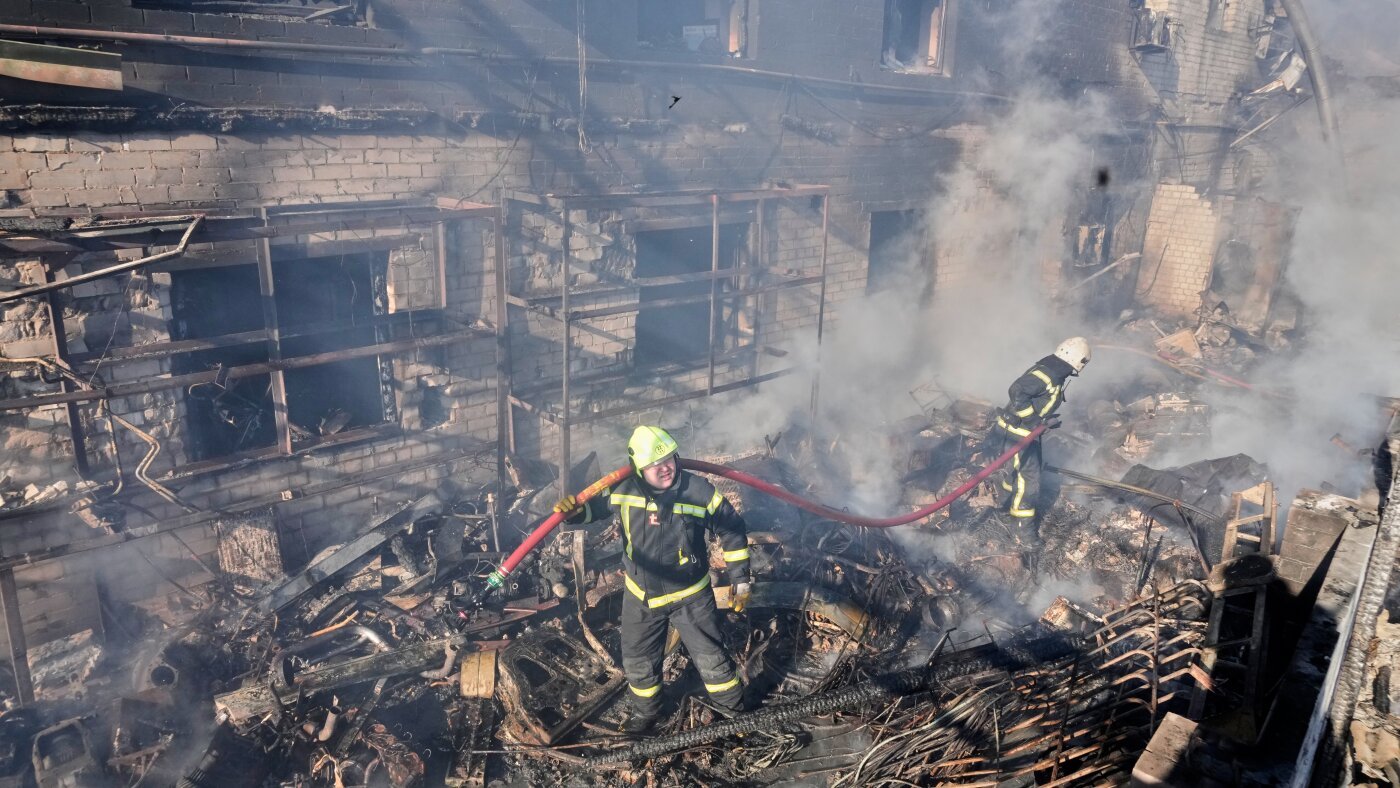
Ukrainian president Volodymyr Zelenskyy said that Russia has carried out “hundreds of attacks” against Ukrainians this week.
In a post on X on Sunday, Zelenskyy said various weapons, including about 1,200 guided aerial bombs, nearly 870 attack drones and more than 80 missilies of different types, had been used by Moscow.
He wrote:
Throughout this week, Russia has carried out hundreds of attacks against our people using various types of weapons: around 1,200 guided aerial bombs, nearly 870 attack drones, and over 80 missiles of different types.
Every Shahed drone and aerial bomb Russia uses contains components supplied in circumvention of sanctions. These weapons include more than 82,000 foreign components.
Every day, we work with our partners to ensure that decisions are made to provide life-saving support: air defense systems, investments in our defense production, and the strengthening of sanctions against Russia.
We continue our efforts to bring a just peace closer and ensure reliable security guarantees.”
Key events
Trump says Zelenskyy took money out of US under Biden ‘like candy from a baby’
Speaking to Fox News in an interview on Sunday, referring to Volodymyr Zelenskyy, the US president, Donald Trump, said the Ukrainian president had taken “money out of this country under Biden like candy from a baby” and described Zelenskky as not being “grateful”.
According to the PA news agency, Trump said:
It was like taking candy from a baby what he did.
He’s a smart guy and he’s a tough guy and he took money out of this country under Biden like candy from a baby. It was so easy.
I just don’t think he’s grateful.”
It comes after the White House suspended military aid and intelligence sharing with Kyiv in the after a confrontation between Trump and Zelensky at the end of February.
Countries cannot be “dragooned” into the “coalition of the willing” by the UK, a senior minister has suggested, reports the PA news agency.
Pat McFadden has said that nations have to “step forward themselves” if they want to be part of the group of nations willing to defend a peace deal in Ukraine. The UK and France have been leading efforts to get countries to commit to the peacekeeping coalition.
Not all the countries interested in the plan would necessarily provide troops to a peacekeeping force, it is understood, but they could contribute in other ways.
Asked on the BBC’s Sunday with Laura Kuenssberg how many countries have said they would be willing to take part, chancellor of the duchy of Lancaster McFadden said:
These discussions are going on, I think it’s important to have European countries involved in this.
The phrase ‘step up’ has been used quite a lot in recent weeks. The UK is stepping up.
The prime minister certainly stepped up and other countries have indicated that they want to do that.
Of course, coalition of the willing means people have to be up for it. They have to step forward themselves, they can’t be dragooned by us. But the UK and the prime minister is playing an important role in those discussions, and will continue to do that.”
On Saturday, Keir Starmer welcomed a commitment from Australia to “consider contributing” to the coalition after a phone call with Anthony Albanese.
Diplomatic efforts to secure a peace deal will continue this week, with talks due between the US and Ukraine in Saudi Arabia. The UK’s defence secretary, John Healey, is also expected to join discussions with his own counterparts.
Meanwhile, Donald Trump has said that Ukraine was able to take money out of the US “under Biden like candy from a baby”.
McFadden did not say whether it was “wrong” for the US to stop sharing satellite imagery but said that the US is trying to “bring the war to an end”.
Asked whether it was “wrong”, McFadden told Sky News’ Sunday Morning with Trevor Phillips:
Well, it’s their decision. It’s not something that we’ve done.
We support Ukraine, we continue to supply Ukraine with weapons, with intelligence support, with help on the cyber front, because we believe that they’re engaged in a really important fight for their country’s freedom and the capacity to decide their own future.”
Pushed further on whether the White House bears any responsibility for casualties in recent days in Ukraine, McFadden said:
With regard to the United States, what they’re trying to do is bring the war to an end. I think that aim is shared by everyone.
What we want to secure is not just an end to the fighting, but a peace that lasts, and that has underlined every action the prime minister has taken in recent weeks, because it will do nothing to secure Ukraine’s future if we have a temporary ceasefire, which lasts only as long as president Putin wants it to.”
EU president von der Leyen sees US as ‘allies’ despite ‘differences’
The EU still sees the United States as “allies” despite president Donald Trump’s verbal broadsides against the bloc, European Commission president Ursula von der Leyen said on Sunday, while stressing the need for Europe to “step up” on defence.
According to Reuters, when asked in a news conference if she saw a need to redefine Brussels’s approach to Washington, as it has already done towards Beijing, von der Leyen said the answer was “a clear no – it’s a completely different relationship that we have with the United States than we have with China”.
“Of course the US are allies,” she told reporters in Brussels. She added:
Yes, there are differences … but if you look at the common interests that we have, they always outweigh our differences.
We will have our differences. We have to sort them out.”
Trump has repeatedly threatened to slap tariffs on the EU, and his alignment with Russia on Ukraine has deeply unsettled European officials. The US leader has also thrown up questions about US security commitments to Europe under the Nato umbrella.
Von der Leyen, speaking in general terms, stated that in the world today “everything has become transactional”, reports Agence France-Presse (AFP).
There was a growing sense of urgency within the 27-nation EU because “something fundamental has shifted. Our European values – democracy, freedom, the rule of law – are under threat,” she said. “The world around us is changing at lightning speed. Geopolitical shifts are shaking alliances. Decade-old certainties are crumbling.”
When questioned specifically about the future of the transatlantic relationship with the US, von der Leyen said that, while an allied bond persisted, “this does not mean that the pattern that we had the last … 25 to 30 years … is still the right one”.
She stated that the changing tone of US ties was “a very strong wake-up call, and Europe’s moment now really (is) to step up in defence and giving ourselves the posture that we need”.
The bloc has already sent a clear signal it is moving in that direction, with an EU summit on Thursday agreeing to mobilise about €800bn ($860bn) to boost defence spending, which has long been urged by Washington, the EU chief said.
“We are allies, but this means that all allies have to take their responsibilities,” she said.
Von der Leyen added that, within the “next weeks”, she would call the bloc’s first-ever meeting of EU commissioners focused on “external and internal security, to energy, defence and research” and including cybersecurity, trade and “foreign interference”.
Russia has carried out ‘hundreds of attacks’ against Ukrainians this week, says Zelenskyy
Ukrainian president Volodymyr Zelenskyy said that Russia has carried out “hundreds of attacks” against Ukrainians this week.
In a post on X on Sunday, Zelenskyy said various weapons, including about 1,200 guided aerial bombs, nearly 870 attack drones and more than 80 missilies of different types, had been used by Moscow.
He wrote:
Throughout this week, Russia has carried out hundreds of attacks against our people using various types of weapons: around 1,200 guided aerial bombs, nearly 870 attack drones, and over 80 missiles of different types.
Every Shahed drone and aerial bomb Russia uses contains components supplied in circumvention of sanctions. These weapons include more than 82,000 foreign components.
Every day, we work with our partners to ensure that decisions are made to provide life-saving support: air defense systems, investments in our defense production, and the strengthening of sanctions against Russia.
We continue our efforts to bring a just peace closer and ensure reliable security guarantees.”
Russia’s Medvedev says Ukraine’s forces in Kursk are almost surrounded
Former Russian president Dmitry Medvedev said on Sunday that recent advances by Russian forces against Ukraine in the Kursk region meant that Kyiv’s soldiers were almost surrounded.
In a post on Telegram about the fighting in Kursk, Medvedev wrote:
The lid of the smoking cauldron is almost closed. The offensive continues.”
Poland says it may need alternative to Musk’s Starlink in Ukraine
Poland, which pays for Ukraine’s Starlink internet services, may seek an alternative if Elon Musk’s company proves to be “unreliable”, the foreign minister said on Sunday after the billionaire speculated about turning off access to the system.
Starlink provides crucial internet connectivity to Ukraine and its military. US negotiators pressing Kyiv for access to Ukraine’s critical minerals have raised the possibility of cutting the country’s access to the service, sources familiar with the matter told Reuters in February.
Musk, a high-profile figure in the administration of US president Donald Trump, said in a post on his X social media platform on Sunday, that Ukraine’s “entire frontline would collapse if I turned it (Starlink) off”. He said he was “sickened by … years of slaughter in a stalemate that Ukraine will inevitably lose”, reports Reuters.
The US government has already revoked some access to satellite imagery for Ukraine and paused intelligence sharing, piling pressure on Kyiv as Trump seeks a swift end to the war, now in its fourth year after Russia’s full-scale invasion in February 2022.
“Starlinks for Ukraine are paid for by the Polish digitisation ministry at the cost of about $50m per year,” Polish foreign minister Radosław Sikorski wrote on X. He added:
The ethics of threatening the victim of aggression apart, if SpaceX proves to be an unreliable provider we will be forced to look for other suppliers.”
Starlink’s parent company SpaceX did not immediately reply to an emailed request for comment outside normal business hours, said Reuters.
Shares in Franco-British satellite operator Eutelsat increased by as much as 650% during the week ending 7 March, due to speculation the company could replace Starlink in providing internet access to Ukraine. The shares pulled back on Friday to end the week up about 380%, reports Reuters.
Poland said in February that it would continue to cover Ukraine’s Starlink subscription despite sources saying the US could consider cutting it.
UK not considering reintroducing conscription, says minister
The UK government is not considering reintroducing conscription, a senior minister has said, as the Latvian president said European countries should consider the measure, reports the PA news agency.
Pat McFadden, chancellor of the duchy of Lancaster, pointed to the government’s increase in defence spending in recent weeks but said the prime minister, Keir Starmer, was not examining bringing in mandatory recruitment into the armed forces.
His comments came in response to the Latvian president Edgars Rinkēvičs, who said its continental neighbours should “absolutely” look into the policy.
Latvia reinstituted its compulsory conscription policy in April 2023, after having abolished it in 2007. It is mandatory for men between 18 and 27, and lasts 11 months.
Rinkēvičs was asked by Trevor Phillips on Sky News:
Do you think other European countries need to take similar kind of decisions that you’ve taken in terms of spending, in terms perhaps of conscription?”
Rinkēvičs replied:
Absolutely. Seeing what is happening in the world, the decision that we took – many other European countries need to follow that.
A lot of people are a little bit nervous. People are following the news. Of course, strong reassurances [are] one thing, but another thing is other European governments [have] to make sure that we all get stronger.”
Germany’s Merz open to talks about sharing UK and French nuclear weapons
German chancellor-in-waiting Friedrich Merz has said he would like talks with France and the UK about sharing their nuclear weapons, but not as a substitute for US nuclear protection of Europe, reports Reuters.
“Sharing nuclear weapons is an issue that we need to talk about …we have to become stronger together in nuclear deterrence,” he said in an interview on Deutschlandfunk radio on Sunday.
He added:
We should talk with both countries (France and Britain), always also from the perspective of supplementing the American nuclear shield, which we of course want to see maintained.”
Germany, due to its second world war past, has bound itself to non-nuclear defence in a number of international treaties but participates in Nato weapons-sharing arrangements, reports Reuters.
At their summit in Brussels on Thursday, EU leaders backed plans to spend more on defence amid fears that Russia, emboldened by its war in Ukraine, may attack an EU country next and that Europe can no longer rely on the US to come to its aid.
On Wednesday evening, the French president, Emmanuel Macron, addressed his nation warning that Russian aggression “knows no borders”. He said he would discuss with European partners extending French nuclear deterrence to other countries on the continent, but that the decision and control would always remain in the hands of the French president.
US secretary of state Marco Rubio will visit Saudi Arabia over 10-12 March for talks with Ukrainian counterparts, a statement from the US state department said.
Rubio will also have a meeting with Saudi Crown Prince Mohammed bin Salman Al Saud, the statement from spokesperson Tammy Bruce said.
Toby Helm
When he rose to his feet at prime minister’s questions on Wednesday, Keir Starmer delivered a stirring tribute to six British soldiers who lost their lives in Afghanistan 13 years ago.
He read out their names very deliberately, one by one. The House was silent. The prime minister then added a tribute to a 22-year-old British Royal Marine, also killed on 6 March, but in 2007 in Helmand province.
They were poignant moments, on what is normally a raucous and crudely partisan occasion in the political week. Across the wars in Afghanistan and Iraq, Starmer told MPs, 642 individuals had died “fighting for Britain alongside our allies”. Many more had been wounded. “We will never forget their bravery and their sacrifice,” Starmer said.
But the prime minister’s tributes were not just for the families of the lost soldiers. Nor were they just for British ears. They were also intended to be heard loud and clear in the US, inside Donald Trump’s administration, most notably by vice-president JD Vance, who the day before had appeared to disrespect British troops by saying that a US stake in Ukraine’s economy was a “better security guarantee than 20,000 troops from some random country that hasn’t fought a war in 30 or 40 years”.
Less than a week after Starmer’s tactile “love in” with Donald Trump in the White House, views on how to react to the new US administration had evolved, not just here, but across Europe.
Trump and Vance’s wild, erratic and at times insulting comments about European governments, had left politicians on this side of the Atlantic facing two dawning realities: first, that they had, somehow, to find ways to push back against Trump and Vance without stoking tensions to even more dangerous levels. And second that for the long-term they had to formulate a real plan for a world in which the US would no longer be the cornerstone of western security.
As one European diplomat put it: “It has become clear that Trump is not saying what he is saying just to shake us up, but he is saying it because he means it.”
Amid the turbulence, Ukrainian president Volodymyr Zelenskyy was in Brussels on Thursday attending an EU summit called to address the security crisis. To the sound of spontaneous clapping, EU leaders rose to their feet to shake his hand, offering backslaps and air kisses. While Zelensky was there Trump’s Ukraine envoy Keith Kellogg gave a brutal justification of his country’s decision to freeze military aid: “The best way I can describe it is sort of like hitting a mule with a two by four across the nose. You get their attention.”
You can read the full piece by Toby Helm, Jennifer Rankin in Brussels, Luke Harding in Kyiv and Kate Connolly in Berlin here:
The EU remains committed to entirely phasing out the supply of Russian gas, EU Commission president Ursula von der Leyen said on Sunday, reports Reuters.
“I commit very clearly to phasing out the Russian gas … this is an absolute must,” von der Leyen told reporters in Brussels. “We’ve been successful, but we always see of course that there are loopholes where we have to be careful and we have to work on.”
Here are some of the latest images coming in via the newswires:

Lloyd Green
Alexander Vindman entered the spotlight in 2019. As a US army lieutenant colonel detailed to the national security council, the Ukraine-born officer listened to a 25 July phone call between Donald Trump and Volodymyr Zelenskyy, Ukraine’s president. Vindman thought Trump’s demand, that Zelenskyy find dirt on the Bidens or lose US aid, crossed a line. He formally reported the call. In that moment, he helped trigger the first Trump impeachment.
In February 2022, Russia invaded Ukraine, a move by Vladimir Putin that Trump described as “genius” and “savvy” while calling Nato “dumb”. The swift victory contemplated by the Kremlin and Trump did not come. The war enters its fourth year.
Sadly, US support for Ukraine frays. Joe Biden is no longer in the White House, the Republicans control all three branches of government. On 28 February, an explosive Oval Office meeting between Trump, vice-president JD Vance and Zelenskyy left little doubt that US sympathies now lie with Moscow. Military and intelligence support has been suspended. Last week, the US awoke to learn that the Trump administration contemplates deporting 240,000 Ukrainian refugees.
Enter Vindman, again, with a book subtitled “How the West Deceived Itself About Russia and Betrayed Ukraine” and meant as an indictment of Washington’s stance toward the former Soviet republic over the last three decades and more, from George HW Bush onward.
“Starting with the fall of the Soviet Union at the end of 1991, extending throughout six US presidential administrations … US policymakers have bought fully into Russia’s vision of itself as the exceptionally and naturally dominant player in the post-Soviet space,” Vindman charges.

Léonie Chao-Fong
In just seven weeks since returning to the White House for a second term, Donald Trump has upended the US approach to the invasion of Ukraine and treated Russia increasingly not as an adversary, but an ally.
After tossing aside decades of alignment with Europe against Russian aggression, the US president suspended military assistance and intelligence to Kyiv and said on Friday he finds it “easier” to work with Russia than Ukraine.
You can find a timeline of the Trump administration’s moves towards an apparent new alliance at the link below: