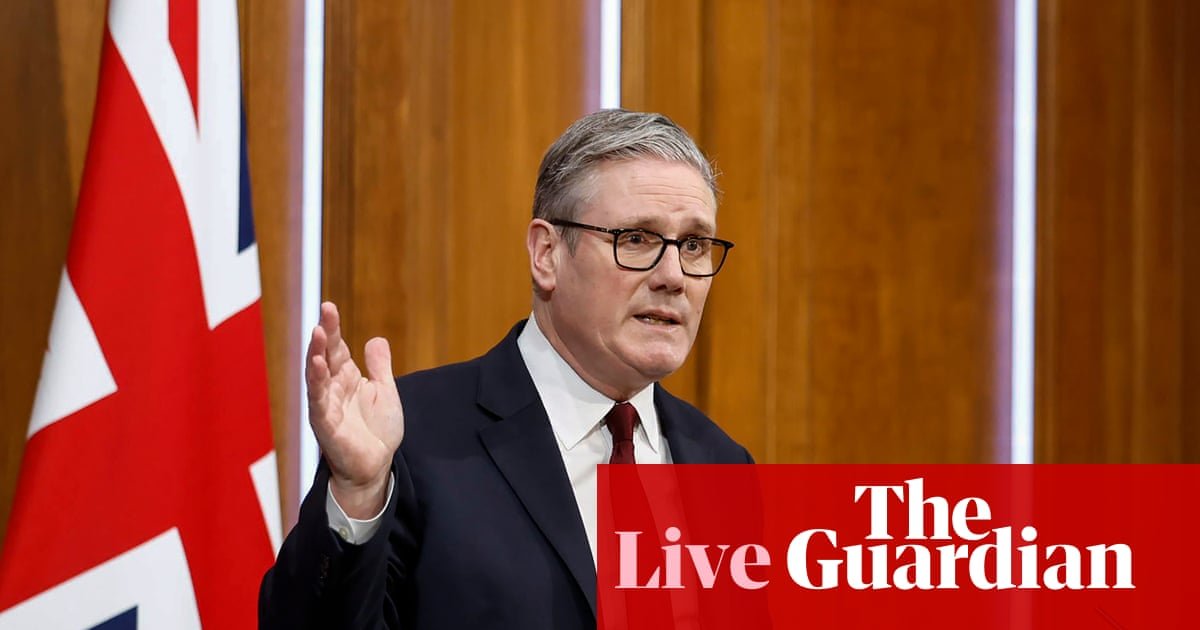

Starmer says UK ‘will not be drawn into wider war’ as he opens No 10 press conference
Keir Starmer is speaking at his press conference.
The war is entering its third week, he says.
He says he has been clear in his objectives.
First, we will protect our people in the region.
Second, while taking the necessary action to defend ourselves and our allies, we will not be drawn into the wider war.
And third, we will keep working towards a swift resolution that brings security and stability back to the region and stops the Iranian threat to its neighbours.
Key events
In the Commons Stephen Doughty, the Foreign Office minister, is responding to an urgent question from the Tories about the strait of Hormuz.
He starts by saying Yvette Cooper, the foreign secretary, will make a statement to MPs tomorrow, covering this and other matters relating to the Iran war, including her recent visit to the Gulf. He says she is currently speaking to Marco Rubio, the US secretary of state.
On the strait of Hormuz, Doughty says the Iranian attacks on tankers going through the strait of Hormuz have “put a fifth of the world’s oil supply effectively on hold”.
He says the UK government wants the strait to reopen as quickly as possible. But this is “not a simple task”, he says.
‘Drop in the ocean’ – SNP says heating oil grant for Scotland not enough
According to the figures in this House of Commons briefing, in 2021 49.5% of households in Northern Ireland used oil for central heating. The equivalent figure for England and Wales was 3.5%.
In Scotland the figure was closer to 5%. Heating oil is not as much as a priority issue there as it is in Northern Ireland (see 2.14pm), but proportionately there are more Scottish families affected by heating oil prices than English families, and opposition parties from Scotland have complained that the sum allocated for Scotland is not enough.
This is from Andrew Bowie, the shadow Scottish secretary.
This support will be welcome for rural households who’ve been ripped off by rogue heating oil suppliers, particularly in Scotland where a higher proportion of homes rely on heating oil.
But in Scotland this money cannot simply disappear into the black hole of the SNP government’s budget. SNP Ministers must guarantee every penny reaches rural households, and the Conservatives will hold them to account to make sure it does.
And this is from the SNP MSP Karen Adam.
Of course support is welcome, but this is a drop in the ocean and after talking it up all weekend, the level of cash delivered here is far from enough from the Labour UK government.
There is a fundamental injustice that people in energy rich Scotland find themselves fuel poor – that a nation with our offshore industry can find its people struggling to afford to fill the oil tank.
(The SNP is an opposition party at Westminster, but not at Holyrood, of course, where it is in government.)
Paul Johnson, the former head of the Institute for Fiscal Studies thinktank who now heads Queen’s College, Oxford, has said that he is worried about the precedent being set by today’s support package for households using heating oil.
In an interview with Times Radio, Johnson said that the amount of money involved in today’s announcement (£53m) was “tiny” in government terms. But he said that it would make it harder for the government to refuse much more expensive bailouts in future. He explained:
The thing that worries me is not so much can [they] find a few tens of millions – as I say a very small amount for this group of people – but what expectations does this set if other forms of power become more expensive?
So if gas prices start to rise, if electricity becomes significantly more expensive, people will say, well you help the people with the oil, but what about the 99% of us, or whatever it is, who don’t use heating oil, who use other forms of energy? Are you going to bail us out?
Now that then becomes staggeringly expensive.
So what worries me is not, is this very expensive? It’s the precedent it might be setting for the future.
The latest episode of the Guardian’s Politics Weekly podcast is out. It features Pippa Crerar and Kiran Stacey talking about how the government is responding to the Iran war, and its impact on the cost of living, and about the reset in UK-EU relations.
UK has been complicit in ‘one of greatest crimes of our time’, report from Corbyn’s Gaza Tribunal says
Jeremy Corbyn, the former Labour leader who is now the parliamentary leader for Your Party, has now published the full report from the tribunal he set up to investigate whether British support for Israel’s actions in Gaza was compatible with international law. As Patrick Wintour reports in his preview story, it says Britain failed in its duty to prevent genocide.
Here is an extract from the 112-page report.
At the time of writing, the official death toll in Gaza has exceeded 73,000, of whom at least 20,000 are children. These conservative figures do not include an untold number of people lost under the rubble. According to a study published in February 2026 by the Lancet Global Health medical journal, the death toll exceeded 75,000 more than a year ago – and the real figure could be closer to 186,000. At least 170,000 more have been injured; Gaza is now the home of the largest cohort of child amputees in the world. More than 80 percent of the buildings in Gaza have been either damaged or destroyed, including more than 90 percent of housing, 97 percent of schools, thirty-three of thirty-six hospitals, and all the universities. More than 95 percent of Gaza’s agricultural land has been rendered unusable. At least 1.9 million people across the Gaza Strip have been displaced. Right now, over a million Palestinians are living in squalid tents without electricity, running water or a sewage system.
The Gaza Tribunal provided a platform for survivors, witnesses and experts to uncover the devastating scope of Israel’s genocide in Gaza and the true scale of British involvement. The Tribunal serves as a historical repository of evidence of British complicity in one of the greatest crimes of our time, with the aim of mobilising global support in the pursuit of justice, liberation, freedom and peace for the people of Palestine.
Cumulatively, the testimony of survivors, lawyers, healthcare workers, journalists, international legal experts and academics established beyond doubt the following: the British government (both Conservative and Labour) has systematically failed to meet a range of legal obligations, most notably the obligation to prevent genocide. The evidence presented before the Tribunal reveals that the British government has been complicit in war crimes, crimes against humanity and genocide committed by Israel. Evidence further suggests that in some instances the British government has even been an active participant in these crimes. The violation of international law could implicate individual ministers and officials, including those who have authorised the continuation of economic ties with Israel, as well as the commission of arms trades, arm transfers and intelligence exchange.
There will be three urgent questions in the Commons today after 3.30pm, all tabled by the Conservatives: on reopening the strait of Hormuz, on the publication of the Peter Mandelson documents required by the humble address, and on changes to the GP contract for 2026/27.
After those, at some point after 5pm, Martin McCluskey, the energy minister, will make a statement about the measures announced today to help people with rising heating oil bills.
Stormont’s finance minister says size of £17m heating oil grant for Northern Ireland ‘extremely disappointing’
John O’Dowd, the finance minister in the Northern Ireland executive, has described the £17m allocated by Westminster to help people with rising heating oil bills in Northern Ireland as “extremely disappointing”, the BBC reports. O’Dowd, a Sinn Féin minister in the cross-party executive, said that because almost two thirds of homes in Northern Ireland have oil-fired central heating (the highest proportion by far in the UK), this amounted to just £35 per household. He said the executive would use the money to help the poorest families.
Lib Dems call for 3-month VAT holiday on heating oil and ‘proper price cap’
The Liberal Democrats have said the government plans announced today to help low-income families with rising heating oil bills (see 12.27pm) do not go far enough. In a statement, Ed Davey, the Lib Dem leader, said:
The prime minister’s offer on heating oil today will see too many households falling through the cracks and missing out on support.
Heating oil customers have been defenceless against skyrocketing global prices, caught in the crossfire of Russia’s war in Ukraine and now the volatility in the Middle East. Instead of temporary sticking plasters, we need an immediate three-month VAT holiday on heating oil and the introduction of a proper price cap. They deserve the same kinds of protections as those on the grid.
Zack Polanski challenges government to confirm US B-52 bombers taking off from UK not inflicting civilian casualties
Zack Polanski, the Green party leader, has urged the government to clarify what role is being played by US B-52 bombers operating from RAF Fairfield in Gloucestershire. In a statement today, he said:
B-52 bombers are taking off from RAF Fairfield, we are told, for defensive US action. The prime minister needs to explain clearly how planes loaded up with missiles, taking off from a UK base, are being used for defensive rather than offensive raids.
The fact is these planes are part of “Operation Epic Fury”, a dangerous war of choice by the US.
The British public do not support this war. So Keir Starmer must answer this: are B-52 bomb carriers taking off from UK soil being used to inflict civilian casualities or damage civilian infrastructure in Iran?
Reform UK would make coastline one of ‘most surveilled borders in world’ using AI and satellite tech, Zia Yusuf says
Robert Booth
Robert Booth is the Guardian’s UK technology editor.
Reform UK will turn Britain’s coastline into one of the most surveilled in the world using AI and satellite technology in a bid to halt illegal migration, the party’s home affairs spokesman, Zia Yusuf, has said.
Nigel Farage’s party has been briefed on a range of technologies to surveil maritime borders and has been examining the examples of Kuwait and Australia, Yusuf told the Guardian at a tech policy event in London.
Kuwait this year began using driverless boats called the Needlefish which reach speeds of 40mph and can stream surveillance information from cameras and radar back to shore. Australia is also using unmanned vessels for coastal surveillance. The Home Office previously contracted with the US AI weapons company Anduril to provide a handful of several AI-enabled maritime sentry towers in the south-east of England that algorithmically identify and track individuals or vessels of interest. Anduril supplies similar towers to the US border with Mexico.
Yusuf said it was it was “beyond insane” that small boat crossings were not all detected. He said:
If Reform wins the next general election and Nigel Farage is prime minister, Britain’s maritime borders will be among the most surveilled borders in the world …
It will be a focus for us to ensure that you should not be able to land on our shores on a boat and … evade any form of detection.
He said a Reform government could bolt AI tools onto radar systems to help coastguards and immigration officials detect suspicious activity.
There’s some novel technologies around using satellites that are very useful.
If you are using things like radar, [the AI is] trying to work out what is a dinghy with 90 people on it. That technology does exist. It’s not being deployed in any meaningful way at the moment.
Yusuf said Reform would make a more detailed announcement in the coming weeks. The surveillance plans come amid the rising use of AI powered facial recognition technology by police forces and private retailers to prevent shoplifting.
Tice says everyone should pay as little tax as policy, dismissing report exposing his ‘aggressive tax avoidance’ as ‘smear’

Peter Walker
Peter Walker is the Guardian’s senior political correspondent.
All Britons should do their best to pay the minimum tax they possibly can, Richard Tice, Reform UK’s deputy leader has argued, as he dismissed a newspaper investigation over his own tax affairs as a “smear”.
Tice, who was presenting a press conference todaytabout Reform’s claims to have saved large amounts of money in the English councils it runs, faced questions about a Sunday Times story which detailed of a tax scheme the paper said had helped him avoid nearly £600,000 in corporation tax.
According to the paper, Tice’s property company used a rare legal status known as a real estate investment trust, or Reit, to mean it paid no corporation tax between 2018 and 2021. Labour has urged HMRC to investigate the arrangements.
Asked whether he was right to minimise his tax payments in such a way, Tice told reporters that he rejected the idea people should “pay the absolute maximum tax possible”.
Asked if he would thus encourage everyone in the UK to pay as little tax as possible, if it was within legal limits, Tice replied: “Yes, of course, that’s what you should do.”
Tice also used a tweet by the Sunday Times journalist, Gabriel Pogrund, about the story, which confirmed that Tice had paid the necessary tax under the terms of the scheme, to claim the story about him had been misleading.
“Given that was his conclusion by the end of the afternoon, maybe he was just trying to smear me,” Tice said.
In fact, Pogrund’s tweet had re-stated what the story set out: that while Tice did not appear to have broken any laws or criminally underpaid tax, his use of a Reit scheme for his property company was a complex and unusual way to minimise tax.
Tice sought to characterise the story as an attempt by the media to argue that everyone had to pay the maximum tax possible. He said:
We have entered a new a new world where there is a moral imperative now in the United Kingdom that you shouldn’t just pay tax as required …
You must pay the maximum personal income tax rate on everything – that is a mad situation to be in. We have to call it out.
How many friends and family do you have who voluntarily choose to pay more tax than they are legally obliged to do, or who voluntarily decide, actually I’m going to pay the absolute maximum I can?
Tice argued that this “new moral code” would lead to people leaving the UK in large numbers.
Torsten Bell, a Treasury minister, has criticised Tice for “aggressive tax avoidance”. In posts on social media yesterday, prompted by the Tory peer Daniel Hannan claiming that what Tice did was equivalent to putting money in an ISA, Bell said:
Idea that what Tice was doing was remotely like opening an ISA is mad. His was VERY unusual behaviour associated with aggressive tax planning :
– UK resident using an offshore trust
– he claimed REIT status for a firm that never met the tests (because he owned it personally)
The contrast is clear:
– Parliament legislated specifically FOR people to be able to open ISAs.
– Parliament has legislated specifically AGAINST people engaging in aggressive tax avoidance like this (ie the General Anti-Abuse Rule)
It’s for Richard Tice & HMRC to conclude on the specific legal position here. But it’s already clear this was someone doing absolutely everything to avoid paying the tax that ordinary people contribute week in week out. Oh, and he was meant to be a public servant at the time.
Kemi Badenoch has accused Keir Starmer of not being fully involved in the US plan to reopen the strait of Hormuz. She told the Press Association this morning:
We have believed in freedom of navigation as a country for centuries, even this government has had targeted strikes at the Houthis in the Strait of Hormuz.
But what is the plan? We need to see the plan.
It is not clear the prime minister has been involved in the planning process. All of our allies seem to be worried about how slow he is.
I’m worried that he’s not deep enough in conversations with the US. But before we start sending ships out, we need to know what the plan is.
This comment implies that the US actually has a plan that Starmer should be more fully engaged with to get oil flowing past the strait of Hormuz. In fact, the evidence implies no such plan exists. In the US it has been reported that Trump and his team did not fully appreciate the risk of the strait being closed.