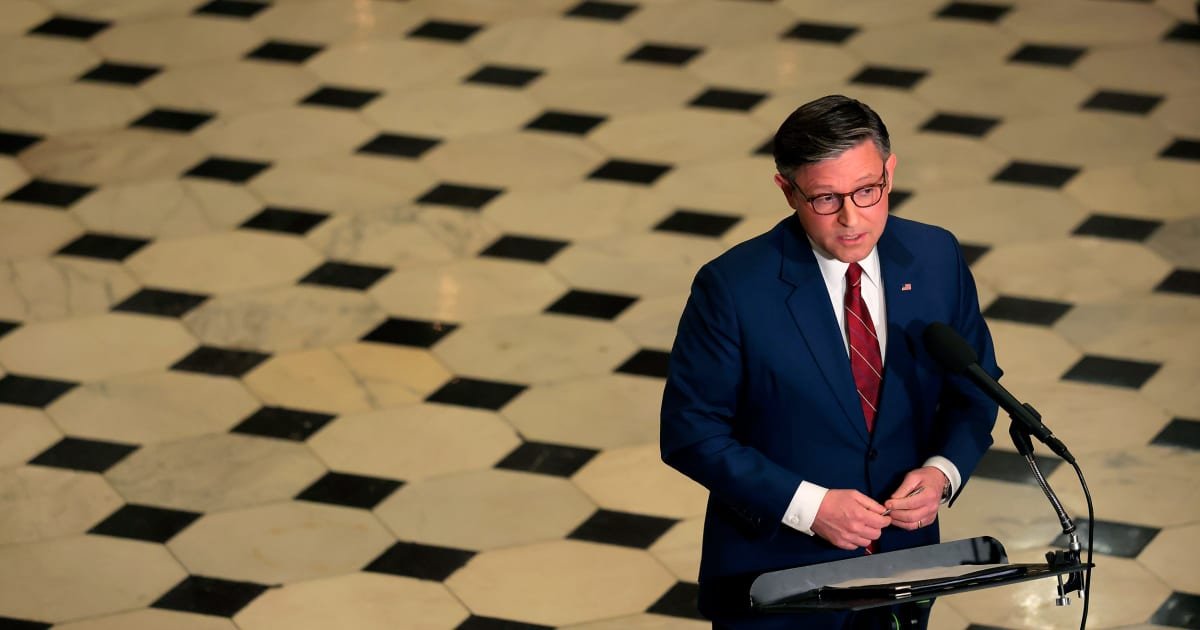

House Speaker Mike Johnson’s unenviable situation got a little worse on Wednesday when four centrist Republicans — all from competitive districts — joined a Democratic effort to force a vote on extending the Affordable Care Act’s expiring health insurance subsidies. Alongside last month’s successful push to override his obstructionism on the Epstein files, Wednesday’s revolt adds to a growing chorus of GOP lawmakers rejecting their leader’s bad political judgment.
Unlike his predecessor, Speaker Emerita Nancy Pelosi, Johnson’s tumultuous two years as speaker have been marred by embarrassing withdrawn votes and high-profile party defections. He ends 2025 in perhaps the worst political position of any speaker in recent memory, facing down both internal party dissent and the likelihood of an electoral bruising next year. Wednesday’s revolt isn’t a one-off — it’s a sign of things to come for a broken Republican Party.
Mike Johnson is weaker than ever — and his Republican colleagues know it.
Johnson’s time in the speaker’s chair coincided with some of the least productive terms of any Congress in history, including presiding over the longest-ever federal shutdown. That’s not just bad timing on Johnson’s part — it’s a direct result of his inability to lead the House at a moment when voters want swift action from their representatives. Johnson’s colleagues now worry his tone-deafness to the problems facing voters will ultimately cost them their jobs.
In other words, Johnson is weaker than ever — and his Republican colleagues know it.
The speaker’s latest face-plant came after Reps. Brian Fitzpatrick, Rob Bresnahan and Ryan Mackenzie of Pennsylvania, along with Rep. Mike Lawler of New York, lost patience with Johnson’s unwillingness to compromise on extending the ACA’s popular health care subsidies.
Health care affordability has been a burning issue for voters this year, and anger over the threat of skyrocketing health insurance premiums played a prominent role in Democrats’ resounding overperformance in Virginia’s and New Jersey’s statewide elections. Fitzpatrick, Lawler, Bresnahan and Mackenzie all represent districts Democrats aim to flip next year.
Support for the ACA, also known as Obamacare, has never been higher. A recent Gallup poll showed national approval of the program at a record 57%, driven by a surge in support from crucial independent voters. An NBC News Decision Desk poll published this week found that voters trust Democrats (57%) more than Republicans (43%) to address rising health insurance prices.
Americans are also sure of where to lay the blame if Congress fails to protect their health insurance premiums from shooting through the roof. A December survey by the nonpartisan Kaiser Family Foundation, or KFF, found that most ACA enrollees would blame President Donald Trump and congressional Republicans for failing to act. Fitzpatrick, Lawler, Bresnahan and Mackenzie all fear that Johnson is providing voters with the perfect image of a powerful GOP leader visibly failing to act.
“As I’ve stated many times before, the only policy that is worse than a clean three-year extension without any reforms, is a policy of complete expiration without any bridge,” Fitzpatrick said in a statement. “Unfortunately, it is House leadership themselves that have forced this outcome.”
But Johnson’s headaches didn’t start in December. Rep. Thomas Massie, R-Ky., and outgoing Rep. Marjorie Taylor Greene, R-Ga., have been vocal critics of Johnson’s refusal to release the thousands of documents connected to child sex trafficker Jeffrey Epstein. Johnson’s stonewalling led Massie to launch his own discharge petition, which ultimately forced the speaker’s hand.
Recommended
Johnson now looks so unreasonable that even his own colleagues would rather work with Democrats to solve Americans’ problems.
Even before the ultimately successful vote, plenty of Republicans openly fretted that Johnson’s myriad evasions made Republicans look like they had something to hide. Far from tempering voter fury over the GOP’s Epstein Files hypocrisy, Johnson only guaranteed the issue remained at the top of international headlines. For Republicans facing tough reelection races, Johnson’s spectacular failure to navigate the Epstein Files seriously damaged their confidence in his ability to read the political winds ahead of the 2026 midterms.
Those suspicions only worsened when Johnson dug in his heels against an ACA subsidy extension despite pleas to compromise from within his own caucus. Now that Republicans realize how easy it is to go around their leader, why would any of them feel obligated to tie themselves to Johnson’s bad political judgment? Instead of marching off the electoral cliff with Johnson, embattled Republicans such as Massie, Lawler and Fitzpatrick are turning to an unlikely collaborator: Democratic leader Hakeem Jeffries.
In contrast to Johnson’s reflexive and often wrong political gambits, Jeffiries’ decision to stand firm behind Democrats’ proposed three-year ACA subsidy extension now looks shrewd. Not only has Jeffries managed to get his proposal to a floor vote without surrendering key elements to Johnson, he succeeded by going over Johnson’s head with his own colleagues. Jeffries now puts Johnson in the nasty position of rejecting a bipartisan proposal supported by four Republican lawmakers who Johnson has consistently praised as serious policymakers. To borrow a popular MAGA phrase, Jeffries’ move feels a lot like 5D chess.
Johnson now looks so unreasonable that even his own colleagues would rather work with Democrats to solve Americans’ problems. The political ad practically writes itself. But Johnson isn’t done making missteps, because he’s now fallen back to the last-ditch play of a desperate man: delay, delay, delay.

In remarks to NBC News chief Capitol Hill correspondent Ryan Nobles, Lawler urged Johnson to bring Jeffries’ three-year ACA extension to a vote before the House leaves for its holiday break. That’s a direct challenge to Johnson, who earlier in the day refused to specify when the vote might take place. Lawler and his rebel Republicans don’t want voters to spend the long holiday break blaming Republicans for how much their health care costs are about to increase. Johnson, it seems, doesn’t share his colleagues’ concerns.
Increasingly ignored and overruled by his own caucus, Johnson will enter the new year with none of the influence and power traditionally associated with the speakership. If 2025 proved to be a headache for him, 2026 is shaping up to be a migraine. Effective leadership requires strong character and firm values. Johnson lacked both, and now his caucus is moving on without him.

Max Burns is a Democratic strategist and founder of Third Degree Strategies. Find him on X, @themaxburns.