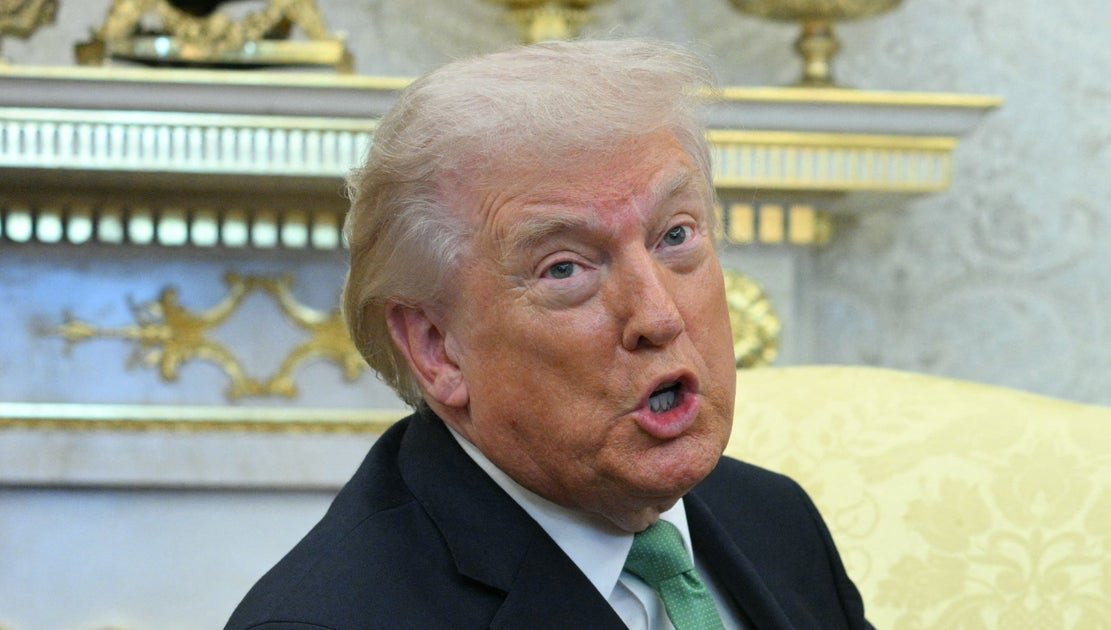

President Donald Trump recently unleashed a fiery rant about the U.S. Supreme Court over its February tariff ruling in a post published on his Truth Social platform late Sunday night. Legal and political science experts say the president’s post reveals quite a lot about how he views his relationship with the nation’s highest court.
Trump lashed out at the Supreme Court justices for striking down most of his sweeping “emergency” tariffs in a 6-3 decision last month, writing, “The decision that mattered most to me was TARIFFS!”
“The Court knew where I stood, how badly I wanted this Victory for our Country, and instead decided to, potentially, give away Trillions of Dollars to Countries and Companies who have been taking advantage of the United States for decades,” he wrote in the lengthy post, before saying he has already begun to explore other routes to impose tariffs.
Trump applauded the three conservative justices — Clarence Thomas, Brett Kavanaugh and Samuel Alito — who sided with him in the tariffs case. He criticized the other conservative justices for not deciding in his favor.
“The Democrats on the Court always ‘stick together,’ no matter how strong a case is put before them — There is rarely even a minor ‘waver.’ But Republicans do not do this,” he said.
“They openly disrespect the Presidents who nominate them to the highest position in the Land, a Justice of the United States Supreme Court, and go out of their way, with bad and wrongful rulings and intentions, to prove how ‘honest,’ ‘independent,’ and ‘legitimate’ they are,” he continued.
Chief Justice John Roberts, who was nominated to the Supreme Court by former President George W. Bush, wrote the majority opinion, with Justices Sonia Sotomayor, Elena Kagan, Neil Gorsuch, Amy Coney Barrett and Ketanji Brown Jackson concurring in part or in all.
Justices Gorsuch and Barrett were Trump’s appointees.
Despite the fact that the majority conservative court has frequently sided with Trump during his second administration, the president wrote on Truth Social that the court is “a weaponized and unjust Political Organization.” He also brought up his baseless claims of 2020 election fraud, complaining that the Supreme Court had previously rejected an attempt to overturn former President Joe Biden’s election victory.
Trump even admitted in his post that his remarks about the conservative justices who ruled against him “will cause me nothing but problems in the future,” but he said he felt it was his obligation to call out their “bad behavior.” Sunday night’s post follows Trump’s reaction in the immediate aftermath of the ruling.
Todd Belt, professor and political management program director at the Graduate School of Political Management at George Washington University, told HuffPost that Trump’s Truth Social post Sunday night shows that “Trump believes that the justices owe him their loyalty.”
“He further believes that they are trying to prove their independence by ruling against him,” he said. “Trump, of course, says nothing about the content of the ruling in any specific terms.”
JIM WATSON via Getty Images
Belt emphasized that this behavior is unusual for a sitting U.S. president.
“Most presidents try to maintain an air of separation between the judiciary and themselves,” he said. “Most don’t want to be accused of politicizing the judicial branch.”
“Trump, of course, does not care about how that looks,” he added.
Steven Lubet, an Edna B. and Ednyfed H. Williams Memorial professor of law emeritus at Northwestern University Pritzker School of Law, said that Trump beginning his post emphasizing that the tariffs decision mattered to him the most reflected a “characteristic sense of entitlement.”
“The court’s job is to get the ruling right, without regard to how much it matters to Trump,” Lubet told HuffPost, before he later pointed out that Trump has referred to his appointees as “my” judges or justices during his first term as president.
“I have never before heard a president express ownership of justices or judges, which is offensive both to the public and the justices themselves,” he said.
Lubet said Trump’s most recent attacks on Truth Social are “just one more example of Trump’s insistent expectation of partisanship from the Court.”
“Given his extraordinary win rate, especially on the shadow docket, it is an especially whining complaint,” he added.
The emergency docket, also referred to as the shadow docket, refers to the process in which emergency applications are filed for the Supreme Court to urgently rule on a case without it fully passing through the normal decision-making process.
The Supreme Court has sided with the Trump administration’s emergency applications 80% of the time in the past year, according to the Brennan Center for Justice, which states that “because of their urgent nature, shadow docket applications usually do not receive extensive briefing or oral arguments, and decisions are often issued with very limited, if any, explanation.”
Belt said that despite Trump suggesting that he expects loyalty from conservative justices, it’s just “not what the system is supposed to produce.”
“Judges should be free from political intrusion,” he said.
Overall, this is just another example of Trump violating the “norms of presidency,” Belt said.
“Most presidents attempt to maintain a wall between themselves and the Judicial branch so they don’t appear to be rigging the system,” he said. “Trump doesn’t care about that, and will always say that the system is rigged against him.”