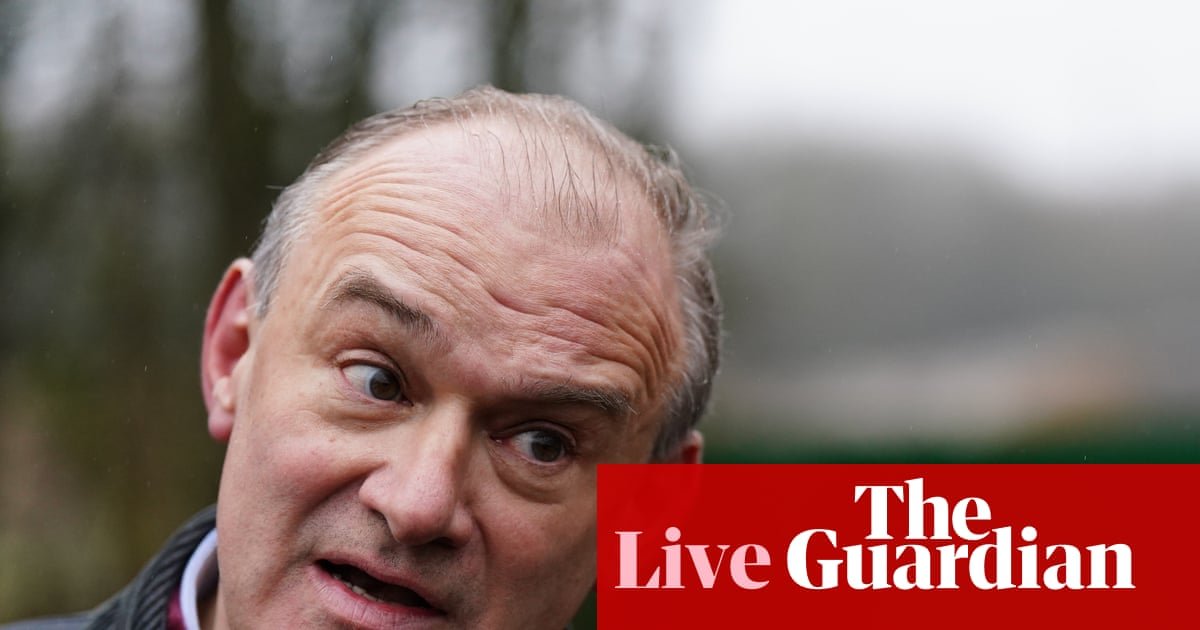

Ed Davey claims ‘historic victory’ for Lib Dems after tokenistic vote in favour of customs union with EU
Ed Davey, the Lib Dem leader, has issued this statement about his party’s narrow victory in the 10-minute rule bill vote on joining a customs union with the EU.
Today was a historic victory for the Liberal Democrats – winning a vote in parliament to finally end the economic nightmare of the Conservatives’ broken Brexit deal.
Across the country, people are crying out for real change and a solution to the cost-of-living crisis. A customs union with the EU is the single biggest step the government could take to grow our economy, put money back into people’s pockets and generate billions for our public services.
The prime minister must now listen to parliament and the public, drop his self-imposed red lines and finally go for proper growth through an ambitious trade deal with the EU.
The vote will have no practical impact, and so for Davey to call it “historic” is a bit of a stretch.
But that does not mean it is not interesting. I will post on what it does mean in a moment.
Key events
Welsh Labour government strikes deal with Plaid Cymru to allow its budget to pass
Steven Morris
Steven Morris is a Guardian reporter covering Wales.
The beleaguered Welsh Labour government has dodged a potential hazard after it reached a deal with Plaid Cymru that will allow its 2026/27 budget to pass.
Labour cannot pass the budget on its own because the party is two votes short of a majority in the Senedd – the Welsh parliament.
There had been concerns that there would be huge cuts to public services if the government could not get its budget through in January.
Plaid has agreed to back the budget in exchange for Labour agreeing that an extra £300m will be ploughed into health and social care and local government.
The first minister, Eluned Morgan, said:
This agreement shows the strength of the Senedd parties working together on shared priorities to deliver for Wales. Through this agreement we have secured the passage of the budget and prevented potentially catastrophic cuts to funding next year.
Rhun ap Iorwerth, leader of Plaid Cymru said:
Our aim in negotiating with the Welsh government was to look after public services, protect jobs and keep council tax bills as low as possible.
Plaid Cymru will not vote for the budget but will abstain to allow it to pass.
The Conservatives called it a “stitch up”.
But it doesn’t mean that Labour and Plaid are suddenly firm friends – the two parties will compete fiercely at next year’s Senedd elections, with polls suggesting Labour could plunge to third place behind bpth Plaid and Reform UK.
Peers table amendments to crime and policing bill for tougher regulation of ‘barely legal’ pornography

Amelia Gentleman
Amelia Gentleman is a senior Guardian reporter.
Leading campaigners for more effective regulation of pornography have proposed a series of measures aimed at tackling “barely legal” material, including content that features incest scenes or encourages child sexual abuse by casting young-looking adults dressed as children.
The Conservative peer Gabby Bertin, author of a review into regulating online pornography, and Beeban Kidron, crossbench peer and campaigner for child online safety, have laid down a series of amendments to the government’s crime and policing bill, aimed at removing loopholes that allow pornography sites to continue hosting violent and harmful material.
Aiming to ban pornography performed by adults mimicking children, sometimes filmed in children’s bedrooms surrounded by dolls, the peers propose extending the offence of making an indecent image of a child to include pornographic material depicting a child, where the role is played by an adult performer. This type of material would historically have been illegal to broadcast offline under British Board of Film Classification regulations, but is permitted online.
The campaigners also propose stricter control of incest pornography. “Research shows incest themed content is among the most recommended to new users on popular platforms – another stark example of algorithms encouraging harmful content,” Bertin said. The amendments would ensure that “protections we have enforced for decades offline apply in the digital age”, clarifying that “material which is too harmful to sell in a shop should not be freely available on a smartphone”, she said.
The campaigners want the legislation to add further controls on nudification technology, and suggest making it an offence to possess or obtain software designed to create nude images of another person without consent. They also propose the creation of a new body, separate to Ofcom but which would work alongside it, responsible for conducting spot checks on pornography platforms and able to act on reports of illegal content.
Citing research by the children’s commissioner, Bertin said “a 13-year-old boy is likely to have viewed incest, rape, and strangulation porn before his first kiss.” She went on:
“Online pornography is now so pervasive that it doesn’t just reflect sexual tastes – it shapes them. It normalises violence, distorts intimacy, grooms men and boys to perpetrate sexual violence, and has contributed to child-on-child sexual abuse,” she said, adding that the amendments “do not police private sexual behaviour” but “regulate an industry that has evaded scrutiny, and is causing demonstrable harm – normalising violence, sexualising children, and enabling abuse”.
How short debate on customs unions shows even Tories have given up defending Boris Johnson’s Brexit deal with EU
In theory this afternoon the Commons voted in favour of the principle of joining a customs union with the EU (on the casting vote of the deputy speaker). But they were not even voting for an actual bill. They were voting on allowing the Lib Dem MP Al Pinkerton to bring in his UK-EU customs union (duty to negotiate) bill. After the results of the vote were read out, MPs were told the second reading has been scheduled for Friday 16 January. But if you turn on up 16 January, you will be disappointed. No time will be set aside for a debate. It never is for these 10-minute rule bills. The legislation is not going anywhere, which is why the vote was tokenistic.
But that is not the same as pointless. For the Lib Dems, it is a straightforward, modest PR win. This is one of their big causes, and they won a vote.
Does it tell us anything meaningful about Labour thinking on the customs union? Not really. Government MPs are told to abstain in these votes, and only 13 of them decided to ignore expectations and to vote with the Lib Dems. That does not mean only 13 Labour MPs favour joining a customs union; it just means most backbenchers decided (rightly) this particular division did not matter.
There was a different backbench response two months ago when Labour MPs voted down a Nigel Farage 10-minute rule bill on withdrawing from the European convention on human rights. Initially Labour MPs were told to abstain, but the whips changed their minds and allowed backbenchers to vote against Farage after some of them kicked up a fuss. That was different, though. Voting against the leaving the ECHR was voting in line with government policy. And it was Farage.
What was interesting, though, was the response of the Conservatives. Only one MP is allowed to speak against a 10-minute rule motion, and the Tory whips chose Simon Hoare, one of the least Brexity MPs in the party. And at no point did he make any serious attempt to defend the Boris Johnson Brexit deal that the Liberal Democrats want to replace. Even Kemi Badenoch is now admitting that it has been a Covid/financial crash-style disaster. (See 11.45am.) Instead – in what was quite an effective speech – Hoare argued against CU membership on centrist, pragmatic grounds. (See 2.54pm.) If you associate the Lib Dems with moderation, he sounded more Lib Dem than Pinkerton.
This matters because it sounded like a dry run for the debate the nation will have when a governing party (probably Labour) does eventually decide to advocate joining a customs union with the EU. What we learned today is that it won’t be a re-run of the Brexit wars. Instead we’ll get a party run by a hard Brexiter defending the trade settlement left by a hard Brexiter using the arguments of old-style remainer. The Tories are adept at shapeshifting, and this is the latest example.
Ed Davey claims ‘historic victory’ for Lib Dems after tokenistic vote in favour of customs union with EU
Ed Davey, the Lib Dem leader, has issued this statement about his party’s narrow victory in the 10-minute rule bill vote on joining a customs union with the EU.
Today was a historic victory for the Liberal Democrats – winning a vote in parliament to finally end the economic nightmare of the Conservatives’ broken Brexit deal.
Across the country, people are crying out for real change and a solution to the cost-of-living crisis. A customs union with the EU is the single biggest step the government could take to grow our economy, put money back into people’s pockets and generate billions for our public services.
The prime minister must now listen to parliament and the public, drop his self-imposed red lines and finally go for proper growth through an ambitious trade deal with the EU.
The vote will have no practical impact, and so for Davey to call it “historic” is a bit of a stretch.
But that does not mean it is not interesting. I will post on what it does mean in a moment.
How MPs vote on 10-minute rule bill to join customs union with EU
The division lists are out in the vote on Al Pinkerton’s 10-minute rule bill.
Of the 100 MPs voting in favour, 65 were Lib Dems, 13 were Labour, 8 were SNP, 4 were independents, 4 were Plaid Cymru, 3 were Greens, 2 were SDLP and 1 was Alliance.
And of the 100 MPs voting against, 89 were Conservatives, 4 were Reform UK, 3 were Labour, 2 were independents, 1 was the TUV and 1 was UUP.
Customs union 10-minute rule bill passed by MPs – on casting vote of deputy speaker after 100 votes for, 100 against tie
We’ve just had the result of the vote on the Al Pinkerton’s 10-minute rule bill on joining an EU customs union. And, unusually, it was a tie – with 100 votes for, and 100 votes against.
As deputy speaker in the chair, Caroline Nokes had to cast the deciding vote.
She voted in favour – in line with precedent, which says that, when there is a tie, the speaker should vote to keep the matter being debated in play.
That means, technically, the Commons has given Pinkerton leave to bring in the bill, and a notional date has been set aside for its second reading.
But no time for it will be allocated on that date – and so it will not be debated further.
Kemi Badenoch has issued a statement about the appointment of Anne Longfield as chair of the grooming gangs inquiry. She is claiming that the Conservatives’ decision to publish their own draft terms of reference for an inquiry yesterday finally prompted the government into action.
Progress is welcome, but it shouldn’t have taken the Conservatives publishing a survivor-led terms of reference for the government to finally move.
Survivors have been waiting far too long for an inquiry they can trust. They have been ignored, dismissed and made to feel invisible. They are the ultimate judges of whether this inquiry is credible.
Tory MP Simon Hoare says in EU there is ‘neither interest in nor appetite for’ customs union with UK
Simon Hoare, a Conservative, is speaking now. He says he is opposing the bill.
He says some of his colleagues will be surprised to hear him argue against Pinkerton. Hoare was opposed to Brexit, and so he is an unusual choice for Tories wanting to take on the Lib Dems on this issue.
He starts by saying the Lib Dems were the first part to call for an in/out referendum on EU membership.
He says he voted to remain in the EU. But he accepted the result of the referendum, and he says he does not accept the Lib Dem argument that Brexit has led to Britain losing influence in the world.
He says the government is trying to develop good relations with the EU without being part of it. MPs should let that process continue, he says.
He says businesses need certainty. They have got that now; they are getting used to the new trading rules with the EU. Joining a customs union would introduce new uncertainty, he says.
He says the Pinkerton plan would also require the UK to renegotiate the post-Brexit trade deals it has already signed.
And he ends by saying the EU does not want to be in a customs union anyway. He says he has spoken to EU officials about this idea, “and there is neither interest in it nor appetite for it”, he says.
MPs are now voting on the 10-minute rule proposal.
UPDATE: Hoare said:
As somebody who voted to remain part of the European Union in the referendum, and campaigned strongly to do so, I accepted the result of the referendum …
[This motion] would fundamentally undermine the welcome and energetic efforts of His Majesty’s government to continue to grow that iterative process of a relationship with the European Union without being part of it. That endeavour deserves the united support of all members.
We all want to see an increase in trade with the European Union and we all want to see the uplifting benefit that that has to all of our citizens.
But the proposal before us in this bill is not the way to achieve it.
Pinkerton says joining a customs union with the EU would benefit the UK economically.
But it would be good for security, he says, strengthening Europe in the face of the threat from Russia.
And he quotes from the US national security strategy published last week, saying the suggestion that the US should be supporting nationalist parties is also a threat.
Lib Dem MP Al Pinkerton says Brexit has been ‘abject economic failure’ as he calls for customs union with EU
In the Commons the statement on the grooming gangs inquiry is over, and Al Pinkerton, the Lib Dem MP, is now introducing his 10-minute rule bill on joining a customs union with the EU.
Up and down the country, businesses know it, the public feel it and it’s time that this House find the courage to lift our whispered voices and admit it – Brexit has been an abject economic failure.
It’s choked business investment, shattered economic resilience, strangled trade, shrunk the economy and left every single one of us poorer.
The economic benefits of Brexit were only ever an illusory mirage.
UPDATE: Pinkerton said:
The most dishonest campaign in modern British political history promised that Brexit would save £350m a week.
Instead, Brexit is now costing this country £250m every single day. That is why we have the highest tax burden in 70 years. That is why families face sky-high bills. That is why we remain trapped in a cost-of-living crisis.
Hilary Benn says evidence of collusion between individual police officers and terrorists in Kenova report ‘shocking’
Britain’s security services allowed a top agent inside the IRA to commit murders and then impeded a police investigation into the affair, according to a damning official report. Rory Carroll has the story.
Speaking in the Commons during an urgent question on the report, Gavin Robinson, the DUP leader, said that peace in Northern Ireland was “won at a high price: and that members of the intelligence services, the armed forces and the RUC risked their lives to protect others.
He went on:
The Kenova report confirms that there was no evidence of high-level state collusion between loyalist paramilitaries and the army or security forces, and it recognises the vital role of intelligence work in saving lives.
Yet it remains absurd that Kenova could not even name Scappaticci, despite his identity having been public knowledge for years.
Hilary Benn, the Northern Ireland secretary, accepted that the report did not find “any evidence of high-level collusion between the security forces and loyalist paramilitaries”.
But he said it was “shocking” to learn about individual collusion.
I do notice what they said about individual collusion, and I use the word shocking deliberately, because to learn now that serving police officers and serving members of the armed forces were colluding with those who were murdering people.
Chris Philp, the shadow home secretary, responded to Mahmood for the opposition. He started with a graphic description of a grooming gang attacks. He recalled a 12-year-old vicitim who, when she was found by police, was arrested herself, instead of seeing her attackers arrested. And he described another gang-rape in detail, telling MPs that the rapist described his victim as “white trash” and said Asian girls would not do what she was doing.
Philp said one study by academics found 83% of perpetrators in the grooming gang cases they studied were of Muslim background, mainly of Pakistani heritage. He said these crimes were “deliberately covered up by those in authority who were more interested in supposed community relations”.
And he claimed that, when the Tory party called for an inquiry in January, Keir Starmer described this as a “far-right bandwagon”.
(See here for an explanation as to what Starmer actually said.)
In her response, Mahmood said that she agreed with Philp about the details of the attacks being horrific.
She said she hoped MPs would be able to adopt a non-partisan approach to this going ahead.