
Expedition 74 started the week training for the arrival of the next U.S. cargo mission and continuing to clean up after last week’s spacewalk. The orbital residents also practiced medical emergency procedures, unloaded supplies from a new Roscosmos resupply ship, and ensured the International Space Station remains in tip-top shape.
Northrop Grumman’s Cygnus XL cargo spacecraft is the next mission targeted to launch to the orbital outpost no earlier than Wednesday, April 8 at 8:49 a.m. EDT. NASA flight engineers Chris Williams and Jack Hathaway joined each other on Monday and reviewed the upcoming Cygnus XL mission, trained for its rendezvous procedures, and familiarized themselves with the equipment they will use to monitor Cygnus’ arrival. Cygnus will be delivering advanced microgravity research gear to study quantum physics, test stem cell therapies, promote astronaut health, and more.
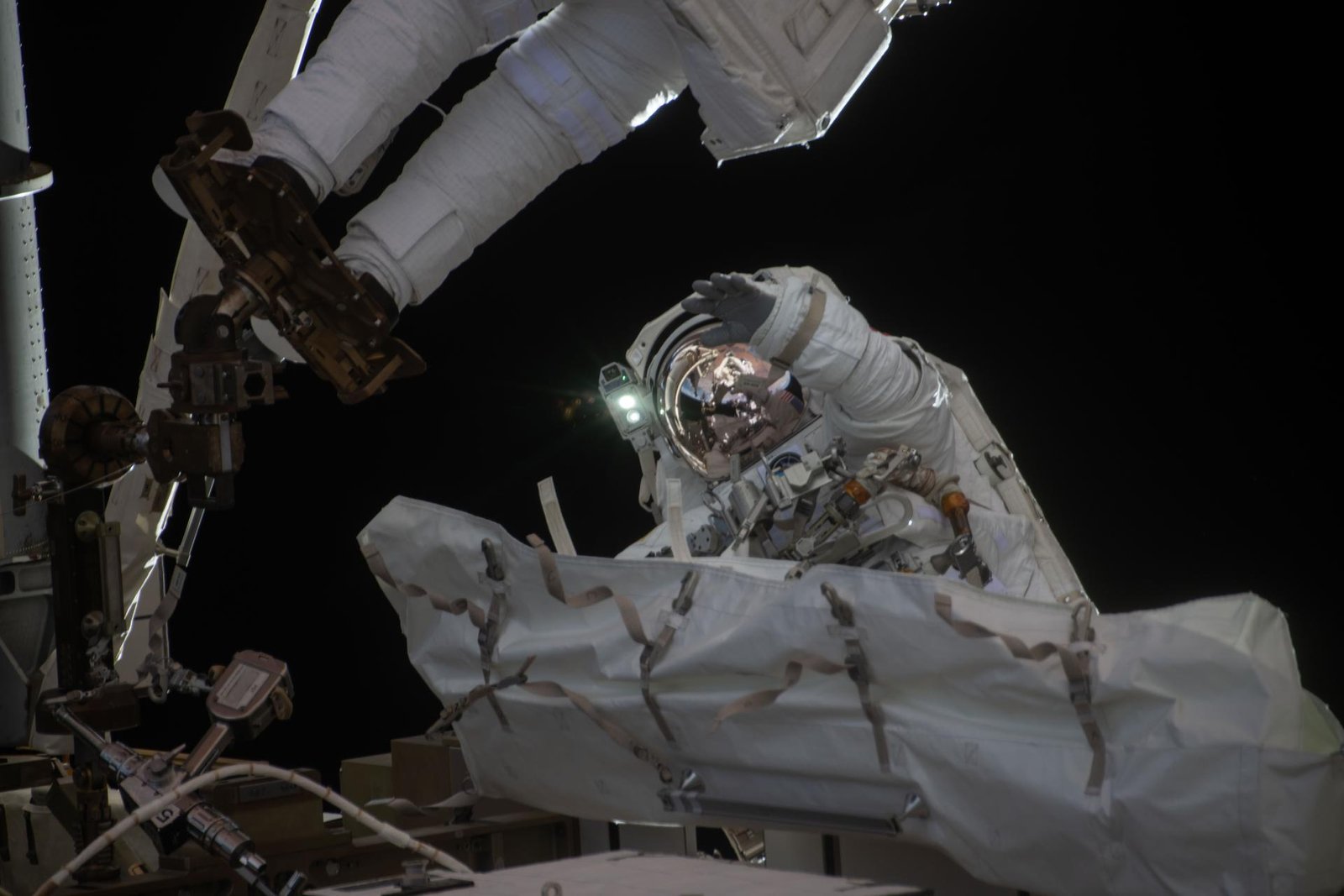
NASA flight engineer Jessica Meir spent Monday servicing a pair of spacesuits that she and Williams wore during a seven-hour and two-minute spacewalk on March 18. She first cleaned and flushed the suit’s water-cooling loops that regulate an astronaut’s body temperature in the extreme environment of space. Next, she emptied and refilled the suit’s water system to remove gas bubbles and contaminants keeping its life‑support system healthy and reliable.
Flight engineer Sophie Adenot of ESA (European Space Agency) focused on a variety scientific experiments throughout Monday that explore different microgravity phenomena. Adenot first collected data and powered down hardware from an investigation that is studying ways to quickly download large amounts of data from space. Next, she swapped research samples inside a science freezer then inventoried and trashed used biomedical gear that examined the crew’s cardiovascular health. Adenot finally recorded a video message for students on Earth describing why conducting science in space is important.
All four astronauts also joined Roscosmos cosmonaut Andrey Fedyaev for a mid-afternoon emergency drill reviewing how to use and where to locate medical hardware. The five crewmates also practiced CPR, or cardiopulmonary resuscitation, and discussed individual roles and responsibilities in the event of a medical situation in low Earth orbit.
Fedyaev began his shift replacing smoke detectors and gas masks inside the Nauka science module. The two-time station visitor wrapped up his duties in the orbital outpost’s Roscosmos segment and checked the quality of drinking water.
Station commander Sergey Kud-Sverchkov serviced electrical components and checked the operation of the Elektron oxygen generator inside the Zvezda service module. Afterward, Kud-Sverchkov studied using artificial intelligence tools to improve crew operations and communications with mission controllers. Roscosmos flight engineer Sergei Mikaev spent his day offloading some of the three tons of food, fuel, and supplies packed inside the Progress 94 resupply ship that docked to the Poisk module on March 24.
Learn more about station activities by following the space station blog, @space_station on X, as well as the ISS Facebook and ISS Instagram accounts.
Get the latest from NASA delivered every week. Subscribe here.