
Did you drink ice water today? If you did, that was “not very Chinese of you”, according to Sherry Zhu, a 23-year-old Chinese American creator based in New Jersey. If you were really serious about “becoming Chinese”, you would be sipping hot water every day, she warned in a TikTok video with millions of views. “I really do feel like, digestion-wise, a lot better when I’m drinking hot water,” she later explained to GQ.
Zhu’s guidance is taken from traditional Chinese medicine (TCM), a health system that dates back 5,000 years and offers a holistic approach to treating symptoms – physically, emotionally and spiritually. Other creators of Chinese descent have their own TCM hacks: keep your feet warm and your periods will be more bearable. Drink tea made with goji berries, jujubes and ginger as a cure-all. Move your body every day to promote the flow of qi, or internal energy. “Do my Chinese baddie routine with me,” they caption their videos in half-authoritative, half-joking tones. “Advice from your Chinese big sister.”
Creators of non-Asian descent have been eager to prove they can follow directions. “Day one of being Chinese,” they post, showing off pots of boiled apple or savory breakfasts (both better for digestion, according to TCM). “It has come to my attention that we are all suddenly Chinese,” a white health influencer declared as she bumbled through her first congee recipe.
Why are Americans drawn to Chinese wellness tips – and expressing interest in “becoming Chinese” or “being in a very Chinese time” of their lives? It’s tied to what some have dubbed “Chinamaxxing”, a recent trend begun by Americans, involving the sharing of memes and videos in praise of Chinese culture.
Ironically, Chinamaxxing was a response to Donald Trump’s economic targeting of the country in 2025. Between a bungled trade war, flip-flopping restrictions on Chinese tech and a fudged TikTok ban, the US began to look feeble in comparison with its geopolitical rival. With a sense of subversiveness, young Americans started professing fascination with Chinese culture. Influencers such as iShowSpeed and Hasan Piker traveled to China to produce content, while the US market embraced Chinese cultural goods, such as Labubus, the video game Black Myth: Wukong and Adidas’s athleisure spin on the Tang suit.
“When Americans don’t trust their own institutions, media or political class, they become more willing to look for alternative reference points,” said Shaoyu Yuan, a scholar of international relations and New York University professor, over email. “Public debates over TikTok, sanctions, export controls and ‘decoupling’ signal to many young people that China is central to the future, whether they like it or not.”
Chinamaxxing also comes as Americans’ trust in the US healthcare system plummets. RFK Jr has consistently cast doubt on vaccines and other conventional medicine while promoting “alternative” remedies, boosting a wellness market that repackages holistic care from other cultures as luxury treatments. Chinese medicine might seem less “woo-woo” than it once did now that the US health secretary is bragging about drinking cod liver oil.
Lulu Ge, the founder of Elix, a wellness brand that uses Chinese traditional herbs, makes videos about “avoiding ice drinks and eating warm foods” to promote her brand. For years her content invited mostly skeptical reactions. But when the Chinamaxxing trend exploded in January, she was taken aback by a sudden surge of engagement: Elix’s social channels saw a 250% increase in organic impressions and its site traffic went up 40% week over week.
Ge believes that Americans have become skeptical of the US healthcare system’s emphasis on physician “specialization”, which can frustrate people seeking treatment for multi-symptom conditions such as long Covid and autoimmune disorders. “Chinese medicine really works best for chronic conditions where it touches upon multiple different health systems,” she said. (Numerous studies have shown that TCM therapies can play an important role in the prevention and treatment of chronic diseases – but they can’t be claimed as a cure for all conditions.)
Promoting TCM is part of China’s soft power strategy. In 2016, Xi Jinping’s administration issued a directive for China to “actively introduce TCM to the rest of the world”. In 2020, China’s National Health Commission advised the use of TCM in its recommended treatment of Covid-19 and drafted a plan to punish anyone who “slanders” the medicine system (which it later abandoned). The government also sent TCM doctors and supplies to countries that were particularly affected by the virus’s spread, such as Uzbekistan and Italy. By 2022 the global TCM market had a valuation of $400bn.
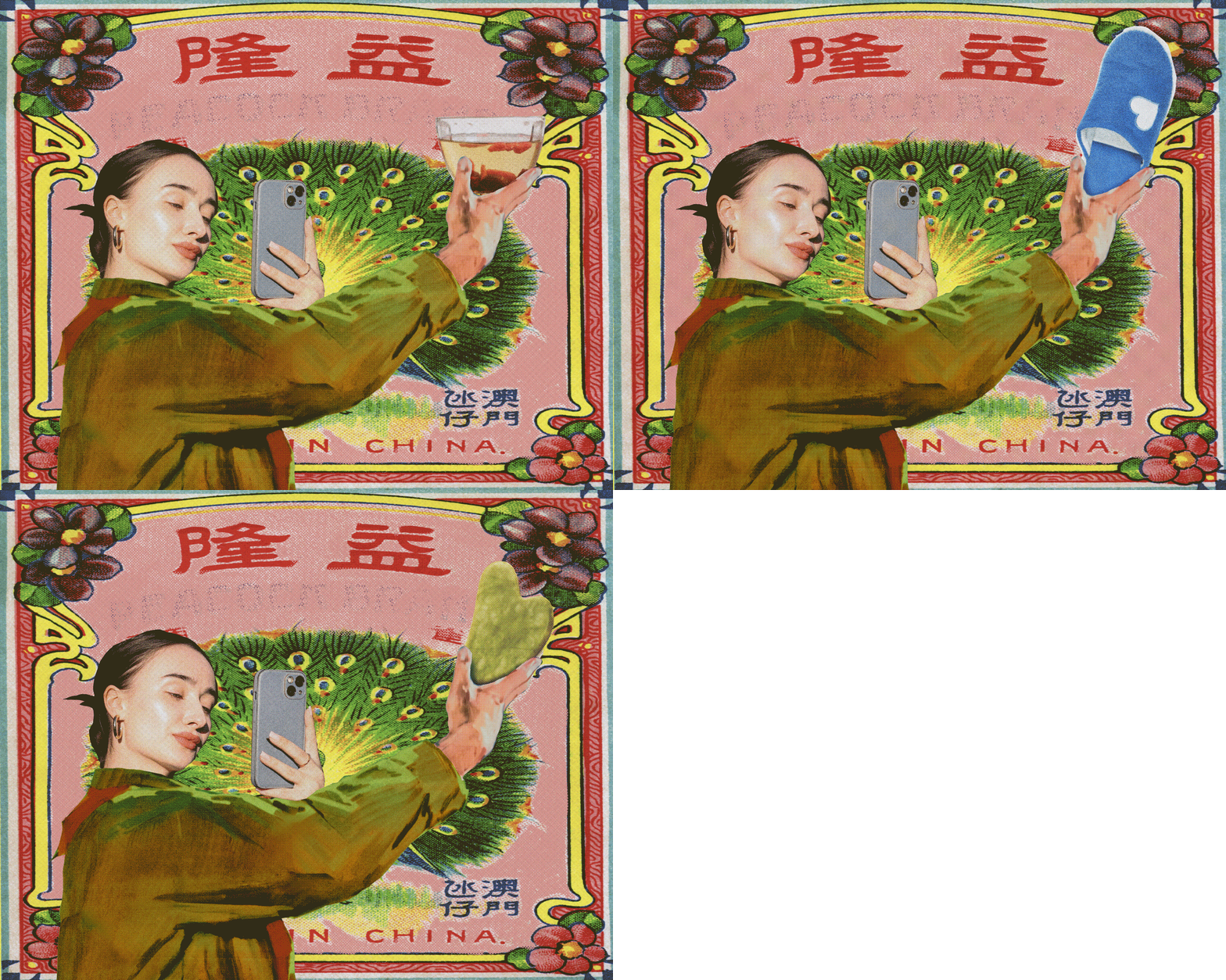
TCM staked out a presence in America in 2021, when beauty creators began scraping their faces with gua sha stones to promote lymphatic drainage, and Covid longhaulers sought acupuncture to manage their most mysterious and persistent symptoms. Last year, TikTokers spearheaded a niche “Chinese face mapping” trend, asking ChatGPT to act as a TCM doctor and offer less-than-trustworthy assessments of their health based on puffy eyes or pale tongues. When cold and flu season hit this year, many were eager to receive and share health tips, culminating in the broader call to Chinamaxx wellness routines. It helped that practices culled from TCM – such as going to sleep before 11pm – fit neatly within the “get ready with me” and “bedtime routine” formats so popular on social media.
“When someone adopts qigong, acupuncture, cupping therapy, herbal remedies [or] gua sha … they are not consuming a one-time cultural export. Instead they are building a habit, and habits quietly change how foreignness feels,” Yuan said. “That doesn’t mean they are ‘switching sides’, however … People can be skeptical of Chinese state policies and still find Chinese wellness practices useful or interesting.”
Some Asian American creators and writers have found this online obsession with China jarring, especially because people of Asian descent in the US were harassed, assaulted and even killed during Covid times. Others have called out white creators for assuming authority on Chinese practices – like the non-Asians claiming to offer the wisdom of a “Chinese grandmother” via recipes for waterless chicken soup. “What a privilege it is, to be able to try on someone else’s identity for a day without inheriting any of the consequences,” wrote Faith Xue, the editor-in-chief of Coveteur.
One Chinese American creator questioned her decision to post a video of “Chinese baddie tips” to promote her tea business. After seeing how “saturated” the trend had become, she wondered whether content about TCM was “appreciation or extraction” of Chinese culture.
Dr Felice Chan, an acupuncturist, doctor of Chinese medicine and co-founder of the skincare brand Moonbow, said that she loves the visibility around TCM. “If it gives acupuncturists jobs, if it gives light to other Chinese medicine brands, why not?” she said. But she is aware of “surface level” content that flattens or oversimplifies the health benefits of TCM, which is a shared wisdom best passed down through families, not algorithms.
“There’s a reason why your mom told you to wear slippers in the house … If our feet are cold, our womb is cold, we have bad period cramps, right?” Chan said. “There is a medicine tied to it, but there’s almost a lapse in communication or understanding of why our parents told us.”
Other creators embrace the familial framing. “I’m spending my nights and weekends on TikTok telling people that they’re part of my Chinese family, that they’re being adopted by my Chinese mom,” Ge said. “We get people saying, ‘Can I get adopted?’ We’re doing this together, sis. We’re basically like family.” For Ge, this kind of response “speaks to this broader desire for community, for belonging”.
The Chinamaxxing trend blazed on through February, buoyed up by the lunar new year and an influx of content about bringing good fortune in the year of the fire horse. The spiritual nature of such guidance underlined another explanation for TCM’s popularity right now: the system itself can be poetic and mystical, defying the creep of AI and automated systems into western healthcare. For instance, according to TCM practitioners, the herbal blend to treat a persistent stuck throat, or “plum pit qi”, can also help quell the emotions brought on by “a situation that is figuratively too hard to swallow”.
“[TCM] is very rich with heritage, lineage, tradition [and] extremely rich in symbology,” said Minjung Hwangbo, a student of TCM and content creator. “This medicine is so personalized to being human, and with the emergence of AI, I think people are craving meaning and a return to humanness.”
The lunar new year happened on the same day as the beginning of Ramadan, during Black History Month, and shortly after a Super Bowl half-time performance from Bad Bunny that briefly “made everyone Puerto Rican”. As one X user joked, Americans are “globalismmaxxing” now – eager to seek out cross-cultural connections, if only through the lens of a 10-second meme.