
www.theguardian.com
Albanese prepares to address the nation tonight
Tom McIlroy
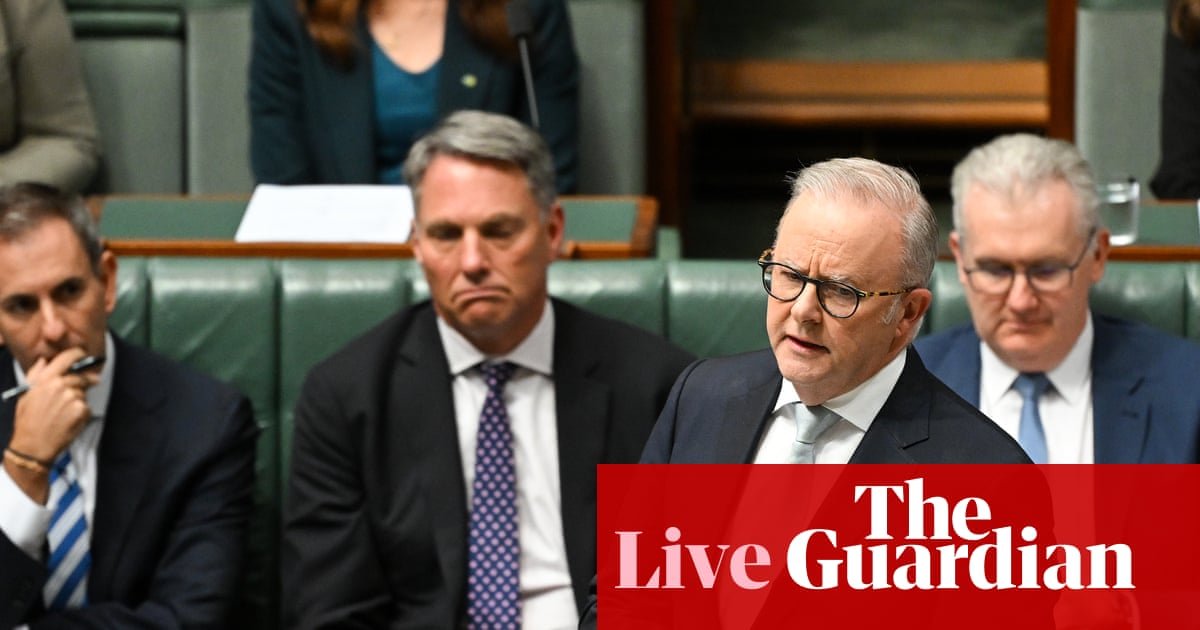
Anthony Albanese is preparing to address the nation this evening, as the war in Iran grows and economic fallout intensifies.
Guardian Australia understands an address is being planned for tonight.
The prime minister is expected to speak from Canberra after today’s sitting of parliament.
Albanese will also address the National Press Club in Canberra tomorrow.

Key events
Albanese cancels trip to Gallipoli for Anzac day
Liberal frontbencher, Andrew Hastie, is up next and asks the government to confirm if ministers are cancelling events through April, and why, if there isn’t a fuel shortage.
The prime minister says that he has cancelled a trip to Gallipoli for Anzac day this year.
He says he has “prioritised” the government’s response to the crisis.
Because of the circumstances of travel to Turkey at the moment, obviously I have cancelled it. I’ve prioritised what we are dealing with at the moment, engaging with our regional partners. That’s a responsible and the right thing to do.
Over to the crossbench, and Andrew Wilkie asks what the “veracity” is of a report in the Sydney Morning Herald that the prime minister will soon announce reforms to online gambling ads.
Wilkie and others have been pushing the government for years to address the issue, while it still hasn’t responded to a report led by late Labor MP Peta Murphy that was handed down nearly three years ago.
Anthony Albanese won’t confirm anything and says the government hasn’t made any decisions on the policy.
But his language is interesting – since he was asked for an update on gambling by independent MP Kate Chaney a few weeks ago – specifying that the government wants young people to “be able to watch sport and not see a link between sport and gambling.”
Albanese says that the government continues to work on reform.
We haven’t concluded what we’re doing … I think that we need to get absolutely the balance right between people’s right to have a punt and the the view that I have, which is that it is too prevalent, and that people, particularly young people, should be able to watch sport and not see a link between sport, necessarily, and gambling, that we need to delink those issues.
Angus Taylor asks if further fuel shipments have been cancelled
Have any additional fuel carriers bound for Australia been delayed or cancelled, asks Angus Taylor, since the government announced last month that six shipments had been cancelled (and subsequently replaced).
Anthony Albanese says his answer hasn’t changed since Monday, that those shipments were replaced, and an additional nine fuel shipments are scheduled to arrive this month.
Chris Bowen also said yesterday that there are currently 53 ships with fuel en route to Australia. He said on average 81 shipments arrive each month, and the next month is on track to receive that amount.
Albanese turns to our Asia Pacific neighbours (from whom we import a lot of fuel), and says that Australia expects reciprocation from our gas exports.
We continue to engage as well with our international partners. There’s a range of further discussions will take place over future days, including over Easter, [we] will continue to engage with our partners. We’re a reliable supplier of energy security around our region. We expect that to be reciprocated.
It’s question time! (The one before the budget)
Angus Taylor begins, asking the prime minister “what has changed since yesterday?”, when the prime minister said fuel supplies haven’t changed, to today announcing he will deliver a national address tonight.
Anthony Albanese says “nothing has changed”.
He says that like Andrew Hastie has said publicly, everyone has to “keep calm and carry on”.
The last time a prime minister made an address to the nation, it was Scott Morrison on 12 March 2020 talking about the Covid pandemic.
The issues are real. The war in the Middle East is real.
[Hastie] said this, and this will be consistent with what I will say tonight. This is where every Australian has to just keep calm and carry on. Do what they can to look after themselves and their neighbours. We’ve got a lot of oil and gas and other precious commodities trapped in the Persian Gulf behind the strait of Hormuz. So until the war is resolved, we’re going to feel supply pressures. That was real when the member for Canning said it. It’s real when every member of the government understands it.

Benita Kolovos
Victoria expands phone ban to private and Catholic schools
Jacinta Allan’s press conference this morning was held at St Aloysius Catholic College in North Melbourne, where she announced an expansion of the government’s nation-leading phone ban to all private and Catholic schools.
Allan also announced new legislation would crack down on wearable devices like smart watches and wireless earbuds.
Under the proposed laws, mobile phones must be switched off and stored away during school hours across all Victorian schools, and personal audio devices also cannot be used. Wearable devices would be restricted, with notifications, cellular connections and recording functions switched off.
If passed, the changes would come into effect from term one in 2027. Exemptions would apply for students who need devices to monitor health conditions. Allan said:
Victoria was the first state in the nation to ban mobile phones in classrooms. We did this in 2020 and it was an important step in supporting the work of teachers and staff in the classroom, to manage the disruptive impact these devices were having in the classroom and also to make sure that kids are given every opportunity to make the most of their learning … Since that time we’ve seen so many other jurisdictions around the country have followed Victoria’s lead [and] it’s worked – classrooms have been less disruptive, students have been able to focus better on their classes.
Asked whether legislation was necessary, the education minister and deputy premier, Ben Carroll, said:
It sends a very strong signal, a bit like the social media ban, when parents and teachers and principals can be up there at the classroom saying, ‘This is the law. It’s not just me telling you, we need you to follow these rules and guidance.’ It’s evidence-based best practice and evidence-based policy. And the great announcement today is that we’re bringing every school, every school student, under the one umbrella of the legislation.

Patrick Commins
Parkinson backs fuel excise cut, but says long-term measures needed
Back to Martin Parkinson at the National Press Club, who says it was “unrealistic” to not expect the government would provide extra cost of living support to Australians, despite warnings the cut to the fuel excise could further intensify inflationary pressures.
Parkinson said there was room in the May budget for longer-term reforms and short-term support for those badly affected by the spike in fuel prices associated with the Iran war.
Governments are elected to make trade-offs, and they’ve got to think about the politics and the economics of this.
Just think about what’s happened to the price of fuel – that is incredibly inflationary. And the excise tax cut is only taking a little bit off the top of that inflationary pressure.
So the argument that I’ve seen, ‘oh, it’s a bad thing to do’ – the community got used to support in Covid. And it’s unrealistic to expect that governments would not have done something.
The question is, what are you going to do for the medium and longer term that’s going to result in reduced inflationary pressure and greater growth in living standards? And that comes back to a reform and productivity agenda.
Greens say AI deal needs ‘parliamentary scrutiny’, warning Labor not to ‘sell out’ artists to AI companies
The Greens have warned government deals with AI companies must not “sell out” Australian creators, journalists and the environment, after Labor signed a memorandum of understanding with the AI giant Anthropic.
Greens senator Sarah Hanson-Young says the creative sector is concerned the signing of the deal is a “signal that the Albanese government has gone weak on artist and journalist protections”.
She’s calling on the government to release the details of the agreement signed today.
There are serious questions about the impact this deal will have on our environment and creative sectors. Datacentres have a huge environmental footprint. They use massive amounts of water and energy and impact biodiversity.
The Australian government must put the interests of Australians above massive multinational tech companies. This deal needs parliamentary scrutiny and we will be pursuing all options available to us.
Patrick Commins
Martin Parkinson predicts ‘long-lasting effects’ from Iran war
Martin Parkinson says the “consequences” and the “forces that have been unleashed by this war are going to have long-lasting effects”.
The former Treasury secretary said even if the war ended tomorrow, the practical realities of restarting and repairing oil and gas infrastructure, and getting ships loaded and in and out of the Middle East, meant the resumption of pre-conflict levels of trade through the strait of Hormuz “is going to take a considerable amount of time”.
Answering questions at the National Press Club, Parkinson said “to me, the issue is not so much the here and now”.
I don’t think we’re in a situation of stagflation today, but I do think there’s a risk. And I emphasise risk; it’s not guaranteed it’s going to happen, but there is a risk that we could find ourselves in that situation, and that risk goes up the longer the conflict goes on.
Depending on how the conflict is resolved, then that could have really big, quite different impacts on supply and price going forward.
Tory Shepherd
One Nation MPs front press in South Australia
The new One Nation MP for MacKillop, Jason Virgo, has dismissed his time as a candidate for the Australian Sex Party as the crazy antics of a teenager.
Pauline Hanson’s party is claiming four lower house seats and three upper after South Australia’s state election, although one House of Assembly spot (Narungga) is too close to call and is undergoing a recount.
The former Liberal senator Cory Bernardi, One Nation’s leader in the upper house, fronted a press conference earlier today with the MPs and said their strong showing, with a primary vote at 22.5%, was a credit to Hanson and party president Carlos Quaremba.
Virgo was asked if he would import any of the Australian Sex Party’s policies, which included pushing for same-sex marriage, dying with dignity, and decriminalising drugs. “I was a kid,” he said.
I think every person out there when they were 16 and 19 were probably doing some crazier things than joining a political party.
Bernardi talked about the minor party’s policies including scrapping the state’s voice to parliament and ending net zero commitments.
He said ambulance ramping – a key issue at the election – could be fixed by letting ambulance officers tell people who have called them that they do not need an ambulance because it was “like a friendship service for some people”, and to fix bed shortages you could put up to 10 recliner chairs in a single-bed ward for people to see a doctor and be discharged.
He also guaranteed “100%” that the One Nation MPs would stick with the party (which has a long history of defectors).
Quaremba said “you only have to look at the fuel prices that we’re facing now” (which have spiked because of the war) to see the failings of the two major parties.
No one asked the MPs about allegations their leader’s rhetoric on immigration was “reprehensible”, “bigoted” and “wrong”.
Benita Kolovos
Victorian government backs NSW GST plan
The Victorian premier, Jacinta Allan, held a press conference this morning, where she threw her support behind a proposal from New South Wales to pass on a GST windfall from soaring fuel prices through lower prices at the bowser.
It follows a meeting of first ministers on Tuesday, during which the NSW government proposed that all states should pass on the windfall. The NSW government claims this move would cut fuel prices by an estimated seven to 10 cents a litre, in addition to the drop already expected from the federal government’s temporary halving of the fuel excise.
Victorian government sources say the leaders failed to reach a consensus during the meeting. Allan suggested to the group that if states couldn’t agree, the additional revenue could instead be redirected to support the struggling agricultural sector.
But on Wednesday, Allan told reporters she backed the NSW plan. She said:
I don’t want to go into [details] too much, because I want to respect my colleagues in the room. We agreed on a nationally consistent approach. We agreed on the principle of using the GST to further reduce prices at the pump. Our officials needed to do some work on the quantum and the mechanism to deliver that and that work has been undertaken over the course of yesterday, which has given me the opportunity to be able to confirm today, Victoria’s position on applying the GST to further reduce fuel prices at the pump … We support the use of the GST to further drive down fuel prices at the pump.
She said state and territory officials were working through the details of the plan today. However, Allan would not confirm whether she had advice that it would reduce petrol prices by seven to 10 cents a litre.
There is some complexity in terms of how the GST is collected and the mechanism. So I think let’s be a little fair to our officials who need some time to work through those numbers. But the prinicpal position is absolutely clear – GST applying to further reduce fuel prices at the pump, supporting the halving of the fuel excise as announced by the prime minister.
Allan added that she would continue to advocate for support for the agriculture sector:
This is not an issue that’s not going away, and it continues to be a priority for me.
Aussie shares spike as Trump signals end to Iran war
Australia’s share market has bounced on hopes the US-led war on Iran could end soon after President Donald Trump said negotiations were going well, AAP reports.
The S&P/ASX200 jumped 146.2 points by midday, up 1.72%, to 8,629, as the broader All Ordinaries gained 156.9 points, or 1.81%, to 8,840.8.
The local rally followed a strong Wall Street session, when Donald Trump flagged the US military campaign could end “within two weeks, maybe two weeks, maybe three”.
While Trump has promised an end to the conflict on several occasions, his latest comments appeared the most definitive to date, Betashares chief economist David Bassanese said.
Trump’s final calculation appears relatively straightforward.
Brent crude has eased from around $US108 a barrel to $US104.30, still up more than 40% since the US campaign began on 28 February.
The potentially improved outlook for global growth sent Australian investors flocking to basic materials stocks, with the sector jumping 4.6% by midday and tracking similar gains for miners BHP and Rio Tinto.
Beaten-down gold stocks performed even better, as the precious metal lifted to US$4,700 an ounce, boosting the All Ordinaries gold sub-industry by almost 6%.
‘Staring into stagflation’: former Treasury boss calls for urgent reform to migration system
Patrick Commins
Martin Parkinson, a former Treasury secretary, says Australia’s obsession with migrant numbers has overshadowed the urgent need to reform a migration program that has left half of all permanent arrivals working below their skill level.
Speaking at the National Press Club, Parkinson said the country was “staring into stagflation” as the Iran war pushes up inflation and drags on growth, and that there was more need now than ever to lift our productivity.
What we are seeing is yet another example of the most depressing experience of my 40 years in government – the repeated misdiagnosis of policy problems combined with the lack of political will, or perhaps political skill, to level with the Australian people.
We have built a system that prevents migrants, not just those who may come in the future, but those who are already here, from working at their full capacity.
No matter where you sit on the size of the migration program debate, you have to recognise that a more immediate question is whether Australia is getting the economic value it should from the skilled people it has already invited here, and those it will invite in the future.
Also speaking at the National Press Club, Violet Roumeliotis, the chief executive officer of Settlement Services International, said “what success looks like is simple”:
A system where qualified people have a clear recognition pathway, get assessed quickly and fairly, can afford any gap training or recognition of prior learning required, and move into work quickly, with employers able to trust the process and Australians able to trust the quality.
Petrol prices begin to fall in some locations across Australia

Luca Ittimani
Petrol prices have stopped rising in some cities, as suppliers adjust to the new normal.
The government on Monday announced it would halve the fuel excise, cutting 26.3 cents from the per-litre price of petrol and diesel, which coincided with a pause in price spirals.
Prices had been rising almost every day in Australia’s capital cities since the start of March, Informed Sources data shows.
Unleaded petrol slipped from Monday to Tuesday to average 258.8 cents a litre in Brisbane and 257.4 in Sydney. It held at about 259 cents a litre in Melbourne and 258 in Canberra from Sunday.
Prices had slowed around the rest of the country before Monday’s announcement. From Friday to Tuesday, unleaded held steady in Adelaide at about 259 cents per litre and in Darwin at 264 cents.
Unleaded went backwards in Hobart, from 260 cents to 257.5, over the same period. It fell in Perth from 258.3 cents to 251.7 from Thursday to Tuesday.
Diesel prices continued to rise daily in all capitals except Sydney and Brisbane, which stayed at about 322 and 323 cents a litre respectively from Monday to Tuesday.

Penry Buckley
Fuel shortages down at NSW service stations before excise cut
The New South Wales premier, Chris Minns, says fuel shortages in the state have reduced slightly ahead of consumer relief being passed on by the cut in the federal excise.
At a press conference today, the premier said 30 fuel stations in NSW had no fuel, down from the 61 provided in an update by the federal energy minister, Chris Bowen, yesterday. The premier said the number of stations without diesel has dropped from 247 to 207.
He said his “strong suspicion is that that’s as a result of consumers waiting for the excise to be cut before they fill up their tank”.
The premier was also asked about NSW’s proposal to other states to pass on the GST windfall on as an additional reduction in fuel prices, which the state government says would lead to an additional reduction of 7 to 10 cents a litre.
Minns said NSW cannot pursue the policy alone after state and territory leaders did not agree to it yesterday, saying the distribution of the GST windfall from increased fuel prices, announced by the federal government on Monday, requires a unanimous agreement from the states.
Asked if the prime minister supported NSW’s proposal, Minns said:
Yeah, I think he’d like to see the GST windfall come off the excise as the easiest way of passing on cost of living relief in the shortest possible time.
One Nation voters turn to ‘reverse shy-Toryism’
One Nation voters could be so chuffed with their choices they’re wrongly saying they supported them in the past (when they didn’t).
Polling outfit Fox and Hedgehog say they’re happy with their polls (which put One Nation at a primary vote of 21% for the South Australian election – they’re currently at 22.5%), and noted there were “unusually high levels of recalled past vote for One Nation, well above its historical vote share”.
It’s a well-established phenomenon, it says, where voters match up how they voted in the past with their current political preference.
As a party grows, some voters begin to report that they supported it previously, even when they did not …
In the context of One Nation, we refer to this dynamic as a form of ‘reverse shy-Toryism’. We don’t see a reluctance of One Nation voters to disclose their support, rather a tendency to retrospectively claim it for past elections.
(Shy Tories are the ones who won’t say they voted for the, in some circles, unpopular party).
Which other prime ministers have made an address to the nation?
There have been just a few addresses to the nation by prime ministers in this century – with Anthony Albanese to join those ranks when his address is broadcast across TV and radio stations tonight.
Here are a few examples (this is not an exhaustive list!):
On 12 March 2020, Scott Morrison made a televised address to the nation near the beginning of the Covid pandemic.
Before him, Kevin Rudd made an address to the nation on 14 October 2008, where he announced a $10.4bn economic stimulus package.
On 20 March 2003, John Howard made an address to the nation announcing Australian troops would be sent to Iraq.
Howard had already made another address to the nation, on 30 November 1997, when he announced a plan in response to the Wik high court decision.
On 15 November 1993, Paul Keating made a televised address in response to the high court’s Mabo decision.
Jewish groups in Australia criticise Israel’s death penalty laws against Palestinians

Sarah Basford Canales
Australia’s peak Jewish group has criticised new Israeli laws imposing the death penalty on Palestinians convicted on terror charges but not Jewish extremists accused of similar crimes, describing it as a “troubling departure from the principles that have guided Israeli law and Jewish tradition”.
In a statement this morning, the Executive Council of Australia Jewry (ECAJ) said it was concerned by the passing of the new laws, adding its opposition came from a “place of solidarity” with the “desire for justice felt by victims and their families” in Israel.
The legislation makes the death penalty the default punishment for Palestinians in the Israeli-occupied West Bank found guilty of intentionally carrying out deadly attacks deemed acts of terrorism by a military court.
The law, initiated by the far-right Otzma Yehudit party led by Israel’s national security minister Itamar Ben-Gvir, has drawn sharp criticism from opponents who warned it would mark a significant escalation in Israel’s penal policy.
ECAJ’s statement noted the law applied differently depending on nationality – Israeli or Palestinian – and would be decided by a military court with limited judicial discretion.
The statement continued:
The Otzma Yehudit party’s campaign for this legislation represents a troubling departure from the principles that have guided Israeli law and Jewish tradition. We trust that Israel’s supreme court will carefully scrutinise this legislation.
The Zionist Federation of Australia released a similar statement this morning, with president, Jeremy Liebler, saying “Jewish law and tradition insist on the equal worth of every human life as a reflection of the divine image”.
Read more:
O’Neil defends PM’s planned address and points to ‘huge amount of clarity’ during fuel crisis
Government frontbencher Clare O’Neil says that prime ministers will make national addresses “in times of great challenge” and has rejected claims Anthony Albanese has not provided enough clarity.
Speaking to Sky News, O’Neil says there has been a “huge amount of clarity” and says the government is doing what it should be to address the crisis.
I think it’s fairly clear that what’s going on in the Middle East is having widespread ramifications.
The prime minister will be talking about the status of what’s going on in Iran and the plans that the government has to protect the Australian community from the worst.
She says any politician would know that the message from the crisis is that Australia needs to be able to “stand on its own two feet”. She says that particularly goes to the expansion of renewable energy.
There isn’t a global power that can stop us from using the sun and wind that we’ve been gifted as endowments to Australia.