
www.npr.org
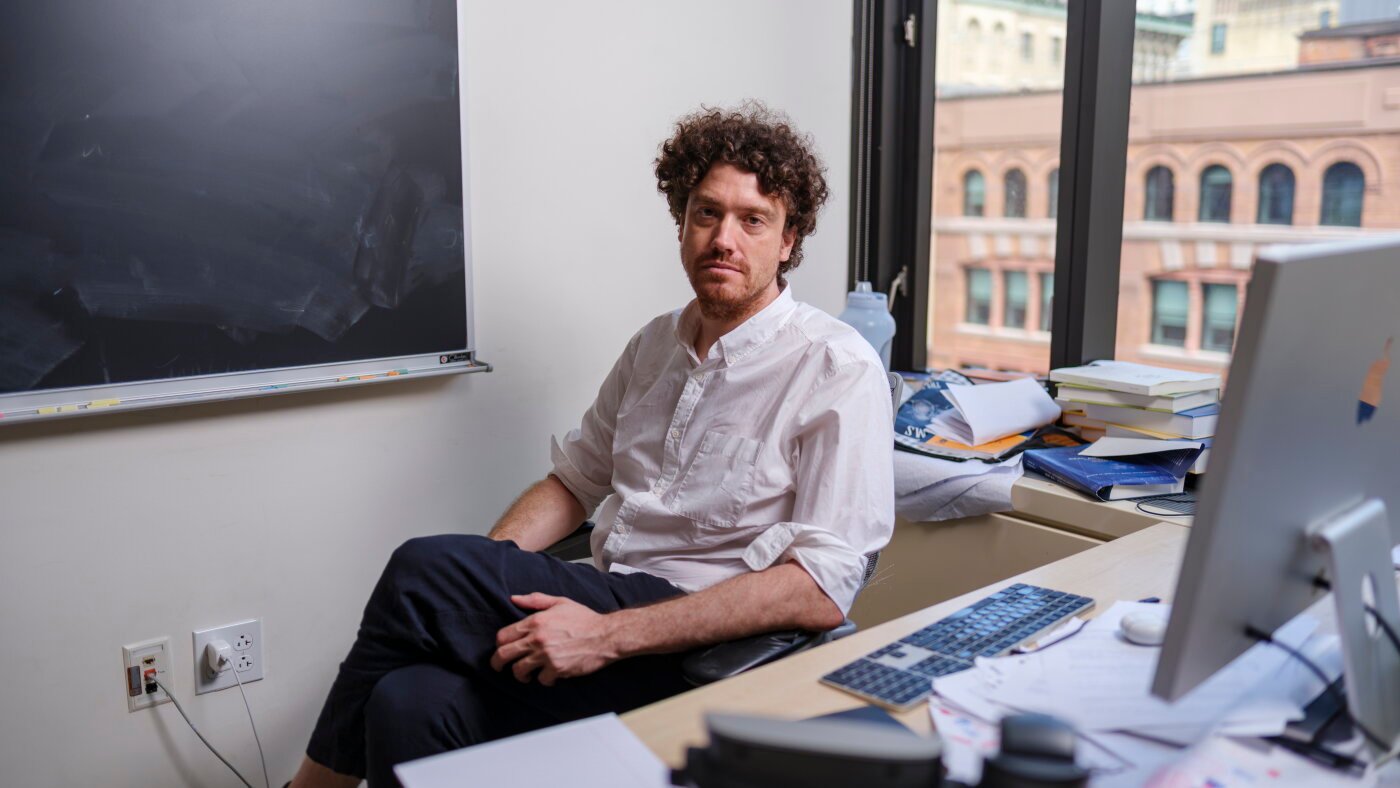
Tristan Buckmaster is a mathematician at New York University. He poses for a portrait in his office in Manhattan on September 11, 2026. Buckmaster and his collaborator Levent Alpöge have been working on the Navier-Stokes equations. They are clashing with OpenAI, which claims to have cracked the equations.
Karsten Moran/for The Washington Post/Getty Images
hide caption
toggle caption
Karsten Moran/for The Washington Post/Getty Images
When OpenAI announced its AI had solved one of the world’s toughest math problems earlier this month, its tone was celebratory:
“A major goal of our work is to empower scientists to advance research and technology that benefits all of humanity,” the company wrote.
But mathematicians say that, so far, humanity has learned very little from the solution the company’s AI model purportedly found. Although they believe the proof to be technically correct, the dense, 166-page manuscript drafted by AI is proving to be a difficult read.
“So far it’s been very difficult to really extract any human understanding from this new AI proof,” said James Maynard, a mathematician at the University of Oxford.
“The paper is not written for humans,” said Javier Gómez-Serrano, a mathematician at Brown University who uses AI in his own research. He said he believes the proof could help advance the field after “some serious re-writing,” but “as of today, the paper doesn’t teach us much.”
The solution came as AI appears to be rapidly gaining mathematical insights. AI has exploded onto the math scene over the past six months, academic mathematicians contacted by NPR said. For the first time, large language models appear capable of producing real results that could lead to new mathematical discoveries.

But few see OpenAI’s announcement, which came as human mathematicians were closing in on a solution, as an example of how AI and mathematicians can work together.
“This whole episode could have been a wonderful proof-of-concept of the power of collaboration between humans and AI,” said Maynard, who signed a statement by 25 winners of the prestigious Fields Medal. The statement, which was published September 11, decried “misaligned goals” between the AI companies and the mathematics community.
“Unfortunately, because of the decisions of humans involved, it became this scrappy, messy battle,” he said.
Rush to discovery
The problem OpenAI apparently solved is considered among the most important unanswered questions in mathematics.
Known as the “Navier-Stokes problem,” it concerns a set of equations used to describe the flow of fluids. The equations are used every day across physics and engineering, said Tristan Buckmaster, a mathematician at New York University.
And yet, at a fundamental level, researchers really don’t understand why they work. Buckmaster says that getting deeper insights into Navier-Stokes would likely yield “a new toolkit to understand complicated solutions to fluids.” That in turn could lead to better models of things like turbulence in fluids and lift in aircraft.
In order to find a better version of Navier-Stokes, researchers had been looking for scenarios where the equations “broke down,” or stopped working. Describing such scenarios became one of the $1 million Millenium Prize Problems, which were established in 2000 by the Clay Mathematics Institute.
Mathematicians had been working towards an answer to the Navier-Stokes problem for years, and the community could sense they were getting close. “Among the seven Millennium Problems … Everyone agreed that this would be the next one that got solved,” said Martin Hairer, a mathematician at EPFL, a top European technical university located in Lausanne, Switzerland who also signed the statement.

Buckmaster and his collaborator, Levent Alpöge at Anthropic, were among the human mathematicians who were inching closer to finding a scenario where the equations stopped working. The two were using AI tools, including OpenAI’s chatbot to work towards a solution.
Then OpenAI caught wind that the problem might soon be solved.
“On Tuesday, September 1, we heard rumors that two Millennium Prize problems had been resolved,” the company wrote. “Inspired by these rumors and by the step change in performance of our internal model, we launched an effort to evaluate it on all open Millennium Prize problems and a few other high-impact problems.”
The company marshalled some 10,000 AI agents to work on the Navier-Stokes problem. The agents worked for 88 hours, using around 130 billion output tokens, or units of text and characters generated by the model. According to OpenAI’s pricing for its most advanced publicly available model, the solution to the Navier-Stokes problem cost the company somewhere around $6-$10 million to compute. (Overall, the company says it used 300 billion tokens, closer to $15-20 million, looking for solutions.)
The announcement of OpenAI’s solution sparked controversy after Buckmaster issued a public statement describing how the company had approached him. According to Buckmaster, they said they would put him on their paper if he dropped Alpöge, his collaborator at rival company Anthropic.
Buckmaster told NPR he believes OpenAI was tipped off to the approach he and Alpöge were using to try and find the solution to Navier-Stokes.
“There’s so much circumstantial evidence that they had far more knowledge of what we were doing than they let on,” he said. He added that the word “they” doesn’t necessarily mean a person. “It could mean the agents,” he said.
OpenAI has denied that they used Buckmaster and Alpöge’s prompts or proofs in its search for a solution.
Regardless, the hurried results seem muddled. Several mathematicians who looked at OpenAI’s paper said it was virtually unreadable.
“It’s a terribly written paper,” Buckmaster said.
“The paper doesn’t explain what parts are important. What parts are routine? How does the idea feed into other places?” added Gómez-Serrano.
Buckmaster said that OpenAI’s decision to rush out an answer forced him to publish his own heavily AI-influenced preliminary results. Those too, he said, are not very well written. “Everything was rushed out,” he said. “It’s still not at the level I’m happy with, but at least the introduction has all the key ideas.”
Computers check computers
While OpenAI’s 166-page proof is taking weeks to untangle, few mathematicians believe it’s wrong. That’s because in addition to publishing the proof, the company also produced a piece of computer code called a Lean formalization. Lean is a programming language used in mathematics to check if proofs are correct. If the code can be compiled, then the proof is considered complete.
The Lean code produced by OpenAI’s tools did compile as expected, Gómez-Serrano said. Based on that, “the community seems to have the consensus that it is correct.”
Gómez-Serrano, Buckmaster and other mathematicians contacted by NPR all said they envisioned a future for AI in mathematics. The field is open to new tools, in part because for decades, it’s ceded much of the day-to-day computations required for making advancements to computers.
But this episode is a reminder that mathematics is about more than just finding a solution, said Maynard. “It wasn’t about only answering this problem, it was about the human understanding behind it,” he said.