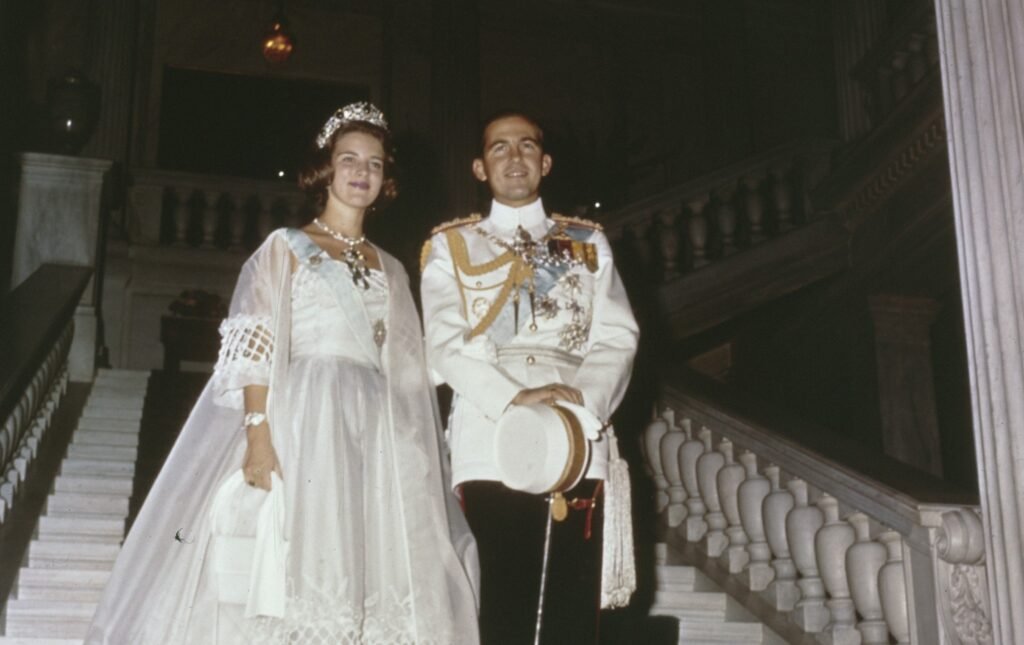

It was a marriage that sealed a famous love story and turned a
princess into a queen. On September 18th 1964, royalty
from across Europe gathered in Athens to see the continent’s newest
monarch wed a bride who had just turned eighteen. Constantine II of
Greece and Anne-Marie of Denmark’s romance went on to weather
political crises and exile and endured until his death in early
2023. And it had been cemented in a royal wedding that made
headlines around the world.
Their path to the altar had begun five years earlier when the
then Crown Prince Constantine, only son of King Paul and Queen
Frederica of Greece, had accompanied his parents on a State Visit
to Denmark. There, they had been hosted by King Frederik IX and
Queen Ingrid and their three daughters, among them
Anne-Marie. Two years later, Constantine and Anne-Marie met
again in Denmark, and by the time she acted as bridesmaid to his
sister, Sofía, in Athens in May 1962, the couple were smitten.
The Crown Prince of Greece proposed to his Danish princess that
summer, but her father had other ideas about marriage. King
Frederik insisted that his daughter, still just sixteen, had to
complete her education before any wedding could take place while
the couple also had to wait to make their engagement public.
The confirmation that the pair were to wed finally came on
January 23rd 1963. Twenty-two-year-old Constantine
travelled to Copenhagen for the announcement, appearing on the
balcony of the Amalienborg Palace with his bride and her family.
The wedding was due to take place two years later. However, the
death of King Paul in March 1964 turned Constantine into a monarch.
Suddenly, marriage plans were accelerated, and the ceremony was set
for September that year.
The bride arrived in her new home country in the week before her
wedding, having taken part in several days of celebrations back in
Denmark. A gala dinner for the couple’s royal guests took place a
few days before the marriage at the Royal Palace.
By the time Princess Anne-Marie walked into the Metropolitan
Cathedral of the Annunciation in Athens on the arm of her father,
she had already converted to the Greek Orthodox faith. The marriage
ceremony took place in front of around 1,200 guests including the
Prince of Wales. He stood alongside King Baudouin and Queen Fabiola
of the Belgians, Queen Juliana of the Netherlands, King Olav V of
Norway and King Gustaf VI Adolf of Sweden and dozens of other royal
guests for the ceremony which was followed by a reception at the
Royal Palace.
The new Queen of Greece had chosen a Danish designer to make her
wedding gown. Jorgen Bender’s creation featured a rounded neckline,
three quarter length sleeves and an empire line waist which gave
way to a full skirt with a train measuring around twenty feet. The
bride’s bouquet was dominated by lily of the valley, the
sweet-scented flower which denotes a return to happiness in the
language of flowers.
All royal brides need a tiara, and Anne-Marie kept things in the
family for this part of her bridal look, choosing an all diamond
diadem which belonged to her mother. Queen Ingrid of Denmark had
inherited the Khedive of Egypt tiara from her mother, Princess
Margaret of Connaught, following her untimely death in 1920.
Presented to Margaret by the Khedive of Egypt at the time of her
marriage in 1905, it features swirling scrolls of diamonds and has
been used by all of Ingrid’s female descendants on their wedding
days.
Anne-Marie wore it with another family heirloom that provided a
link with Margaret, the maternal grandmother she never knew. The
tiara anchored in place the Irish lace veil which Margaret had worn
at her own wedding and which her only daughter, Ingrid, also chose
to use as part of her wedding outfit.
Constantine and Anne-Marie had enjoyed a very romantic royal
love story, and the fairytale air continued as they departed for a
honeymoon in Corfu. Reality would kick in very soon after their
return as political unrest in Greece led to a tumultuous and bumpy
reign for Constantine which ultimately led to exile. But their
royal wedding remains a glittering moment in a story that continues
to fascinate.
Lydia Starbuck is a pen name of June Woolerton who has
written extensively on royal history. Her book, A History of Royal Jubilees, is
available now. She is also the author of a popular cosy mystery,
All Manner of
Murder.