
www.theguardian.com
Burke rubbishes ‘absurd’ claims of ‘mass migration’ in Australia
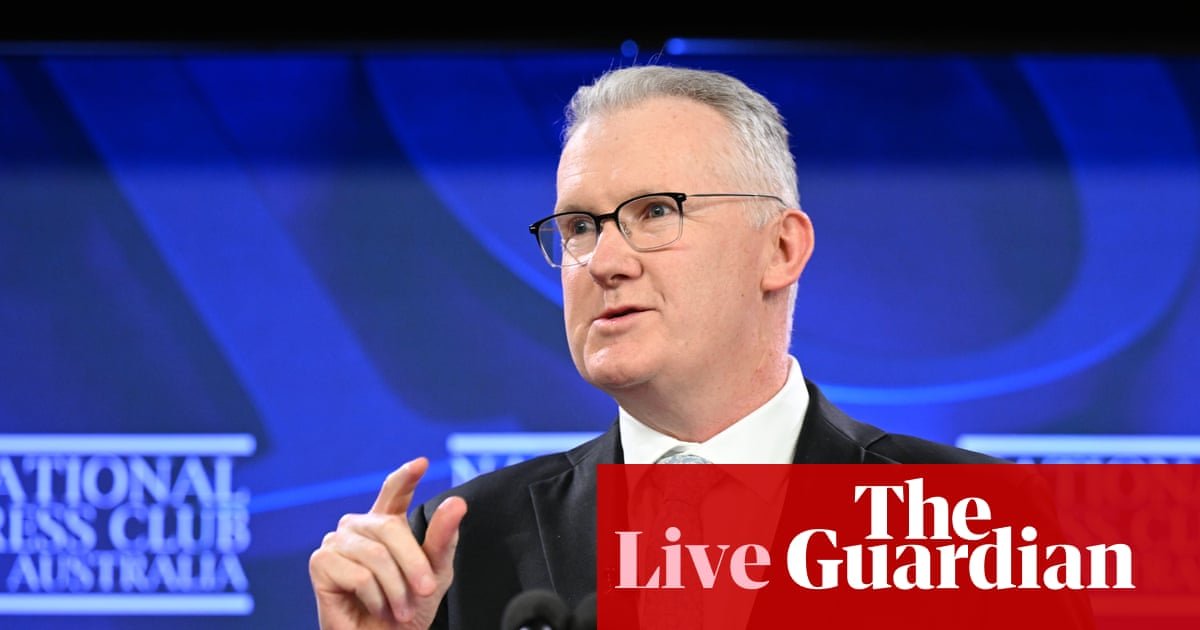
Tony Burke starts his address trying to dispel some of the most “absurd” claims in the migration debate – starting with the claim that Australia is a nation of “mass migration”.
Burke tells the National Press Club that there’s one simple fact to counter that:
Before the pandemic, the intergenerational report had the projections for where Australia’s population would be by 2030–31. When we get to that point, we’ll be 700,000 people smaller than what had been projected before the pandemic.
He then takes aim at claims that backpacker and Palm scheme visas don’t form part of the net migration number – most of them do. He said last year backpackers made up 48,000 of the net overseas migration figure.
There’s almost an approach, sort of the Nom version of nimbyism – I won’t try to invent the ‘nombyism’ word. It’s a concept where people say they want immigration numbers to go down, but they don’t want to mention this visa class and they immediately want to rule out all the ones that they would rely on.
Despite international students being targeted by the government in its migration changes, Burke acknowledges that the cohort are incredibly important to the economy.
He doesn’t say One Nation, but he’s clearly having a crack at their policy.
There’s a whole section of the economy in the cities that is only there because we have an important export industry in international students. Drastic cuts, wherever you make them, hurt the economy in every part, in every area. And what we need to make sure of is anything we do to temper migration needs to take account of the economic costs.
Key events
Tom McIlroy
Parents, teachers, coaches have a role in preventing radicalisation: Burke
Jumping back to the end of his address to the National Press Club, Tony Burke was asked about reports in The Australian documenting four major terror plots that had been disrupted since the deadly Bondi Beach shootings in December.
The alleged schemes were all thwarted in the first six months of the year, with five males, including three teenagers, charged.
Burke said that work is under way right now to consider changes to the terror threat level system, including possibly changing categories such as “probable” to give the public a better understanding of the likely threat.
Burke mentioned advertising related to the National Security Hotline and said a real risk was young men and boys engaging with people or AI chat bots online and becoming radicalised.
We’ve talked today about what comes over the border and who comes over the border. Can I also say we need to be really careful about what comes over the browser.
We have real national security risks there, particularly for young people. So, one of the challenges in any advertising campaign there is, what do we do for parents to notice what signals there might be?
Burke said parents, teachers, school coaches and other trusted adults were best placed to notice small changes in behaviour and language which might indicate possible risk of radicalisation.
In those cases, he said it could be advisable for adults to call the government’s National Security Hotline. All calls are investigated and care applied to help children and families.
The advertising campaign on that, I think, is the biggest risk that we need to get moving on. Because that’s the bit that people are most likely to be unaware of.
Liberal policy ‘determined by One Nation in the cockpit of a plane donated by a billionaire’, says Chalmers
Nationals MP Kevin Hogan is up next and asks the treasurer how the government can be trusted when it’s blown a $7bn hole in the budget after the prime minister said the refugee intake would remain at 20,000.
For the backstory on that one, read here.
Jim Chalmers decides to take a quick jab at his counterpart, shadow treasurer Tim Wilson, joking that the opposition probably gave the question to the Nats, not expecting him to still be here in QT (because he pretty often gets kicked out).
He says more seriously that the government is working to make the migration system “robust” and one that works in the national interest.
Then decides to get a bit personal again.
The difference between this side of the House and that side of the House is our migration policy is determined by cabinet ministers in the cabinet room. The Liberal Party’s migration policy is determined by One Nation in the cockpit of a plane donated by a billionaire.
Barnaby Joyce fist bumps the air at the shout out.
It’s question time!
Angus Taylor begins and asks why the government did not announce new cuts to migration levels today.
Tony Burke, who has raced back to parliament from the National Press Club, says doing so would trash the economy.
Let me say this to the leader of the opposition, as I said to the National Press Club today. If you make cuts too deep, too hard in the immigration system, you trash the Australian economy.
“You’ve already done that mate,” shouts someone from the opposition benches.
Burke asks Taylor if he’s been listening to his own backbench who have been calling for more backpackers to support regional areas.
Does he understand that the people who have jobs at our universities, funded by international education, are Australian citizens with real jobs? Does he understand that the people who work there have real jobs? Does he understand that the small businesses that exist off the back of international education also are people with real jobs?
What we don’t need is random dog whistling and someone wanting to claim that … they want all the numbers to be lower except every visa that might affect their electorate.
“That’s a slur!” shouts Taylor.
Burke: tougher compliance measures will force ‘behaviour change’
My colleague, Tom McIlroy, asks Burke how many more people will leave under his new enforcement measures.
There are tens of thousands of individuals who have had their visas rejected and then exhausted legal options to remain in the country.
Burke says new compliance officers and beds in new detention centres will help get those numbers down.
It’s not 250 permanent places. So, you’d certainly turn over more than four in a year, and sometimes you’d only have people in there for a couple of weeks, sometimes even less than that. The behavioural change is actually the biggest outcome. So, we’re dealing with something that Australia hasn’t done for 11 years.
He adds that there’s a deterrent effect, where previously six to seven people would depart voluntarily for every person brought into detention.
The real change is effectively for people to be self-managing and working on the basis that ‘this is a country where, if I’ve no longer got a visa, I should leave’.
Everything is hunky dory with the PM and the treasurer, Burke says
Tony Burke says that the prime minister did not intervene last month when he was first due to unveil the migration plan at the Press Club.
He says the first reports of his speech being cancelled came a day after he’d discussed the decision with Anthony Albanese:
It was a bit hard for me to go back and say ‘I’m upset that you’re not agreeing to something that he had agreed to yesterday’, but journalists were saying he hadn’t.
Things are also all good with Jim Chalmers, Burke stresses, after reports the two weren’t seeing eye to eye on the policy.
This morning other cabinet ministers sought to play down any tensions in the cabinet over the plan.
Asked, “are you still mates?”, Burke says:
Yeah, absolutely. Add that to the list of things I’ve read that have surprised me about myself! I’ve had all sorts of arguments that I wasn’t aware of, as I’ve watch the news over the last six weeks.
Migration plan ‘improving supply and reducing demand’ in housing, says Burke
Burke is asked whether the policies will help put downward pressure on housing and rental costs.
At the beginning of his address, the home affairs minister tried to rubbish claims that migration is the leading cause of housing unaffordability.
He said a huge change from the last century is that less people are living in a home together, and more people are living by themselves, meaning you need way more housing stock to accommodate those choices.
He tells the press club these measures will help bring in more trade and construction workers to build more housing while decreasing the total number of migrants competing for housing.
It’s never going to be the only issue. But obviously anything you do that improves supply, you know, we’re both here, we’re both improving supply and reducing demand. We’re doing the two things that should help with exactly what you’ve described.
Lower migration levels would ‘trash the economy’, Tony Burke says
Tony Burke says it would be an “own goal” for the country to drop migration numbers further than what the government is planning over the next few years.
The budget anticipates net overseas migration will drop to 225,000 in 2027-28.
He says any more than that risks critical industries.
He tells the press club that other parties (One Nation) are proposing to stop temporary skilled workers being able to bring their families which would stop many of them coming and “will trash Australian services and trash the Australian economy.”
How many doctors at the moment, the proportion of doctors who come to Australia, come with family attached to their application? 50%.
How many construction workers come with family attached to their application? 50%.
How many nurses and aged care workers come with family attached to their application? Two–thirds …
Imagine half of the construction workers who we have to build the houses that we need, not coming.
Imagine two–thirds of the people who we rely on in aged care or nursing not coming. That’s the impact of those policies.
That’s what those lower numbers do. And if that’s the debate I’m walking into, I am all in.
‘Some of what’s been written is very wrong’: Burke on humanitarian visa reports
We’re onto questions now and Tony Burke is asked about media reports that the government was considering stripping working rights for asylum seekers or that an individual would only have three months to apply for asylum.
Burke says, don’t believe everything you read.
This is the problem we want to solve, but we will insist on solving it in a way that doesn’t undermine the decency of us as a country and doesn’t undermine the fact that we do believe – and the government does believe – for example, the classic one was those [Iranian] footballers, where they came to Australia, they were completely honest about the visa they applied for, they intended to go back, circumstances changed when they were here, and we were a good and decent country. We should continue this.
I don’t think there’s much public appetite for people who know they don’t have a valid claim, being able to game the system. There are ways of working through that. I’m not going to go any deeper than that.
New ballot systems for second and third years of working holiday visas
There are some pretty significant changes to the backpackers’ visas that Burke is announcing today.
Right now you have to do 88 days of regional work to qualify for a second year of the working holidaymaker visa.
Under the new changes, that only gets you into a ballot to then get a chance of remaining here for the second year. Then there will be a further ballot for the third year, for those who have spent six months of their second year working in a regional area.
This is where the government will be cutting down a lot of visa places.
Burke says:
What you will be qualifying for is a ballot. Not everybody will get through because we need to have some control and certainty of what those numbers are. The ballot for year two will be limited to 45,000. For reference, last year there were 57,000 people who qualified.
Year three, with the exception of the UK, is something that is not part of any free trade agreement, that third year, it was something that was introduced not that long ago. We will be seriously limiting year three down to a ballot system of 5,000. Now, last year, there were 31,000 in this group.
As Burke notes there – this won’t affect the free trade agreement signed with the UK.
‘If you no longer have a valid visa, you should leave Australia’: Burke
Burke says the government will hire 100 compliance officers and pursue extra detention centres to deal with tens of thousands of individuals who have remained in Australia without a valid visa – but stresses it won’t be an ICE-style crackdown seen in the US.
He says before 2015 anyone who overstayed their visa would be sent to a detention centre and they pretty quickly booked themselves a flight out of Australia.
But in 2015, after mandatory visa cancellation was introduced, the detention centres were filled with people who had come from prisons.
Burke says:
There are many compounds there where there is no way I would share an overstayer with that particular caseload, and it’s meant that the resources of the department have been had to be used in a very different way.
Burke says now the government is looking to return to that previous system.
What we will do is simply go back to what Australia always did before 2015. This is not the sort of operation that some people have seen on TV happening in other countries …
We already have different alternative places of detention near airports that are available – but we’re also having a look at the former quarantine facility in Melbourne to see how that might be able to be repurposed as well.
Burke outlines crackdown on visa-hopping
There are quite a few changes in store for future international students, including that students will no longer automatically be able to bring their family on a visa with them.
But students from Pacific and Asean nations, as well as students studying PhDs, will still be allowed to bring family.
There will also be changes to the points allocated for certain Tafe or university courses. Normally Tafe courses attract fewer points that are required to study in Australia, but Burke says now construction trades will get the same number of points as a university degree to “make sure that we are getting the construction trades that we desperately need”.
What we’ll be doing is updating that and adding to the priority list, construction, agriculture, fisheries and teaching.
The government will also be cracking down on so-called visa-hopping. Burke says:
Someone finishes their course and where do they go to next? And one of the classic areas of visa hopping is people finish a course, hop to the next course, hop to the next, and one of the worst examples is they transfer down to a not-so-legitimate educational provider who is able to say to them, ‘Study with me. It will cost you less. We’re not very demanding on whether you attend anything. And you’ll be able to go for your life and get out there and work.’
And where this is being used effectively to drive a migration outcome, not an educational outcome.
Burke says to combat this a student will be allowed to change courses “up the qualification scale” but not down.
Burke denies migration plan in response to One Nation threat
Tony Burke says the government has been working on the migration plan since last year – ie refuting the claim that it’s been done in response to One Nation.
It’s simply demonstrably wrong to [suggest] that somehow this is a recent bit of work done to deal with a political climate. It’s not.
But he does say that the reforms don’t go as far as he’d like them to because of the political climate.
He says to go harder and use more “levers” to control migration, legislation is needed, and he knows he’ll struggle to get support from the Coalition or the Greens to do that.
They are not as comprehensive as I would like them to be. Effectively, to be able to add all the levers that I talked about, particularly with respect to the problem of the demand-driven system that we have – you can’t do that without legislation.
Burke rubbishes ‘absurd’ claims of ‘mass migration’ in Australia
Tony Burke starts his address trying to dispel some of the most “absurd” claims in the migration debate – starting with the claim that Australia is a nation of “mass migration”.
Burke tells the National Press Club that there’s one simple fact to counter that:
Before the pandemic, the intergenerational report had the projections for where Australia’s population would be by 2030–31. When we get to that point, we’ll be 700,000 people smaller than what had been projected before the pandemic.
He then takes aim at claims that backpacker and Palm scheme visas don’t form part of the net migration number – most of them do. He said last year backpackers made up 48,000 of the net overseas migration figure.
There’s almost an approach, sort of the Nom version of nimbyism – I won’t try to invent the ‘nombyism’ word. It’s a concept where people say they want immigration numbers to go down, but they don’t want to mention this visa class and they immediately want to rule out all the ones that they would rely on.
Despite international students being targeted by the government in its migration changes, Burke acknowledges that the cohort are incredibly important to the economy.
He doesn’t say One Nation, but he’s clearly having a crack at their policy.
There’s a whole section of the economy in the cities that is only there because we have an important export industry in international students. Drastic cuts, wherever you make them, hurt the economy in every part, in every area. And what we need to make sure of is anything we do to temper migration needs to take account of the economic costs.