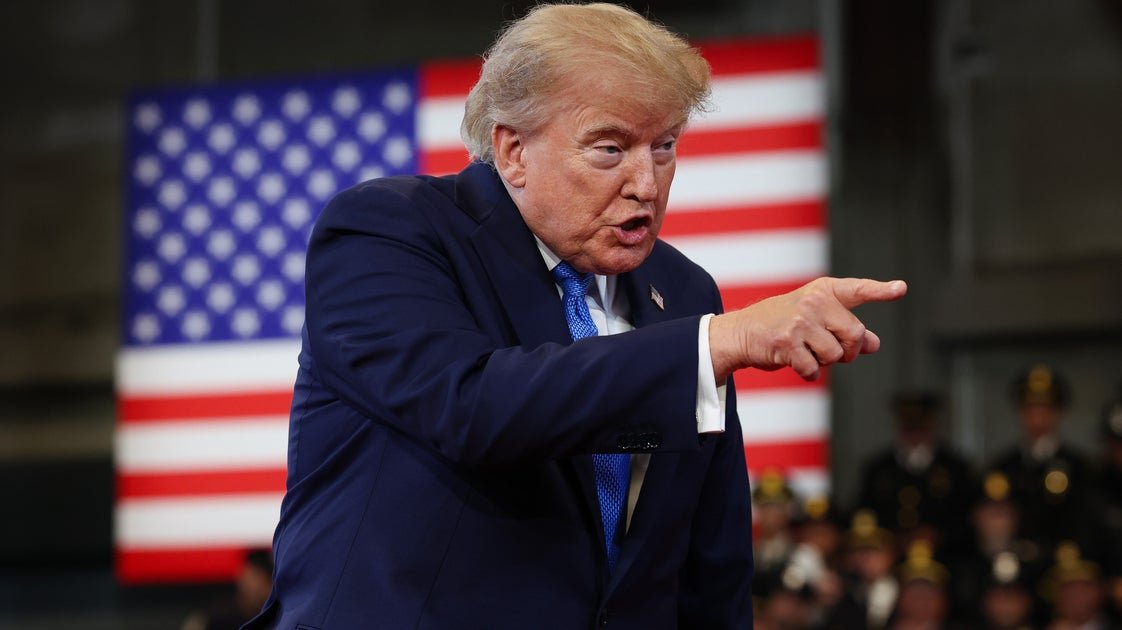

The Department of Homeland Security sparked attention on Monday night after posting a photo of President Donald Trump with the caption, “Did you remain loyal?”
The post was in response to a screenshot of numerous Insider Wire posts about Immigration and Customs Enforcement, the Trump administration’s plans to revoke visas of asylum-seekers, and mail-in ballot restrictions. People on social media responded with fierce criticism, saying the post appears to be “about trying to scare people who don’t support trump” and emphasizing that they’re loyal “to the Constitution, not a man.”
The DHS tweet’s message of loyalty fits into Trump’s broader obsession with the attribute — one that predates his current administration. And the concept of loyalty in government isn’t new either.
“There’s a long history of loyalty tests and loyalty checking in the government, dating back to probably before the Civil War,” Tevi Troy, an author and U.S. deputy secretary of health and human services under former President George W. Bush, told HuffPost.
Typically, the presidential loyalty-sorting effort — a part of the transition — involves checking to ensure candidates will adapt to what the new administration is looking for. “During the Bush years, [it was asking people] ‘Did you work for McCain?’ That kind of stuff — ‘Who did you work for, would you [still] represent [them]?’” Troy said.
But the significant differences in this situation are that there is not a presidential transition underway and the social media post seems to question the loyalty of Americans rather than of job candidates. Experts also told HuffPost the expectation of loyalty seems to go deeper than it has in previous administrations.
When asked to expand on the tweet’s meaning, DHS told HuffPost, “The message is simple: enforce the law, secure the border, and protect the American people. It just so happens that when you uphold these values, you make America great again.”
“Spare us the manufactured outrage,” the DHS spokesperson continued. “Social media does not rewrite the Constitution and pretending otherwise is unserious. DHS will not apologize for standing behind its mission.”
When asked what he thought of the DHS post’s messaging on loyalty, Troy told HuffPost, “I don’t even know what that means.”
Other experts were less puzzled and more alarmed by what it could signal.
“It’s stunning to see a federal agency — one with policing power, no less — calling on Americans to express their loyalty to the president,” Kevin Boyle, a professor of American history at Northwestern University, told HuffPost. “It’s just one more instance of the authoritarian tendencies that infuse the Trump administration, as the president and his appointees have tried to twist patriotism.”
Brendan J. Nyhan, a professor at Dartmouth College who studies political misinformation and communication, told HuffPost he found the post “ominous,” almost as if DHS is “trolling” the public.
“I don’t know of a clear post-Watergate precedent for the DHS post,” Nyhan said. “The president and the national security state should never demand personal loyalty.”
Trump has spoken about loyalty a number of times. When Karoline Leavitt announced earlier this month that she was stepping down as press secretary, Trump initially publicly praised her. But when asked in a Fox News interview on Aug. 14 whether Leavitt was replaceable, Trump joked he’d “found out” she liked her children more than she liked him and he was “very concerned about that.” He repeated this at a Rose Garden event on Monday, telling the crowd Leavitt “loved her children more than she loved Donald Trump” and he was “very upset.”
“No previous president has demanded obeisance in the manner of Donald Trump, who explicitly pursues an agenda of persecuting, prosecuting and punishing any individual, company or nation that he perceives as disloyal,” Kari Winter, a professor of American studies at the University of Buffalo, told HuffPost.
Winter connected this “demand of loyalty to the leader” to fascist and totalitarian beliefs, which prioritize loyalty as a nonnegotiable obligation.
Even before running for president, Trump made it very clear loyalty was a personal and professional value that should be a core requirement for his staff and allies.
“I hire people who are honest and loyal. I value loyalty very much,” Trump wrote in his 2007 book, “Think Big and Kiss Ass in Business and Life.” “I value loyalty above all else — more than brains, more than drive, and more than energy.”
In June 2017, former FBI Director James Comey testified that Trump told him, “I need loyalty, I expect loyalty” during a conversation over dinner on Jan. 27 of that year. Comey, who was still FBI director when the dinner took place, said Trump brought up loyalty again toward the end of dinner, telling Comey, “That’s what I want, honest loyalty.”
In June of this year, Trump told NATO Secretary-General Mark Rutte, “I just want their loyalty. We don’t need their money,” referring to U.S. allies abroad amid the war in Iran. “We don’t need anything. We have the most powerful military in the world by far, but I just want loyalty. You know, we’re so loyal to them.”
“Federal agencies that proclaim their loyalty and obedience to the president are failing to do the work that taxpayers are paying them to do,” Winter told HuffPost. “Abject expressions of loyalty are the only effective way to curry favor with Trump.”