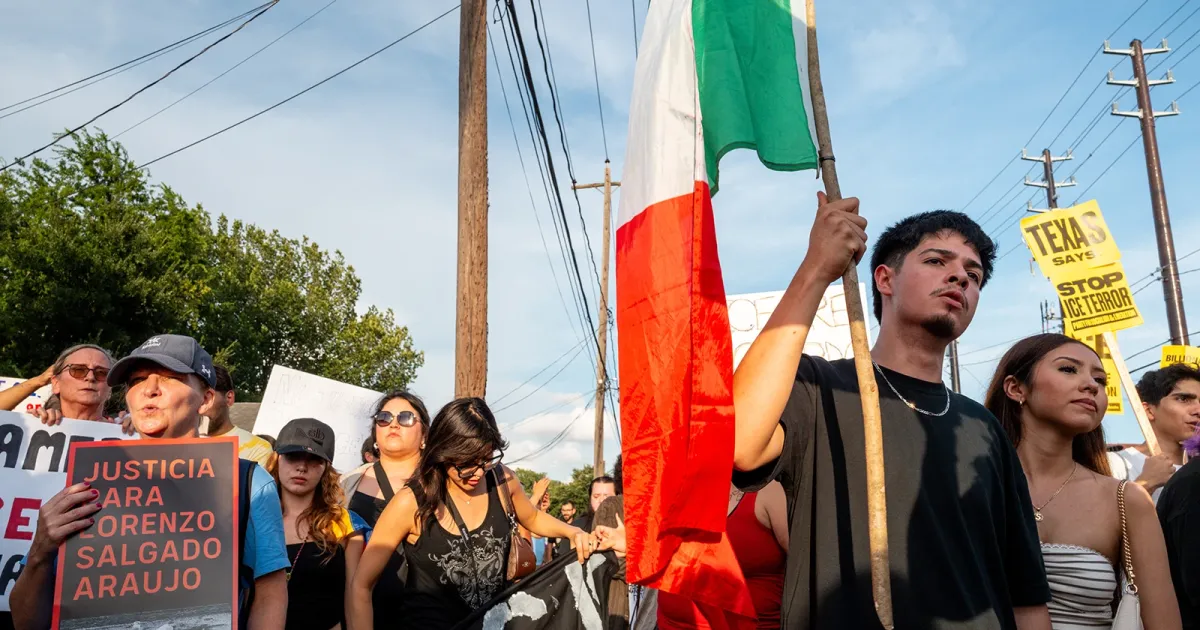

Last Thursday, during a traffic stop in Houston, Immigration and Customs Enforcement agents shot and killed Lorenzo Salgado Araujo, a Mexican national who lived in the United States for 35 years. Salgado is at least the 10th person to be shot and killed by ICE and Customs and Border Enforcement officers since the start of the second Trump administration — and the 17th Mexican to either be fatally shot by ICE or to die in ICE detention, a death toll that has prompted the Mexican government to formally demand an investigation.
Unsurprisingly by now, ICE’s account of the shooting and the subsequent behavior of its agents are raising multiple red flags.
To start, ICE said the shooting was justified because Salgado “weaponized his vehicle,” jargon for saying he tried to run over the officers who stopped his white van. But as The New York Times was quick to point out, this is a common claim made by ICE to justify its violence, but one that has repeatedly fallen apart under scrutiny. Already the three men who were passengers in the van driven by Salgado are disputing ICE’s account, saying that Salgado never swerved and that ICE officers fired almost immediately upon stopping the van.
Unfortunately, it is not clear if this growing mainstream distrust of ICE’s defense of violence will translate into any more accountability for ICE.
In this case, refuting the officers’ claim may be tricky — but only because the officers were not wearing body cameras. An ICE spokesperson blamed the lack of cameras on “back to back Democrat [sic] shutdowns,” but, of course, the Republicans controlled Congress during those shutdowns, and the One Big Beautiful Bill Act gave ICE so much money (roughly $75 billion) that it was essentially unaffected by the shutdown in the first place. And perhaps most important, it was the Trump administration itself that was working hard to thwart the rollout of bodycams.
On top of this, the lawyers of the men ICE arrested in Salgado’s van — the ones claiming vehicular “weaponization” never happened — are alleging that ICE is putting pressure on them to self-deport. This would, of course, make their testimony harder to obtain. And perhaps even more troublingly, ICE officers stripped Salgado of all his identification before putting him in the ambulance after shooting him, which delayed identification after he died at the hospital.
At this point, none of this should come as a surprise. What is surprising to me is the extent to which the media has covered this shooting with much more immediate skepticism than they usually seem to initially bring to incidents of police violence. The Times, for example, immediately noted that ICE had no evidence for its claim, and PBS coverage introduced ICE’s claim with a headline that noted ICE officers “don’t provide evidence.” The Washington Post reframed the entire issue, making the dispute of ICE’s claims the headline of its article.
This swift wariness of ICE’s account is well-earned, given the agency’s increasingly documented acts of seeming deception and dishonesty, certainly when it comes to claims of “vehicle weaponization” in particular, but more broadly as well.
Perhaps most famously, ICE’s claim in Minneapolis that Renee Good attempted to run down ICE agent Jonathan Ross was carefully debunked by the Times. A federal judge in Chicago dismissed two charges involving allegations that someone tried to ram ICE agents, when the case fell apart so completely that the Justice Department had to request that the charges be dropped. In Maryland, the local police took the unusual step of openly contradicting an ICE account of events, noting that a car passenger ICE said suffered whiplash when the driver allegedly tried to drive over the agents had been arrested hours before and was already in ICE custody when he was injured. In fact, last year another federal judge in Chicago explicitly said that ICE’s dishonesty over “weaponized vehicle” incidents during Operation Midway Blitz in Chicago made it “difficult, if not impossible, to believe almost anything that [ICE] says” (emphasis mine).

John Pfaff
John Pfaff is a professor of law at the Fordham University School of Law. He is the author of “Locked In: The True Causes of Mass Incarceration and How to Achieve Real Reform.”