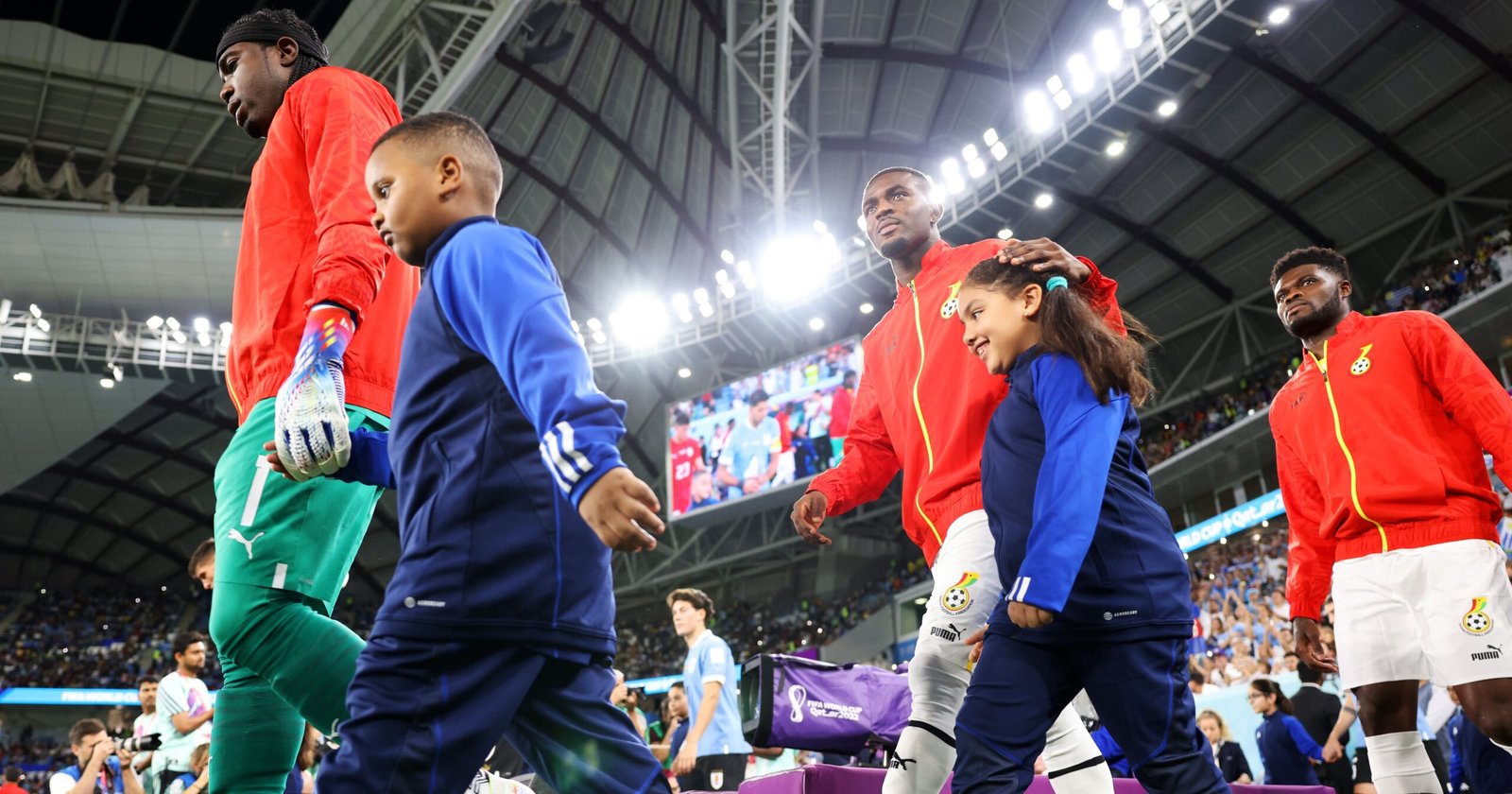

The World Cup 2026 is officially here, which means it’s time for my favorite pregame ritual. If you’ve ever watched the opening ceremonies of a soccer match, you’ve probably noticed this sweet detail: the players always walk onto the field holding the hands of kids, who are dressed like an adorable little squad themselves. Or maybe you’ve seen one of the many videos that’s gone viral, featuring a cute moment between a young fan and a soccer hero as they stand together on the field. Regardless, it always makes me tear up. There’s something incredibly pure and heartwarming about watching the younger generation escort their heroes and role models onto the biggest global stage.
But how did the longstanding tradition responsible for cleaning me out of Kleenex even begin? It’s rarely explained during international tournaments such as the World Cup or the Euros, but we did some digging to find out.
The children who walk out with the players are called “player escorts” or “mascot children,” and they’ve been part of soccer games for well over 20 years now. One of the earliest photos of children walking as mascots was published in the Liverpool Echo after a November 1996 match between Liverpool and Everton. Beginning around 2000, the practice as it is today began: one escort for each player, rather than just one or two per team.
Early on, the practice of having children escort the players doubled as a way to raise awareness for charitable causes. Ahead of the 2002 FIFA World Cup, FIFA and UNICEF partnered on a program called Say Yes For Children, which aimed “to promote and protect the right of all children to healthy recreation and quality primary education,” according to a 2002 UNICEF press release. The statement continued: “Children are being given a prime role at each match, accompanying each player onto the pitch in a symbolic action reminding football enthusiasts that they have a major role to play in building a world fit for children.”
Starting in 2002, McDonald’s became a key sponsor of the mascot program at the World Cup and European Championships, offering parents and children a chance to enter a sweepstakes to win one of those coveted spots. In 2014, McDonald’s reportedly sent 1,400 kids from 70 different countries to the World Cup in Brazil, according to ABC News.
At the 2023 FIFA Women’s World Cup in Australia and New Zealand, sponsor Commonwealth Bank created the CommBank FIFA Women’s World Cup 2023 Player Escort Programm. Through the program, a total of 1,500 children between the ages of 6 and 10 accompanied players onto the pitch before matches throughout the tournament.
In other cases, however, being a mascot might be as simple as paying the price tag. A 2018 investigation by The Guardian revealed that a large number of Premier League teams often charge between £150 and £600 for kids to be escorts at a match. The “mascot packages” often include more than just a place as a mascot — kids are also given gear, autographs, or other swag — but the practice has drawn criticism for excluding kids from less affluent backgrounds.
This year, FIFA partners Quaker and Common Goal are facilitating the player escort program, using the opportunity to build awareness around daily nutrition for families and communities. After completing more than eight hours of educational programming focused on nutrition and wellbeing, 1,738 young people from underserved communities were chosen to “step onto soccer’s biggest stage,” per Common Goal.
“For many of these young people, this will be far more than a walk onto the pitch. It is a moment of recognition, belonging, and possibility on the biggest stage in football,” said Mary Connor, Common Goal CEO. And for audiences, it’s a reminder that there’s more to soccer (or any sport) than the outcome of the game.
— Additional reporting by Alexis Jones
Amanda Prahl is a freelance writer, playwright/lyricist, dramaturg, teacher, and copywriter/editor. Amanda has also contributed to Slate, Bustle, Mic, The Mary Sue, and others.
Alexis Jones is the section lead of the health and fitness verticals at Popsugar, overseeing coverage across the website, social media, and newsletters. In her seven-plus years of editorial experience, Alexis has developed passions for and expertise in mental health, women’s health and fitness, racial and ethnic disparities in healthcare, and chronic conditions. Prior to joining PS, she was the senior editor at Health magazine. Her other bylines can be found at Women’s Health, Prevention, Marie Claire, and more.