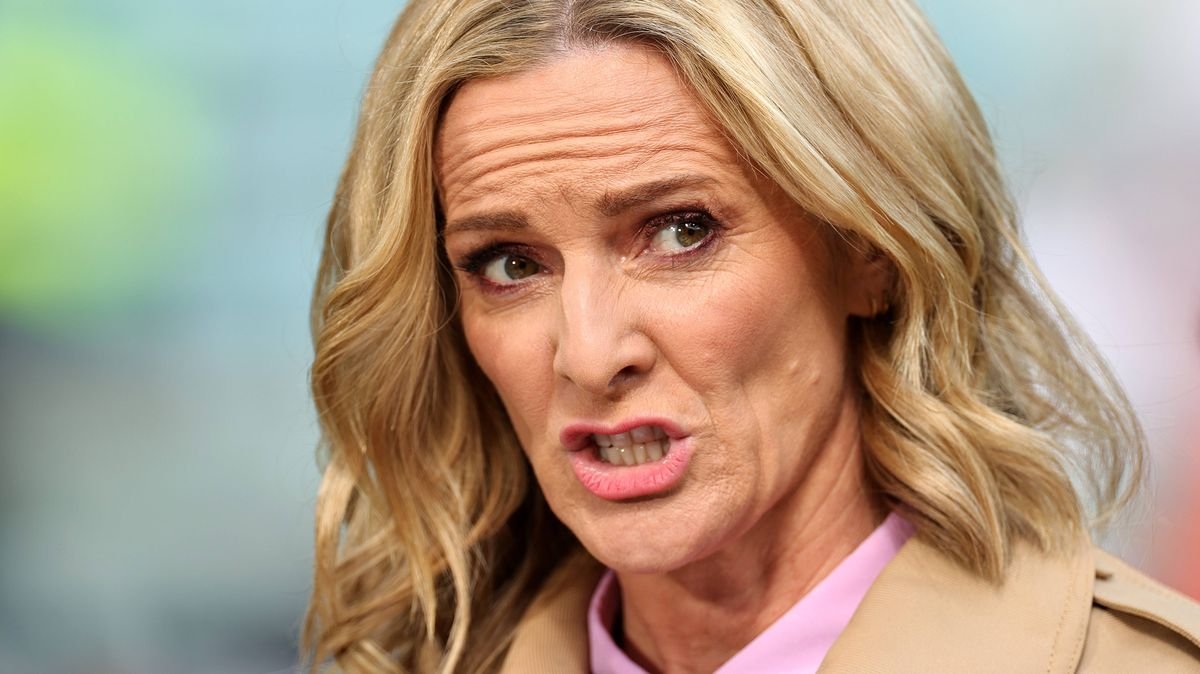

Badenoch dismisses Starmer’s proposed child phone nudity ban, saying general social media ban ‘much simpler’
Kemi Badenoch has claimed that Keir Starmer does not have a “proper plan” to stop children using phone to take naked pictures.
Responding to this morning’s announcement, she claimed that a simpler solution would be to stop children under the age of 16 using social media – a policy the Conservatives have been advocating for some time.
Asked about the Starmer plan, she told the Press Association:
I think the move today is an idea without a proper plan behind it.
I don’t want to see children being able to send nudes, but I don’t know exactly how the government is looking at this.
A much simpler way of dealing with these things is getting children off social media rather than piecemeal measures that are tackling the problems issue by issue.
We’ve got to go much further than that.
(Starmer’s proposal is not an alternative to a social media ban for teenagers; a further announcement about a ban, or at least tighter restrictions, is coming soon. See 8.27am.)
Asked whether she would back a ban on social media that goes up to the age of 18, as suggested by the children’s commissioner for England, Rachel de Souza (see 9.16am), Badenoch replied: “I think that 16 is an appropriate age for children to start using social media.”
Key events
Labour leadership contenders challenged to back Lib Dem plan for £3bn ‘essential energy guarantee’, funded by windfall taxes
Governments have two main options when they consider policies that could help families with fuel bills. They can opt for a universal approach, with help for everyone (for example, in the form of a cap on unit prices, or a cash handout). Or they can target help at those most in need (for example with social tariffs, cheaper unit prices for low-income families).
At a press conference this morning Daisy Cooper, the Lib Dem Treasury spokesperson, and deputy party leader, announced proposals for a £3bn a year “essential energy guarantee” that would combine elements of both approaches. It is based on a plan proposed by the Joseph Rowntree Foundation thinktank.
Under the Lib Dem plan, everyone would get some of their energy at a reduced rate. The Lib Dems say:
This plan would help protect people from global price shocks by giving every household in Britain a basic energy allowance, equivalent to 50% of average energy consumption, at a discounted rate.
This would save the average family around £100 off their energy bill, helping all households to meet their basic energy needs.
But there would also be extra help for bigger families, and poor households.
Families with children would receive an extra portion of discounted energy for each child. Disabled people and the poorest in society, in receipt of means-tested benefits, would receive a discount on all of their energy usage.
The Lib Dems say this would cost £3bn a year. They would raise £2.5bn for it by clawing back what they describe as a £5bn windfall made by energy companies under Ofgem’s RIIO-2 price control framework. They explain:
A flaw in Ofgem’s “RIIO-2” price control framework has rewarded network operator companies with around £5bn in undeserved profits, which are over and above what Ofgem believes is reasonable. Ofgem mistakenly assumed that network companies’ borrowing costs would rise with inflation, but the companies had already locked in their borrowing at historically low fixed interest rates. When inflation spiked, this allowed network companies to pocket the difference.
The Lib Dems would also get another £500m a year from the windfall on banks they proposed last year.
At her news conference, Cooper challenged potential Labour leadership contenders to accept this plan. She said:
Energy is not a luxury. It’s a basic human need. It’s essential. Every single household in Britain should be able to afford their basic everyday energy needs regardless of what happens in global energy markets, and regardless of who happens to be sitting in No 10 …
Labour’s leadership contenders have a choice: turn a blind eye to the windfall profits of energy network operators and big banks, or step in to guarantee basic dignity for families. Commit to introducing our essential energy guarantee within your first 100 days.
Badenoch dismisses Starmer’s proposed child phone nudity ban, saying general social media ban ‘much simpler’
Kemi Badenoch has claimed that Keir Starmer does not have a “proper plan” to stop children using phone to take naked pictures.
Responding to this morning’s announcement, she claimed that a simpler solution would be to stop children under the age of 16 using social media – a policy the Conservatives have been advocating for some time.
Asked about the Starmer plan, she told the Press Association:
I think the move today is an idea without a proper plan behind it.
I don’t want to see children being able to send nudes, but I don’t know exactly how the government is looking at this.
A much simpler way of dealing with these things is getting children off social media rather than piecemeal measures that are tackling the problems issue by issue.
We’ve got to go much further than that.
(Starmer’s proposal is not an alternative to a social media ban for teenagers; a further announcement about a ban, or at least tighter restrictions, is coming soon. See 8.27am.)
Asked whether she would back a ban on social media that goes up to the age of 18, as suggested by the children’s commissioner for England, Rachel de Souza (see 9.16am), Badenoch replied: “I think that 16 is an appropriate age for children to start using social media.”
Earlier I said that Andy Burnham seems to be winning the Makerfield byelection campaign. (See 8.27am.) That was based in part on the two Survation poll from the constituency, the second of which put Burnham 10 points ahead of Robert Kenyon, his Reform UK rival.
In a new post on his Substack blog, the pollster Peter Kellner looks at those polling figures in detail. The first poll had Burnham three points ahead, but Kellner argues that that there was a glitch with the turnout weighting and that it should have had Burnham six points ahead. Kellner also argues that latest figures show tactical voting is helping Labour. He explains:
When we make that adjustment to the first poll, the story of the by-election so far becomes clear. Tactical switching is underway. At the general election two years ago, the Greens, Liberal Democrats and Conservatives together won 22 per cent of the vote. At the start of the by-election campaign, the figure was already down to ten per cent. Now it is just four.
The five-point rise in Labour’s support in the latest poll matches the fall in Green and Lib Dem support, while smaller changes have seen Reform and Restore up and the Tories down. Overall, tactical voting is helping Labour more because it has now enjoys a near-monopoly of the progressive vote (49 out of 52 per cent), while Reform has been unable to squeeze Restore’s support. The overall left-right balance has stayed the same: Labour plus Green plus Lib Dem remain on 52 per cent, while Reform plus Restore plus Conservative amount to 47 per cent in both polls.
Kellner concludes saying he thinks a “big win” for Burnham, which he defines as Burnham winning with a bigger majority than the combined Reform UK and Restore Britain vote, is “more likely than not”. But he would not bet on it, he says.
And these are from my colleague Jessica Elgot on the Starmer announcement.
Keir Starmer’s speech on nudity apps encapsulates much of Labour’s MPs frustration with him. “Ultimatums” rather than action. Talk big, act small. Perhaps you then eventually do act big but not without losing an awful lot of goodwill in the process.
“Britain back in the heart of Europe” but within my arbitrary red lines. Or abolishing hereditary peers but letting the Tories convert a load to life peers. Workers rights but not implemented for years. All gives the impression of someone dragged kicking and screaming to enact their own policies.
Here is Rajeev Syal’s story about Keir Starmer’s announcement this morning.
UK will have ‘one of most authoritarian internet regimes in world’ under child phone nudity rules, says Big Brother Watch
Big Brother Watch, the civil liberties and privacy campaign group, is outraged by the government’s proposal to force tech companies to activate restrictions to stop children using their phones to take naked pictures. Silkie Carlo, its director, said:
Protecting children online is vital, but these are outrageous plans that will fail to address the underlying causes of online harm. This will only result in population-wide ID checks for all of us to use our phones, tablets and laptops.
Put simply, the Labour Government is threatening ID checks for the internet. No one in a democracy should need to show their passport just to get online.
These plans would replace efforts for meaningful tech and parental responsibility with performative, authoritarian government control that children can easily circumvent by accessing adult-registered devices. However, for the UK’s 50 million adults using the internet, this backdoor digital ID requirement would invoke the death of anonymity and internet privacy.
The government’s plan very likely means that unless you submit to intrusive identity checks when setting up your phone or computer, there will be a chokehold on your software and internet access leaving you with a child-locked device. Planned restrictions on messaging, streaming and browsing raise the potential of spyware in our pockets that will be exploited for other purposes before long.
The government mandating that all phones in Britain require ID and surveillance software is a crossing of the Rubicon that would make the UK one of the most authoritarian internet regimes in the world. This extreme technological censorship requires rigorous public and parliamentary scrutiny that is currently totally missing.
Online safety campaigners have welcomed the government’s announcement about forcing tech companies to stop children taking naked pictures on their devices.
This is from Chris Sherwood, chief executive at the NSPCC.
Online grooming, sexual exploitation and the proliferation of child sexual abuse material could be prevented if tech companies did the right thing and introduced nudity blocking technology on children’s phones.
Every day these protections are not in place, more children will continue to face devastating harm in the online world. That’s why we strongly support government’s decision to make it mandatory for these companies to block inappropriate material at device level. This marks a major step forward in our fight against online child sexual abuse.
And this is from Kerry Smith, CEO at the Internet Watch Foundation.
An alarming amount of child sexual abuse material, which our analysts see every day, is self-generated by children as a result of grooming, coercion or manipulation. We need device-level detection and blocking alongside platform-level protections.
That is why we warmly welcome the government’s announcement and see these protections as playing a powerful role in a whole-system response to the threats children face in digital spaces.
Measures to stop children using phones for naked images ‘already exist’ but not applied by tech firms, government says
The government has highlighted work done by the internet safety firm SafeToNet as showing that the technology is already in place that would allow tech companies to stop children using phones to take naked pictures of themselves, or other people. The Home Office says:
Measures to protect children already exist within smartphones and tablets, but are applied inconsistently, often switched off by default and only blurring content rather than blocking it. But the government is working closely with technology companies — some of whom, like Apple, have already taken steps to implement protective features — to make this goal a reality.
Companies must introduce these measures without threatening privacy or collecting any data. The device should simply block harmful content across all apps and services. Over-18s will still be able to view adult content by providing proof of age.
British safety tech firm SafeToNet has shown this change is already achievable, with software that blocks nude content and prevents images being taken if the camera detects a child.
And this is from Richard Pursey, chair of SafeToNet.
The government is right to act. Children have been failed for too long. This news will be welcomed by parents across the UK and hopefully, will inspire other countries to follow the UK’s lead.
We can put an end to so much online misery with this approach. SafeToNet’s HarmBlock technology is a proven example that it is possible to make the device safe by default and not as some optional add-on.
We have proven that with HarmBlock, on-device, tamperproof, embedded safeguards can prevent children from seeing, filming and broadcasting explicit content. It works in real-time including livestream and crucially also protects the privacy rights of the child as no data enters or leaves the application.
Let’s be blunt: manufacturers have built devices capable of facilitating illegal, explicit, image-based harm to children. That’s the reality. But with this world-leading announcement we are finally shifting the battle ground of a child’s online safety to the device.
Home Office says existing phones and tablets, as well as new ones, should be covered by proposed child nudity rules
The Home Office says the restrictions it wants tech companies to impose to stop children using their phones to take naked pictures would apply to all UK devices, not just new ones. In its news release it says:
The changes will apply to UK devices, including both existing and newly sold smartphones and tablets. Legislation could cover operating system providers and others in the supply chain, such as retailers, and will not affect the use of devices owned and used by adults who verify their age …
Apple recently introduced age checks for iPhone users, making it the first company to activate safety features by default for those who are not verified as over 18. This is a significant step forward following the government’s commitments to work with industry, and one this announcement builds on.
Despite this, the nudity detection is not applied to the camera or broader apps, third-party messaging services, or search functions, meaning children can still take, view, share and save nude images. The government therefore wants Apple and Google to block nudity across the whole device by default, so they can only be deactivated via age assurance.
UK to be first country in world where it will be impossible for children to take naked pictures on phones, Home Office says
The Home Office says the ban being proposed today to make it impossible for children to use their phones to take naked images of themselves or others would be a world first. In a news release it says:
In Britain will become the first country in the world where it is impossible for children to take, share or view naked pictures on their devices, the prime minister announced today in a speech at London Tech Week.
Under new plans, Big Tech companies like Apple and Google must activate built-in features or implement technical solutions on smartphones and tablets to detect and block nude images for children.
This will prevent predators from being able to exploit and abuse victims through their devices, as well as stopping children from being able to access pornography. Adults will still be able to take, share or view nude content through an age verification process.
Now is the time for tech companies to step up and work with government to solve this horrific issue. If companies do not act within three months, the government will bring forward legislation to force them to activate the technology. This will include fines for companies. Nothing is off the table, and as a last resort we are exploring criminal liability for tech bosses who fail to comply.
In his speech Starmer cited the government’s response to Grok, when its AI tool was being used to allow people to produce non-consensual intimate images, as an example of how the government would stand up to tech companies.
He said:
Where technology poses a threat to our people, to our children, we will act quickly and firmly.
We saw that earlier this year with Grok. They allowed their tools to be used to create disgusting, explicit images.
So we took them on, and all tech companies should know if they fall short on their responsibility to keep people safe. We will act with the same decisiveness.
Starmer says government will legislate if tech companies don’t stop children using phones to take naked images
Keir Starmer has announced that tech companies must stop children from sending or receiving naked images of themselves, or the government will change the law.
In his speech, Starmer said:
One issue is the ability for children with phones to send and receive nude images.
For too long, people have been told that is simply the price of modern tech, that nothing can be done, that government is powerless, that parents just have to accept it.
I reject that completely, because tech should adapt to the needs of society, not the other way around.
That is why today I am calling on tech companies operating in this country to introduce device controls that prevent children from sending and receiving sexually explicit images.
Because this is not an impossible challenge. These are some of the most innovative companies in the world and I believe they can solve it.
But if they choose not to, then we will act and we will change the law because when it comes to the safety of our children, standing by is not an option.
When Jess Phillips resigned as safeguarding minister last month, she criticised Starmer for not acting more quickly to implement this plan. She said she was pushing for this more than a year ago.
Starmer praised the tech entrepreneurs in his audience for their contribution to the UK’s tech investment record. (See 9.24am.)
Half of all European tech investment in this country – that’s a profound achievement and it belongs to so many people in this room.
But that hasn’t happened by accident. Each one of those investments is an endorsement of British talent, of British industry, and of the approach that Britain is taking, approach that has in no small part been shaped by so many people in this room and by the conversations that we’ve had in the last two years.
Starmer gives speech at start of London Tech Week
Keir Stamer is giving his speech, making the start of London Tech Week.
He began by saying the UK is uniquely placed to lead the world in the technological revolution. And it was a revolution “with the potential to transform lives, to strengthen communities, and create opportunities right across the country and a revolution that Britain is uniquely placed to lead”.
Starmer said:
Britain is the third-largest technology economy in the world. Our start-ups have raised close to half of all European investment in tech this year.
Children’s commissioner for England says restrictions on social media should cover 16 and 17-year-olds too
The Times this morning is reporting that Keir Starmer will soon announce a ban on “harmful” social media platforms for under-16s. (See 8.27am.) In their story, Max Kendix, Stefan Boscia and Oliver Wright say:
Those familiar with the proposals said the prime minister was looking at a “hybrid” system that would include elements of the Australian ban and the outlawing of specific features such as infinite scrolling, push notifications and autoplay.
One source claimed the proposals could have more “granular” age restrictions by limiting certain features and sites to different age groups rather than a blanket under-16s ban like in Australia.
Dame Rachel de Souza, the children’s commissioner for England, has urged the government to go further. In an interview with the Daily Telegraph, she said she would like to see restrictions cover 16 and 17-year-olds too, and apply to gaming platforms as well as social media sites.
She said:
If we are genuinely seeking to safeguard children from harm, we cannot allow 16- and 17-year-olds to have lesser protection …
I am calling for all online services – not just social media platforms, but gaming sites and any platforms that make use of harmful features and functionalities – to be banned from accessing children, until they can prove that they are designed in a way that will protect children’s safety and wellbeing.
De Souza recently co-chaired a review for the government with Russell Viner, an adolescent health professor, that produced guidance for parents on screen use by under-5s. She and Viner are now producing for the government guidance on at what age children should get a smartphone.
In an interview on the Today programme this morning, she said that while children say they don’t like the principle of being banned from accessing social media, they also say that their social media use is bad for them, for example affecting their sleep, and they want help reducing it.
She said for the first time in six years she was “optimistic” about the government being ready to take action.
But children should not get the blame, she stressed. She told the programme:
[We should] ban the companies from having access to our children until they prove that they are actually worthy of them. If they’ve got these terrible algorithms, of course they should be banned.
I just want to frame it not as a ban on children – the children have done nothing wrong. We are protecting children by not allowing these companies to have access to them.
US defence secretary Pete Hegseth ‘lacking in class’ when he launched anti-migration rant at D-day ceremony, minister says
Jacqui Smith, the skills minister, has argued that Pete Hegseth, the US defence secretary, lacked “class” when he used a speech at a D-day commemoration service to criticise European countries over their record on immigration.
As Ashifa Kassam reports, Hegseth’s speech has been condemned across Europe and beyond.
This morning Smith, who has been doing a media round, joined the chorus. Asked on LBC if Hegseth was right, she replied:
No, he’s not right, and no, I think it’s a bit lacking in class to raise it at a ceremony like that.
Smith said there had been “very big reductions” in net migration under Labour and “we will continue to take action on the things that I think people are really worried about, particularly those who are coming across the Channel in small boats.”
Keir Starmer to say ‘tech revolution must work for everyone’ in speech on AI
Good morning. Two weeks today, it seems more likely than not that Andy Burnham will be taking his seat as the new MP for Makerfield. A byelection win is not certain, but the campaign is definitely going his way. Keir Starmer has been saying he won’t just stand aside and let Burnham replace him as Labour leader, but these briefings are being received with a hefty dose of scepticism.
The unnamed minister quoted in today’s Times splash gives a more realistic guide to what is happening. They say:
Keir has entered his legacy era. The conversations are now all, ‘What is announceable in time before Makerfield?’
The Times says that one of these legacy ‘announceables’ will be a ban on “harmful” social media (ie, not all social media) for under-16s. The PM wants to announced that before the byelection, the paper says.
Starmer is also giving a speech on technology this morning. According to the extracts briefed in advance, he will the “tech revolution must work for everyone”. He will say:
No one doubts the huge potential of tech to change lives. But we have to decide who that change is for. This government’s choice is clear: the tech revolution must work for everyone, not just a privileged few.
We’re backing British businesses to lead the way, driving growth and investment that turns into more jobs and stronger communities. And we’re using tech to bring opportunity to every corner of the country – helping people into work, tackling inequalities, boosting skills and building a fairer future.
There was also a mini news announcement in the overnight briefing – but not one that will be remembered by anyone writing about Starmer’s legacy. He will say the Department for Work and Pensions is trialling what it calls an “AI work assistant” to help the jobless find work. No 10 says:
The tool will provide a 24/7 resource for people, offering guidance on topics such as career development, job searching and applications. The trial will last for around three months, to gather data and feedback on how people are using the service so that it can be adapted and improved as necessary.
You can access the tool here, although you will need a GOV.UK login.
There may be other news in the speech too.
Here is the agenda for the day.
Morning: Keir Starmer is giving a speech on technology and AI.
10am: Daisy Cooper, the Lib Dem Treasury spokesperson and deputy leader, holds a press conference on tackling energy bills.
Morning: Kemi Badenoch is on a visit in London where she will be speaking to the media.
11.30am: Downing Street holds a lobby briefing.
1pm: Zack Polanski, the Green party leader, speaks at the Bakers, Food and Allied Workers union conference.
1.15pm: Liz Kendall, the technology secretary, gives a speech at the AI adoption summit.
2.30pm: Shabana Mahmood, the home secretary, takes questions in the Commons.
If you want to contact me, please post a message below the line when comments are open (between 10am and 3pm), or message me on social media. I can’t read all the messages BTL, but if you put “Andrew” in a message aimed at me, I am more likely to see it because I search for posts containing that word.
If you want to flag something up urgently, it is best to use social media. You can reach me on Bluesky at @andrewsparrowgdn.bsky.social. The Guardian has given up posting from its official accounts on X, but individual Guardian journalists are there, I still have my account, and if you message me there at @AndrewSparrow, I will see it and respond if necessary.
I find it very helpful when readers point out mistakes, even minor typos. No error is too small to correct. And I find your questions very interesting too. I can’t promise to reply to them all, but I will try to reply to as many as I can, either BTL or sometimes in the blog.