
Policing minister Sarah Jones calls for calm and says police should review anti-racism guidance
Good morning. Keir Starmer spoke for many people yesterday when he said that he felt “sick” watching the video of Henry Nowak being handcuffed as he lay dying, while a police officer who had been told Nowak had committed a racist assault ignored Nowak saying he had been stabbed. Starmer’s was a good faith response to the tragedy, which saw Nowak’s killer jailed for life on Monday.
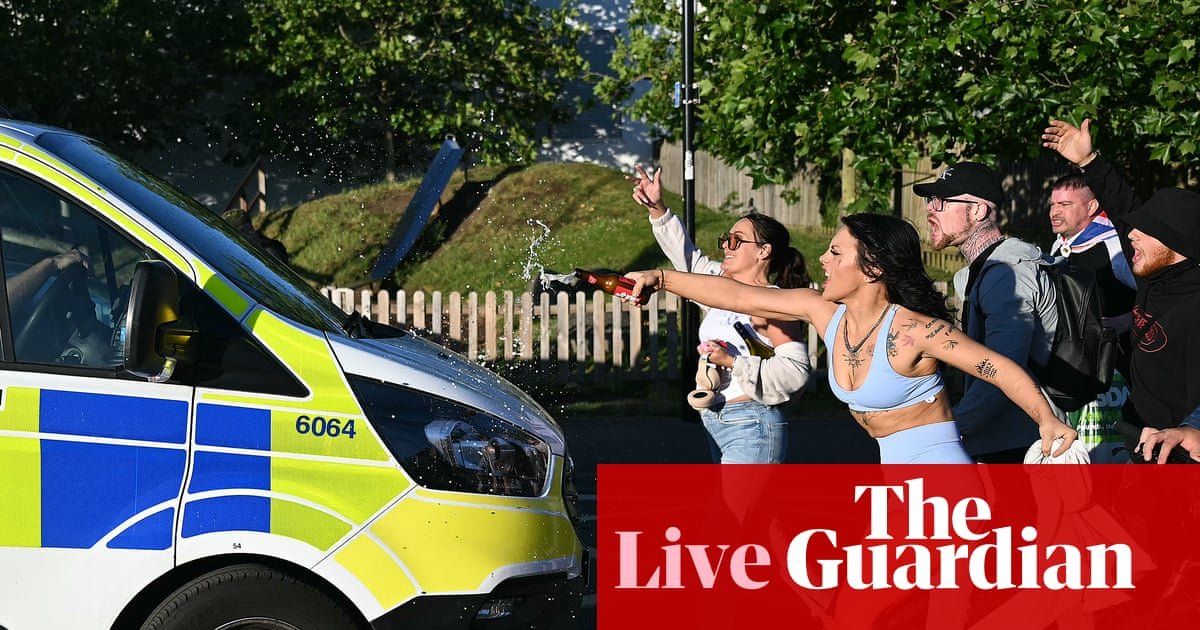
But there have been plenty of bad faith responses to the murder too, which culminated in rioting in Southampton last night. Here is our overnight story about yesterday’s events.
And here is Steven Morris’s report on the rioting.
Sarah Jones, the policing minister, has been giving interviews this morning. Speaking to Times Radio, she said the rioting was unacceptable and she said there had been two arrests, “one for assault of a police officer, one for possession of a weapon”.
She also appealled for calm, saying:
We are urging that people take the anger that they feel, which I understand, but let’s allow justice to do its course, and let’s not over-react, which indeed is what the family are asking us to do as well.”
Shabana Mahmood, the home secretary, issued her own statement last night.
In her interviews this morning, Jones also said the government wanted an official “police anti-racism commitment” reviewed. In the Commons yesterday Chris Philp, the shadow home secretary, saying that this document was “morally wrong”, claiming that it “urges police forces to reverse engineer the same arrest rates between ethnic groups, even though the offending rates are different, by treating different ethnic groups differently”. (In fact it does not say that, although arguably that it what its call for “equality of policing outcomes for people from different ethnic groups” implies.) In the Commons Mahmood gave a non-committal response to Philp. But now the Home Office wants it reconsidered
Asked about the document, Jones told BBC Breakfast that the National Police Chiefs’ Council were reviewing the document. She went on:
We don’t think that language is is right.
It is right to say, and it is important to say, that there is … a long history of racism in policing that we need to acknowledge, and we need to make sure isn’t there.
Of course, in all the training that is done with police officers, it’s an aspect that they are trained on.
This document feels like it’s not right, and I think it’s right that the NPCC are reviewing it.
I will post more from her interviews shortly.
Here is the agenda for the day.
Noon: Keir Starmer faces Kemi Badenoch at PMQs.
After 12.30pm: MPs hold a debate on the Peter Mandelson files released on Monday.
2.30pm: Scientists and experts from the Climate Change Committee and other bodies give evidence to the Commons environmental audit committee on extreme weather.
3.30pm: Rachel Reeves, the chancellor, is speaking at at the Creating a Scientific Superpower Conference on the Oxford-Cambridge Growth Corridor.
If you want to contact me, please post a message below the line when comments are open (between 10am and 3pm), or message me on social media. I can’t read all the messages BTL, but if you put “Andrew” in a message aimed at me, I am more likely to see it because I search for posts containing that word.
If you want to flag something up urgently, it is best to use social media. You can reach me on Bluesky at @andrewsparrowgdn.bsky.social. The Guardian has given up posting from its official accounts on X, but individual Guardian journalists are there, I still have my account, and if you message me there at @AndrewSparrow, I will see it and respond if necessary.
I find it very helpful when readers point out mistakes, even minor typos. No error is too small to correct. And I find your questions very interesting too. I can’t promise to reply to them all, but I will try to reply to as many as I can, either BTL or sometimes in the blog.
Key events
The Green party has also condemned those trying to create divisions in the light of Henry Nowak’s murder. It issued this statement from the Green MP Siân Berry saying:
Those who seek to use this tragedy to incite violence, create division in our communities and further their own political ambitions, are deeply irresponsible and deserve no place in our public life.”
We also reject attempts to scapegoat the entire Sikh community for an act carried out by a single individual and we stand in solidarity with them.
Southampton community leaders have accused the far right of bussing people into the city to “fuel” violence to further their own agenda following the murder of Henry Nowak, the Press Association reports.
Sarah Bogle, the Labour leader of the Southampton council, said:
They were pretty awful scenes last night and very unwelcome to see that level of disturbance in what is normally a very quiet neighbourhood …
It’s a huge tragedy for [Nowak] and his family and it’s awful when these tragedies are weaponised by people who should know better, whether it’s politicians or the far right – it really is unwelcome.
Caroline Nokes, Conservative MP for Romsey and Southampton North, said:
The Sikh community forms a significant part of Southampton’s social fabric, particularly within the Southampton North part of my constituency. Swaythling is home to one of the city’s gurdwaras, and I know how anxious members of the Sikh faith in the city feel right now.
The city needs calm, restraint and respect for the rule of law.
Darren Paffey, Labour MP for Southampton Itchen, said:
This was not a lawful and peaceful protest. Instead, it was the grotesque and cynical spectacle of a young man’s death being used to whip up division, inflame tensions, and provoke criminal disorder.
Satvir Kaur, Labour MP for Southampton Test, said:
At a time when a family and community are in mourning, we should be coming together, not stoking division and pitting communities against each other.
Rural UK ‘particularly at risk’ of diesel shortages if Iran war continues
Rural areas in the UK would be particularly at risk of diesel shortages if the conflict in Iran continues to squeeze supplies, the Organisation for Economic Co-operation and Development has warned. Heather Stewart has the story.
What trial judge said about conduct of police who arrested Nowak after he was stabbed
In the light of all the comment about the policy bodycam footage released on Monday night showing Henry Nowak being handcuffed as he was dying, it is worth flagging up what Judge William Mousley said about the police in his sentencing remarks at the end of the trial of Vickrum Digwa.
Another consequence of those lies is that the attending police officers honestly believed that there were reasonable grounds for suspecting Henry had committed an offence and arrested him with the consequence he was handcuffed for about a minute before his condition further deteriorated and the arresting officer began CPR. The police were given a convincing but wholly false narrative of the incident. It was dark and Henry was wearing a dark top. The entry damage caused by the knife through it, would not have been obvious. Whilst there was visible blood on Henry, it would not have clearly been seen coming from that wound and the clearly visible facial wound was not lifethreatening. Henry was complaining that he had been stabbed and was struggling to breathe but that would not have necessarily told the officers how serious the situation had become. It is the experience of the criminal courts that sometimes, someone arrested and handcuffed will feign injury in the hope they may be released. These police officers were faced with having to make quick decisions in pressurised circumstances about the best way to act. The genuine shock to the particular police officer, when he realised that he had been giving CPR to Henry when he had a serious chest wound tends to show that he was doing his best in a very difficult situation.
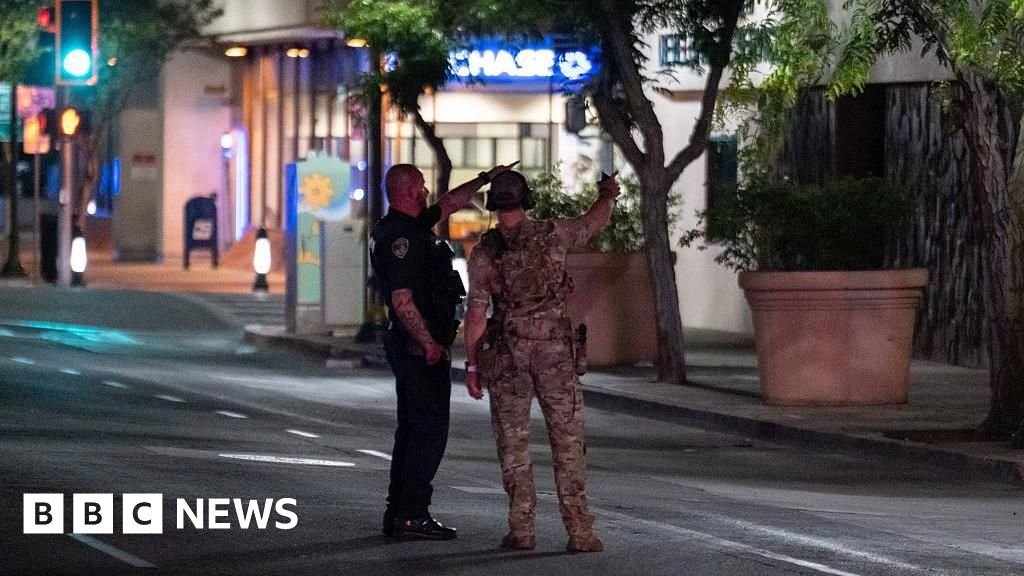
Here is Guardian footage of the police clashing with protesters in Southampton last night.
And here are some pictures from last night.
Reform UK would ban police race action plans, Zia Yusuf says
Zia Yusuf, the Reform UK home affairs spokesperson, told Sky News this morning that he thought the treatment of Henry Nowak did justify his party’s claim that two-tier policing operates in the country. He said:
Having watched that footage [of Nowak’s arrest] … it’s hard to escape the conclusion that it is a demonstrable example of structural two-tier policing that is embedded in Hampshire police force and forces across the country.
People can go to Hampshire police’s website and read their race action plan that was brought about under a Tory government.
Even if it was well intentioned at the time, it demands that police officers must focus their attentions on offences against ethnic minority communities.
And that is why that is why when those officers attended the scene, the accusation of racism from the murderer and his brother was … immediately taken seriously. And the accusation from poor Henry that he had been stabbed, which any reasonable person would agree is a far greater immediate potential threat to life – suddenly there was a burden of proof …
So if we now live in a country where an accusation of racism is so powerful that you can stab somebody repeatedly and have your victim handcuffed by the police, then I think we need to ask ourselves how we arrived in this situation.
Yusuf also announced that Reform UK would pass an equal treatment bill if they won the election, to “ban police race action plans, end DEI practices, and remove the exemption that allows Sikhs to carry large bladed weapons.”
11 officers and one dog injured during Nowak protest in Southampton, Hampshire chief constable says
Hampshire police have said 11 officers and one police dog were injured in the violent clashes last night between its officers and protesters near where Henry Nowak was stabbed to death in Southampton.
In a statement, the chief constable, Alexis Boon, said:
We understand and appreciate as police officers that we are accountable for our actions. What we ask, however, is that those actions are judged through fair and transparent processes. In this case, that process is already underway with the IOPC conducting their independent investigation.
What we, as a society, cannot accept is the violent scenes we saw in Southampton last night.
Some clearly arrived intent on causing disorder and trouble. We saw bottles thrown, makeshift weapons used, damage caused to the homes and vehicles of innocent residents and threats and violence directed towards our officers.
As a result, 11 officers and one police dog were injured, while trying to do their job to protect the communities that we serve.
While we are forced to deal with those determined to spark fear and division, our finite resources are taken away from those who need it most.
Boon said that, while two people have already been arrested, “that number will rise as those investigations continue”.
He added:
I know that since the release of the body-worn video footage from the night of Henry Nowak’s murder, there is a desire for answers and accountability but that must be done in the right way and not used as an excuse to threaten and intimidate my officers and bring violence to our streets causing fear and harm to those living and working in Hampshire and the Isle of Wight.
Badenoch accuses Farage adopting Black Lives Matter approach ‘in reverse’, and says all identity politics wrong
Kemi Badenoch, the Conservative leader, has a long record of criticising anti-racism initiatives in the police force. She was equalities minister in the last government and in that post she championed the controversial Sewell report, which played down the significance of, or even the existence of, structural racism and institutional racism. Badenoch essentially thinks that these are concepts that have been made up or exaggerated by leftwingers, and she was saying so before it became mainstream thinking in the Conservative party.
In recent days Badenoch has argued that the Henry Nowak tragedy vindicates her thinking. She has set this out in an article for the Daily Mail today.
In it, she essentially endorses one of the points Nigel Farage made in his “address” yesterday (see 8.41am) when she says Keir Starmer and Angela Rayner were happy to take the knee for George Floyd, but have not done the same for Nowak.
But she goes on to criticise Farage, claiming that he is just asking for the Black Lives Matter movement in reverse. She says:
Yes, a lot needs to be fixed. But Farage was completely wrong to say that the ‘rights and privileges of white people matter less than those of ethnic minorities’.
This is simply the language of the Black Lives Matter movement in reverse – inflaming tensions, emphasising difference. It is toxic tribal politics that divides our country.
The Conservative party rejects identity politics in its entirety. Every other party – Labour, Reform, the Greens, SNP and others – is pandering to people based on the toxic ideology of separatism. Anyone bandying around policies that are anti-English, Scottish and Welsh; separatist or anti-white; still doesn’t get – or doesn’t care – how dangerous these beliefs can be.
She says the murder of Stephen Lawrence, and the Macpherson report that followed it, led to racism being addressed. But she suggests this has gone too far and she argues that the Nowak murder must be a similar “seminal moment” when the UK changes course. She says:
We will have to sweep out a lot of the historic, incoherent nonsense that has been brought in under the guise of anti-racism.
Notions of ‘white privilege’ and forcing ‘decolonisation’ narratives down the throats of children is not how we build a cohesive society.
We also need to stop the idea that racism is something that happens only to ethnic minorities, perpetrated by white people. This seems to have been the belief of officers in the terrible case of Henry Nowak.
Public bodies must understand that anyone can be a victim of racism.
Yesterday Gavin Stephens, chair of the National Police Chiefs’ Council, said that, althought the NPCC would listen to concerns about how the anti-racism commitment was worded (see 9.29am), the overall intent behind was sound and justified. He said:
It is essential that we police without fear or favour in keeping the peace and enforcing the law. We must do so to earn the confidence of all communities.
This historic and ongoing mistrust between the police and black communities risks, for example, people not reporting things to the police if they are in trouble, or aiding our efforts to catch criminals, fight crime and protect all communities.
We are listening to legitimate concerns about how some of these commitments are worded or phrased, and where needed we can and will make changes, but this should not detract from the intent, which is to improve the quality of policing.
Jones says language in police anti-racism commitment ‘wrong’, and giving ‘wrong impression’
In her interview on the Today programme, Sarah Jones, the policing minister, said the “police anti-racism commitment” was being reviewed (see 8.19am) because the language in it was “wrong”.
She said:
Everyone should be treated equally under the law and I think it’s right that they are reviewing this document and looking at the language.
This particular document is a values document, it’s quite a short document and I don’t think it forms the basis of any training or any police activity.
We think the language is wrong, it gives the wrong impression. But I don’t think it affects how our training is done.
Critics of the document like Chris Philp, the shadow home secretary, seem to be particularly bothered by this passage in the document explaining what the commitment to racial equity (not equality) means.
Producing equality of policing outcomes for people from different ethnic groups by responding to individuals and communities according to their specific needs, circumstances and experiences, with understanding that these will be racialised and with the aim of reducing harm.
It does not mean treating everyone ‘the same’ or being ‘colour blind’ (racial equality).
Jones declines to say if officers involved in Nowak’s arrest as he was dying still on frontline duty
In her Today interview, Jones refused to say if the police officers involved in the arrest of Henry Nowak as he was dying were still on duty.
She said the IOPC [Independent Office of Police Conduct] was dealing with that.
Asked if she knew the answer, she said she did. But she suggested it was not appropriate for her to say because this was a matter for the IOPC.
When it was put to her that it would not be appropriate for officers who displayed “a clear dereliction of duty” to still be on frontline duty, Jones repeated her point that this was a matter for the IOPC to rule on.
Asked if she would be happy for one of these officers to attend an incident, Jones said that as policing minister she had to let the IOPC do its job.
Jones explains why she won’t endorse ‘two-tier policing’ claims
In an interview on the Today programme, Sarah Jones, the policing minister, was also asked if she could confidently say there was no two-tier policing in the UK. She replied:
I would say that the principles are important, that everyone is equal under the law.
I would say that there are 100,000 999 calls a day and that in the majority of cases, the police are doing the right thing, making the right decisions in the right way.
But I would also say that wherever there are mistakes – and this is I think a case where the country is looking to us to make sure we learn the lessons and put anything wrong right – that we continue to strive to do that.
But the principles of what our policing by consent foundations are based on, equality under the law, that is the basis of our entire society.
Asked if there were examples of two-tier policing, she replied:
We see examples of people making the wrong call in different ways. In the main, that is not what we see.
To push a certain sort of agenda in this case is not helpful.
Asked if she thought “anti-white racism” was a factor in how Henry Nowak was treated by the officer who handcuffed him as he lay dying, Jones replied:
I look at that footage and as a mother I find it almost impossible to see. I think everybody does.
I think everybody can’t understand what the response was. I think everybody has a degree of anger about it because it looks so wrong.
But I think we have to step back and allow the IOPC [Independent Office of Police Conduct] to do its investigation
And this government’s commitment is that whatever the IOPC says, there will be consequences to that, there will be action from that.
Jones rejects Farage’s claim police don’t treat white people fairly
Yesterday Nigel Farage, the Reform UK leader, delivered what he called an “emergency address to the nation” on YouTube at around this time. In it, he claimed that the Henry Nowak case was proof that white people were treated unfairly in the UK. He said that George Floyd (whom he described as a “career criminal”) died in policy custody in the US, there was a surge in support for the Black Lives Matter campaign, with Keir Starmer taking the knee. But nothing remotely similar has occurred after the death of Nowak, Farage claimed.
Silence, absolute silence, proof, if ever there was any, that we’re living in a two-tier culture in this country where the rights and privileges of white people matter less than those of ethnic minorities.
Saying that people should respond to Nowak’s death with “pure cold rage”, Farage went on:
Enough of anti white prejudice a promotion of the idea that white lives matter just as much as black lives. An end to DEI [diversity, equity and inclusion] and positive discrimination, but a country that treats everybody equally and fairly before the law.
This is serious. This is urgent. I fear for where our society would be in a few short years if we don’t grip this and do it very, very quickly.
Ben Quinn has a good analysis of Farage’s intervention here.
Ben points out that Farage was speaking at a time when Reform UK risking being outflanked on the right by Restore Britain, an even more exteme party founded by the former Reform UK MP Rupert Lowe.
In an interview on Sky News, Sarah Jones was asked if she agreed with Farage that white people were not treated fairly by the police. She replied:
I don’t think the evidence at the moment would suggest that, if you look at the facts and figures about policing.
I will always listen to the police in terms of what they’re saying and the home secretary said yesterday [that] we need to talk to the police. We need to talk to the Sikh community. We need to talk to knife crime campaigners. We need to understand what it is we need to do differently and better and we will do that.
Last night Abimbola Johnson, a barrister who chairs the independent scrutiny and oversight board for the police Race Action Plan, told Radio 4’s the World Tonight last night that he thought Chris Philp’s criticism of the police anti-racism commitment (see 8.19am) was “disingenuous”. He claimed that when Philp was policing minister between 2022 and 2024 he did not express concerns about the police’s anti-racism approach.
Johnson said:
For [Philp] to take umbrage at the idea that there is a commitment to reduce disparities in arrest rates and use of force is disingenuous.
And I would also highlight that when the Conservative government were in power and Chris Philp was the policing minister, not once did he meet with the Race Action Plan, not once did he bring any legitimate concerns that he may have had around that and involve himself in any constructive conversations about it.
Policing minister Sarah Jones calls for calm and says police should review anti-racism guidance
Good morning. Keir Starmer spoke for many people yesterday when he said that he felt “sick” watching the video of Henry Nowak being handcuffed as he lay dying, while a police officer who had been told Nowak had committed a racist assault ignored Nowak saying he had been stabbed. Starmer’s was a good faith response to the tragedy, which saw Nowak’s killer jailed for life on Monday.
But there have been plenty of bad faith responses to the murder too, which culminated in rioting in Southampton last night. Here is our overnight story about yesterday’s events.
And here is Steven Morris’s report on the rioting.
Sarah Jones, the policing minister, has been giving interviews this morning. Speaking to Times Radio, she said the rioting was unacceptable and she said there had been two arrests, “one for assault of a police officer, one for possession of a weapon”.
She also appealled for calm, saying:
We are urging that people take the anger that they feel, which I understand, but let’s allow justice to do its course, and let’s not over-react, which indeed is what the family are asking us to do as well.”
Shabana Mahmood, the home secretary, issued her own statement last night.
In her interviews this morning, Jones also said the government wanted an official “police anti-racism commitment” reviewed. In the Commons yesterday Chris Philp, the shadow home secretary, saying that this document was “morally wrong”, claiming that it “urges police forces to reverse engineer the same arrest rates between ethnic groups, even though the offending rates are different, by treating different ethnic groups differently”. (In fact it does not say that, although arguably that it what its call for “equality of policing outcomes for people from different ethnic groups” implies.) In the Commons Mahmood gave a non-committal response to Philp. But now the Home Office wants it reconsidered
Asked about the document, Jones told BBC Breakfast that the National Police Chiefs’ Council were reviewing the document. She went on:
We don’t think that language is is right.
It is right to say, and it is important to say, that there is … a long history of racism in policing that we need to acknowledge, and we need to make sure isn’t there.
Of course, in all the training that is done with police officers, it’s an aspect that they are trained on.
This document feels like it’s not right, and I think it’s right that the NPCC are reviewing it.
I will post more from her interviews shortly.
Here is the agenda for the day.
Noon: Keir Starmer faces Kemi Badenoch at PMQs.
After 12.30pm: MPs hold a debate on the Peter Mandelson files released on Monday.
2.30pm: Scientists and experts from the Climate Change Committee and other bodies give evidence to the Commons environmental audit committee on extreme weather.
3.30pm: Rachel Reeves, the chancellor, is speaking at at the Creating a Scientific Superpower Conference on the Oxford-Cambridge Growth Corridor.
If you want to contact me, please post a message below the line when comments are open (between 10am and 3pm), or message me on social media. I can’t read all the messages BTL, but if you put “Andrew” in a message aimed at me, I am more likely to see it because I search for posts containing that word.
If you want to flag something up urgently, it is best to use social media. You can reach me on Bluesky at @andrewsparrowgdn.bsky.social. The Guardian has given up posting from its official accounts on X, but individual Guardian journalists are there, I still have my account, and if you message me there at @AndrewSparrow, I will see it and respond if necessary.
I find it very helpful when readers point out mistakes, even minor typos. No error is too small to correct. And I find your questions very interesting too. I can’t promise to reply to them all, but I will try to reply to as many as I can, either BTL or sometimes in the blog.