
An armed teacher’s ability to get within a few dozen yards of a D.C. hotel ballroom where President Donald Trump and top aides had gathered Saturday night has exposed worrisome vulnerabilities in the Secret Service’s protection bubble around the president, current and former law enforcement officials told MS NOW.
Trump and Secret Service Director Sean Curran praised the service for tackling and subduing the armed suspect before he got to the ballroom entrance for the White House Correspondents’ Dinner, calling it a success of the agency’s protective model.
But many other security officials argued that the suspect’s success in dashing past Secret Service agents and officers manning a key security checkpoint — and in getting so close to the ballroom entrance with a shotgun, handgun and knives — made the breach far too close for comfort.
“It’s true the Secret Service protective model worked, but it only worked because of luck,” said former Secret Service agent Bill Gage. “It was just luck he didn’t get into the room and have a chance to open fire.”
It’s true the Secret Service protective model worked, but it only worked because of luck. It was just luck he didn’t get into the room and have a chance to open fire.”
Former Secret Service agent Bill Gage
Former and current law enforcement agents told MS NOW they noticed three major areas of concern, some of which reporters at MS NOW personally witnessed while attending the dinner:
- A key and final security checkpoint that was critical to protecting the president and senior officials proved porous and weak and failed in multiple ways.
- The evacuation of top administration officials suffered delays and challenges due to the exceptionally crowded arrangement of tables.
- The Secret Service faces unique security risks at the Washington Hilton, which boasts one of the largest ballrooms in the city but is an functioning hotel that is difficult to secure. Experts said the service needs to reassess whether its security plan for the hotel is good enough, and whether it can hold events there in the future.
This is the third time in less than two years that an armed and untrained person appeared set on harming Trump, and pierced several layers of Secret Service protection, using fairly unsophisticated methods. That has caused some current and former agents to worry the Secret Service is not carefully paying attention to the most common threat: a low-tech lone wolf.
In the wake of an attempted assassination of Trump on the campaign trail in July 2024, a major internal review found the Secret Service had failed to follow rudimentary security protocols implemented more than 60 years earlier, in the wake of then-President John F. Kennedy’s assassination in 1963. That included failing to secure the roof of a nearby building overlooking the campaign stage, where a gunman positioned himself, grazing Trump with a bullet and killing an audience member.
The checkpoint
On Saturday, video showed staff at the final checkpoint before the ballroom entrance was slow to react and in some cases, looking elsewhere when the suspect ran past Secret Service officers and agents with a weapon in hand.
This checkpoint, where Secret Service officers use a magnetometer to screen guests for weapons, is just one flight of stairs away from the ballroom’s main entrance, creating little room for error if breached.
Unlike at major “national special security events,” known as NSSEs, such as political conventions, there were no specially trained counter-assault agents on standby to stop a breach or a person with a weapon. The dinner is not considered an NSSE, which triggers a higher, almost militaristic level of protection and brings in added security teams from across the federal government.
A current Secret Service official told MS NOW the checkpoint staff wasn’t paying close attention, in part because the dinner had begun at 8:00 p.m. and they didn’t expect to be screening any additional guests.
Secret Service spokesman Anthony Guglielmi said the agency’s protective model worked by stopping the gunman before he entered the ballroom.
He said the checkpoint was in the process of closing for the night, but that left another important security layer between the attacker and the dinner guests in the ballroom.
Secret Service agents had “hardened” the ballroom as the dinner began, he said, by closing the doors and taking up guard positions at each entrance to ensure no one who was unscreened got inside.
The chaotic evacuation
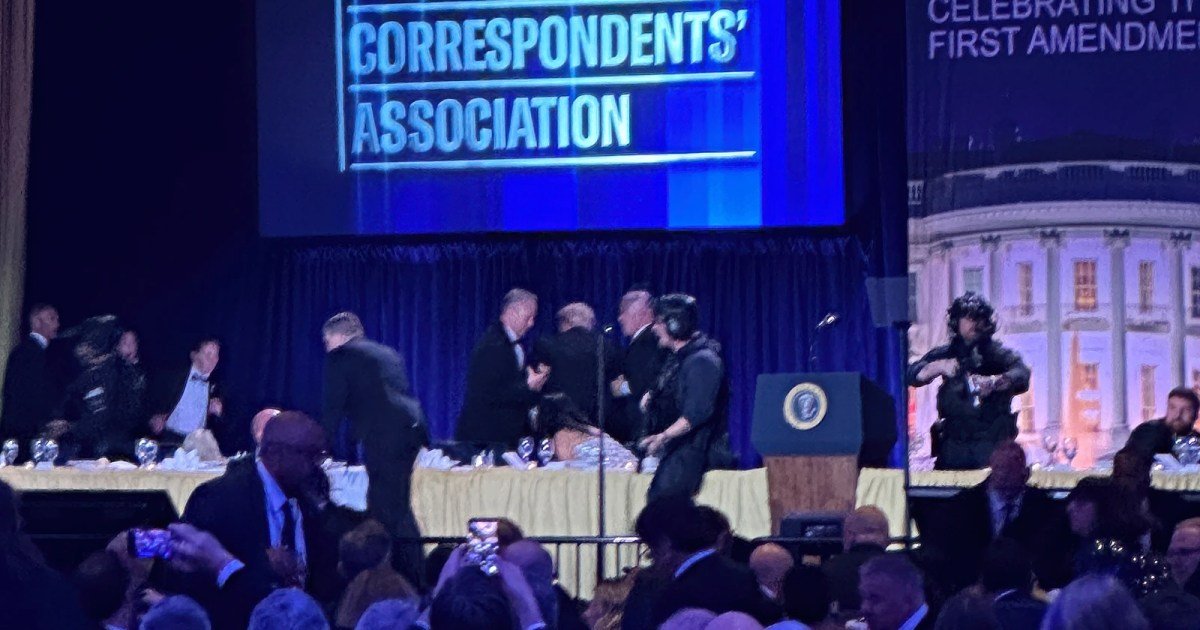
Secret Service agents and other agency security teams rushed into the ballroom to evacuate Cabinet secretaries and other top administration officials they protect.
But reporters watched aghast as these agents struggled to make their way across a huge ballroom with more than 1,000 guests, many of them confused and hiding under their tables. The agents had to awkwardly clamber over guests, and even step onto chairs and tables to reach the official they were protecting.
The Secret Service detail leaders for the president and for the vice president were just a few feet away from the front of the ballroom, where Trump and Vice President J.D. Vance were seated on the stage, standard procedure at all events to ensure they could react quickly to cover and evacuate them in an emergency.
Many officials MS NOW spoke with also questioned why Vance’s detail leader evacuated him before Trump was taken off stage to a secure holding area.
Recommended
A Secret Service official told MS NOW on Sunday that Trump’s detail agents believed from radio communications that the ballroom was safe at that moment; agents were manning every door to prevent anyone armed from entering and the armed suspect had by then been subdued.
Instead, Trump’s detail leader took a few moments to ensure that Secret Service personnel were in position to guard all entrances to the Hilton’s subterranean “presidential walk” so his detail could safely move Trump along that hallway to a special holding room there. The secure walk was specifically designed by the Hilton in consultation with the Secret Service after the assassination attempt on then-President Ronald Reagan just outside the Hilton in 1981.
Unlike the agents shielding the president and vice president, the agents who protect several other senior administration officials instead waited outside or on the the ballroom’s perimeter because there wasn’t room for them to be seated.
“This is one of the most coveted tickets in the city,” said one former Secret Service agent. “The Secret Service arranges a hold area for all these detail leaders to wait and stand by.”
For example, FBI Director Kash Patel waited with his girlfriend for several minutes after the shooting and before a law enforcement agent approached their table to escort them from the building.
Reevaluate security plan at the Hilton
Because the Washington Hilton is an open hotel, with guests not connected to the event entering and exiting without being screened, it’s more difficult to secure the enormous dinner in the huge basement ballroom.
“Hotel guests could still come and go, no checking credentials nor physical screening outside of area, just the [magnetometers] near the ballroom,” said one former Secret Service official, who asked to speak anonymously because he was discussing sensitive protection details. “Considering the VP and Cabinet members were there, there should have been more security. “
Unlike other large events the president attends, the Hilton magnetometers have long been stationed very close to the actual event to avoid interfering with other hotel conference rooms or ballrooms. At other major presidential events, advance agents push that security perimeter much farther away from the president, giving fellow agents more time and room to quickly address potential breaches or combat an attack.
Some argue the service should push back against using the Hilton again for such crowded events, where evacuation of administration officials is difficult at best and creating a secure perimeter is a challenge. Said one former presidential detail leader: “I hate that venue. Too much working against you.”
Gage said it’s important to highlight the Secret Service’s successes at the Saturday dinner, too.
An agent’s job can be difficult because it requires a lot of waiting around while still trying to maintain vigilance.
Gage credits the agent at the checkpoint for recovering rather quickly, assessing that the suspect was armed and then drawing his weapon to shoot and stop him. His colleagues then rushed after the man and tackled him to the ground as he tried to hurry down the stairs.
“Think about the boredom of standing for hours on end, wearing all of this gear,” Gage said. “It’s a pretty good reaction time. Even though he was delayed, they still took action. They stopped an attack. Good on them.”
Carol Leonnig is a senior investigative reporter with MS NOW.