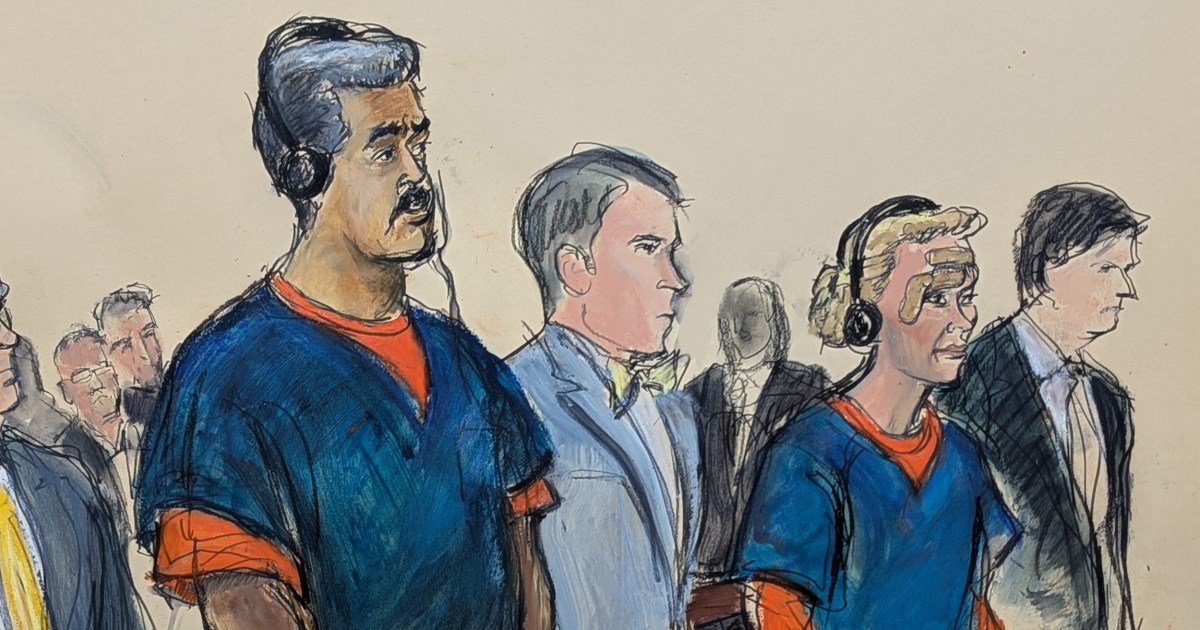

Last week, Nicolás Maduro and his wife, Cilia Flores, made their second appearance in an American courtroom. But the case bore very little resemblance to other matters on the docket that day, or any other day this week, for that matter. And while the world may have moved on from the extraordinary events of Jan. 3, these incredible legal proceedings continue very slowly to work their way through the U.S. judicial system. Meanwhile, the former leader of a South American country remains locked up in a Brooklyn, New York, jail cell, held on charges of drug trafficking in support of terrorism.
Thursday’s hearing provided a vivid example of the ways that this case will be markedly different from most criminal cases, in which defendants hire their own lawyers or the court appoints counsel for the indigent. In this case, the Maduros say the government is preventing them from receiving funds to pay for their legal representation, a move that may violate their Sixth Amendment right to counsel.
The Maduros say the government is preventing them from receiving funds to pay for their legal representation, a move that may violate their Sixth Amendment right to counsel.
The court has declined to appoint a public defender on the grounds that the complexity of the case would drain resources from the truly indigent. But because Venezuela is subject to U.S. sanctions, funds cannot legally be transferred to Maduro’s lawyer without permission from the U.S. government. Only the U.S. Office of Foreign Assets Control can grant the license that would permit those transactions. To date, U.S. government officials have refused to do so on the grounds that the Maduros can pay their own fees without help from their government, though they were unable to provide any evidence to support that claim at the hearing.
In other words, the U.S. government is both prosecuting the case and preventing the Maduros from hiring lawyers. U.S. District Judge Alvin Hellerstein said he lacks the authority to order OFAC to grant the license, noting, “There’s no case like this.”
The only case comparable to Maduro’s is the 1989 indictment and arrest of Manuel Noriega. But even the case against the Panamanian strongman lacked some of the brazen illegality of the Maduro arrest.
Both cases involved military operations to support law enforcement action. Like the Noriega arrest, Maduro’s capture appears to violate the United Nations Charter, which prohibits the use of force against another country without its consent. In 1989, the General Assembly and Security Council condemned the invasion of Panama as “a flagrant violation of international law and the independence, sovereignty and territorial integrity of states.”
Under the Constitution, Congress’ 1945 approval of the U.N. Charter as a treaty makes it the supreme law of the land, meaning that a president who disobeys the charter not only violates international law but also breaches their duty to take care that the laws be faithfully executed. A Justice Department memo written by William Barr, who would later twice serve as attorney general, concluded that the president has legal authority to override international law for law enforcement operations, though some scholars disagree.
But that’s where the similarities between the Maduro and Noriega cases end. First, the Noriega arrest came amid the U.S. occupation of the Canal Zone, then home to 35,000 Americans, before the canal was turned over to Panama in 1999. The United States has no such presence in Venezuela. Second, the operation occurred after the National Assembly of Panama had declared a state of war against the United States. No similar declaration occurred in Venezuela. Third, forces under Noriega’s command killed a U.S. Marine, wounded another and beat a third American service member. Venezuela has conducted no similar attacks on Americans. Finally, Noriega was only the de facto head of state, refusing to leave office after losing re-election. Maduro is the actual president of Venezuela, even if some have said that his election was tainted by fraud.
By using a criminal case to wag the regime change dog, the Trump administration has made the world less stable. The Maduro operation undermines the commitment other countries have made under the U.N. Charter to avoid military aggression. It also creates precedent for other countries to conduct similarly illegal military operations and arrests of political leaders — perhaps even Americans.

Barbara McQuade is a former Michigan U.S. attorney and legal analyst.