
How confident are you when cooking fish at home? Between working out how to pick the right fish at the monger, maintaining moisture, infusing flavour, and keeping the house from smelling like the seaside, there’s a lot to think about.
But what if I told you that you’ve got this one … in the bag?
En papillote, to be exact, which is somewhere between baking and steaming, and is often referred to as “in bag” cooking, though more accurately translates to “in parchment”.
With this cooking method, ingredients, be they protein or vegetable, are tucked into a parchment paper parcel along with aromatics, then sealed so the natural moisture released through baking is trapped inside.
Trapped too is the aroma, which can sometimes be a barrier to those hoping to get more fish into their diets but who worry about strong sea smells lingering in the kitchen.
Now, if you’re reading this thinking “fresh fish shouldn’t smell”, then you can give yourself a pat on the back! When fish is fresh, it should have minimal aroma, a glossy but not slimy look and, if whole, have clear (not clouded) eyes and shiny scales. Once filleted, it’s harder to clock these fresh fish markers, which is why I have one very easy question to ask my fishmonger that’s far less rude than implying any of their fish is less fresh. I ask: “Which fish fillets would you take home tonight?”
When buying your fish prepacked, it’s harder to gauge freshness, so look for the one with the longest use-by date, and of course, all of the sustainably sourced markers relevant to your region.
No matter how fresh your fish, cooking it will naturally release aromatic compounds, but it’ll also absorb the aromatics around it. That’s why keeping ingredients such as citrus, garlic, herbs and spices in the bag is so handy: it is a fantastic way to infuse flavour. That means you can get creative once you get the hang of it: tomatoes and oregano for a Mediterranean flavour profile, or a touch of harissa and preserved lemon for some north African influence.
For this recipe, I’ve chosen to go big on bay leaves – an aromatic that ordinarily gets snickers for not really doing anything in a dish. But if you can get your hands on some fresh bay – perhaps in your garden, or a friendly neighbour’s – you’ll find the most delicate citric base that’s beautiful with fish. If you can only find dried leaves, ease off – the older bay gets, the more herbaceous it becomes, so you can use half of the allocation and hope for the best.
The rest of my flavour base is a play on the classic gilda pintxo of anchovy, green olive and petite piquillo peppers on a skewer, which I ate with abandon on my honeymoon in San Sebastián. You’ll find anchovy-stuffed green olives in the deli section or in jars at the shops. Same goes for small green peppers, whether they’re the traditional Spanish green guindillas or a Greek-style golden chilli pepper.
Ordinarily, when cooking en papillote, each fillet is baked in its own parcel. But for the purposes of a swift meal for four, there’s no reason why you can’t bake everything in one big mama pouch.
If you’re entertaining and prefer the theatre of serving each guest their own papillote, you’re welcome to split the fish and bits across individual paper and foil parcels and bake on an oven tray. For a smaller household, you could also happily halve the recipe in a half pouch and bake for 15 minutes rather than the full 20.
I’ve used flathead fillets, but any skinless, boneless, firm-fleshed fish will hit the spot.
The spuds deserve their own moment too, because oven-baked cubes are my new favourite way to serve potatoes – like roast potatoes and chippies had a bitty baby. They’re tender on the inside, crispy on the outside and genuinely addictive. Choose smaller spuds for these – either new potatoes, chats or kipflers – and something you’d ordinarily use for boiling rather than mashing. That’s because you parboil the little cubes to speed up the cooking time, giving you max roasting and crisping in the oven while the fish bakes.
Gilda’d fish en papillote with roasted chippie chats – recipe
6-8 boneless flathead fillets, 800g
10 fresh bay leaves (you can use even more if you have a tree, but halve the amount if dried)
100g butter, cubed
1 lemon, skin peeled into strips, and the lemon sliced into wedges
235g jar of anchovy-stuffed green olives, drained
200g pickled guindilla (or any golden) peppers
2 tbsp olive oil, plus extra to serve
For the roasted chippie chats
1kg chat potatoes, washed, unpeeled and cut into rough 1cm cubes
4 garlic cloves, unpeeled
60ml olive oil, ¼ cup
1 cup finely chopped curly parsley leaves, loosely packed
Preheat the oven to 200C/180C fan and place a roasting tray inside to preheat.
To make the roasted chippie chats, parboil the potato cubes and garlic by adding them to a pot of well-salted cold water. Bring it to the boil, then boil for 10 minutes or until the potatoes are soft but not completely falling apart. Drain and return them to the pot to steam dry for a minute or two. Remove and discard the garlic cloves. Drizzle the olive oil and sprinkle salt flakes over the potatoes, and stir gently to coat. Line the preheated baking tray with baking paper (be careful, the tray is hot!), then tumble in the spud cubes. Roast on the highest rack of the oven for at least 20 minutes, or until they are golden and crispy.
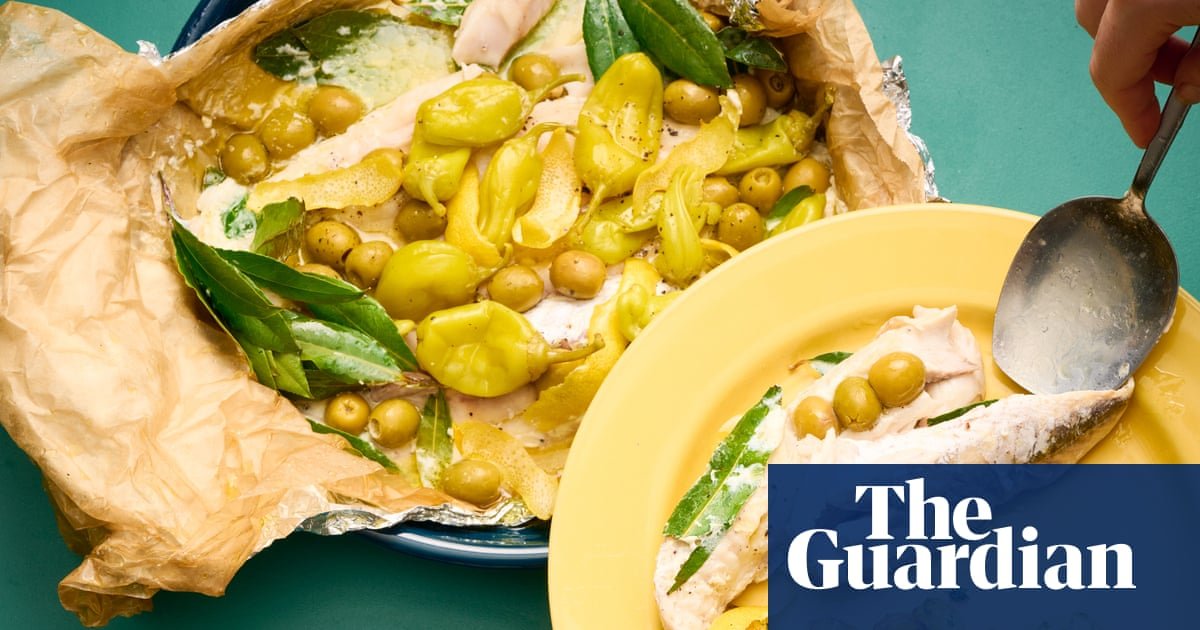
Meanwhile, line a second roasting tray with an extra-long piece of foil and an extra-long piece of baking paper on top. Scatter a generous bed of bay leaves on the centre of the tray. Lay the fish fillets on top, then scatter with butter cubes, lemon peel, olives and pickled peppers. Finish with olive oil, a pinch of salt flakes and cracked pepper.
Fold the extra-long tent of baking paper and foil over the fish, crimping the baking paper and foil along the edges. Leave some ceiling space so air can circulate and the fish can steam in its own juices. Place the tray in the oven on the lowest shelf and roast for 15 to 20 minutes (depending on the thickness of the fillets) until the fish is just opaque. Remove the tray from the oven and leave to rest for 10 minutes.
When the potatoes are done, top with parsley and salt flakes and give them a shake to coat. Taste for seasoning.
Transfer the parcel to a large serving plate. Carefully open the parcel (watch your hands and face, as steam can burn) and sprinkle with a pinch of salt, a crack of pepper and extra olive oil. Serve the opened parcel at the table, using a serving spoon to scoop the fish, buttery tray juices and accoutrements on to plates – the bay leaves make for lovely decoration, too, but you should not eat them. Serve with the roasted chippie chats and lemon wedges.