
Iceberg A-23A has had a more eventful run than most of the large Antarctic icebergs that have calved from the continent’s ice shelves in recent decades. Over its winding, forty-plus-year journey, the “megaberg” spent decades grounded in the Weddell Sea before drifting north, twirling in an ocean vortex for months, and nearly colliding with an island in 2025.
By 2026, the iconic iceberg, sopping with meltwater and shedding smaller bergs as it moved into warmer ocean waters, put on one more show. The chunks of ice and frigid glacial meltwater left in its wake appear to have fueled a surge in phytoplankton abundance, known as a bloom, observed in surface waters by NASA satellites.
Phytoplankton, which harvest sunlight to carry out photosynthesis, form the base of the marine food web. They also produce up to half of the oxygen on Earth and serve as part of the ocean’s “biological carbon pump,” which transfers carbon dioxide from the atmosphere to the deep ocean.
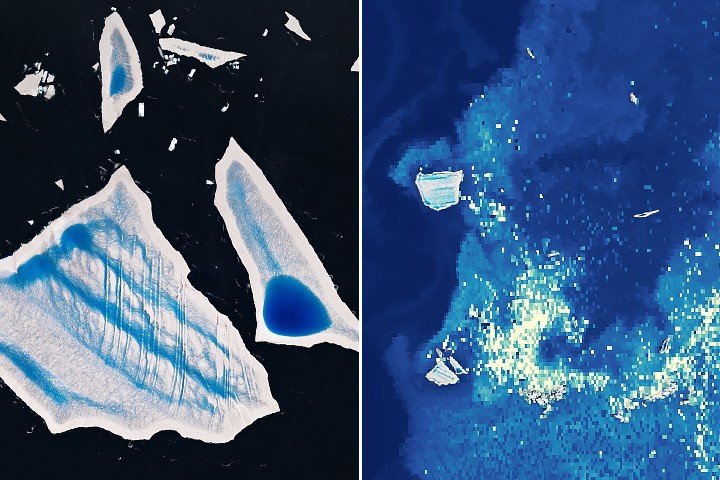
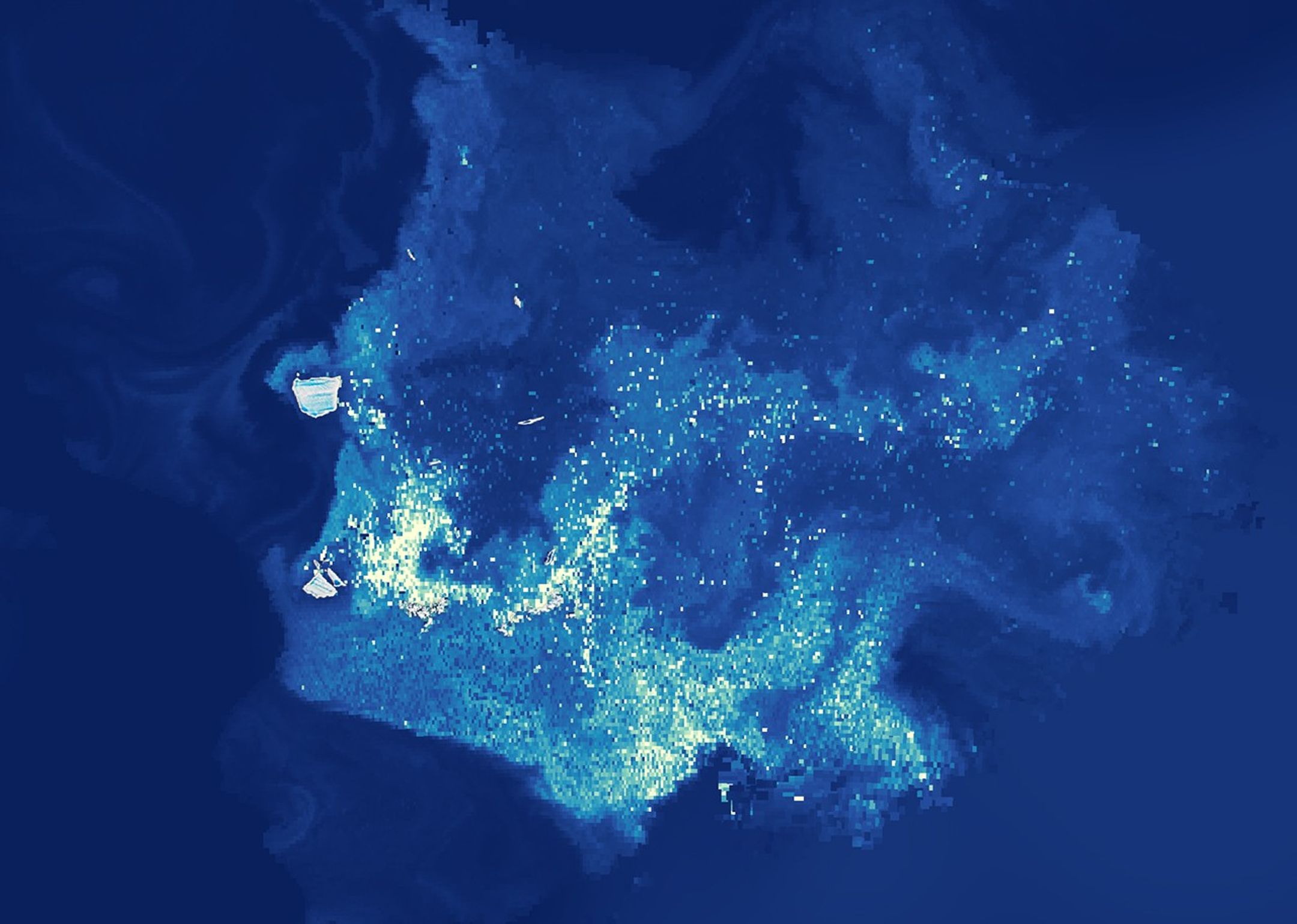
The VIIRS (Visible Infrared Imaging Radiometer Suite) on the Suomi NPP satellite captured this image (left) of the splintering tabular berg on January 25, 2026. The image was acquired after several large pieces had drifted northwestward and then curled toward the northeast following the iceberg breaking apart on January 9. A debris field full of brash ice, small icebergs, and bergy bits was visible east of the largest remaining pieces. Also on January 25, the OCI (Ocean Color Instrument) on NASA’s PACE (Plankton, Aerosol, Cloud, Ocean Ecosystem) satellite detected plumes of chlorophyll-a (right) drifting around the remaining bergs and debris field. Researchers use chlorophyll concentrations as a marker of phytoplankton abundance.
“This bloom is too big and too clearly spreading from the icebergs not to be strongly linked to them,” said Grant Bigg, an emeritus oceanographer at the University of Sheffield. Bigg, who has studied how large icebergs have enhanced phytoplankton activity in this region, noted that while blooms unconnected to icebergs do occur regularly here, satellite imagery shows a connection that has persisted for weeks—increasing his confidence that the iceberg and phytoplankton bloom are related.
The primary factors that limit phytoplankton in this region are access to light and nutrients, explained Heidi Dierssen, an oceanographer at the University of Connecticut. Light can be limiting even in the summer because phytoplankton are often mixed too deeply in the water column due to high winds and turbulence.
Melting icebergs can boost phytoplankton by both creating a stable surface layer with favorable growth conditions and releasing plumes of meltwater rich in iron—a key nutrient for phytoplankton that can be scarce in this part of the South Atlantic, she said. Research indicates that icebergs also often contain significant amounts of manganese and macronutrients, such as nitrates and phosphates, that can benefit phytoplankton. These nutrients often accumulate on icebergs through windblown dust or through contact with bedrock or soil.
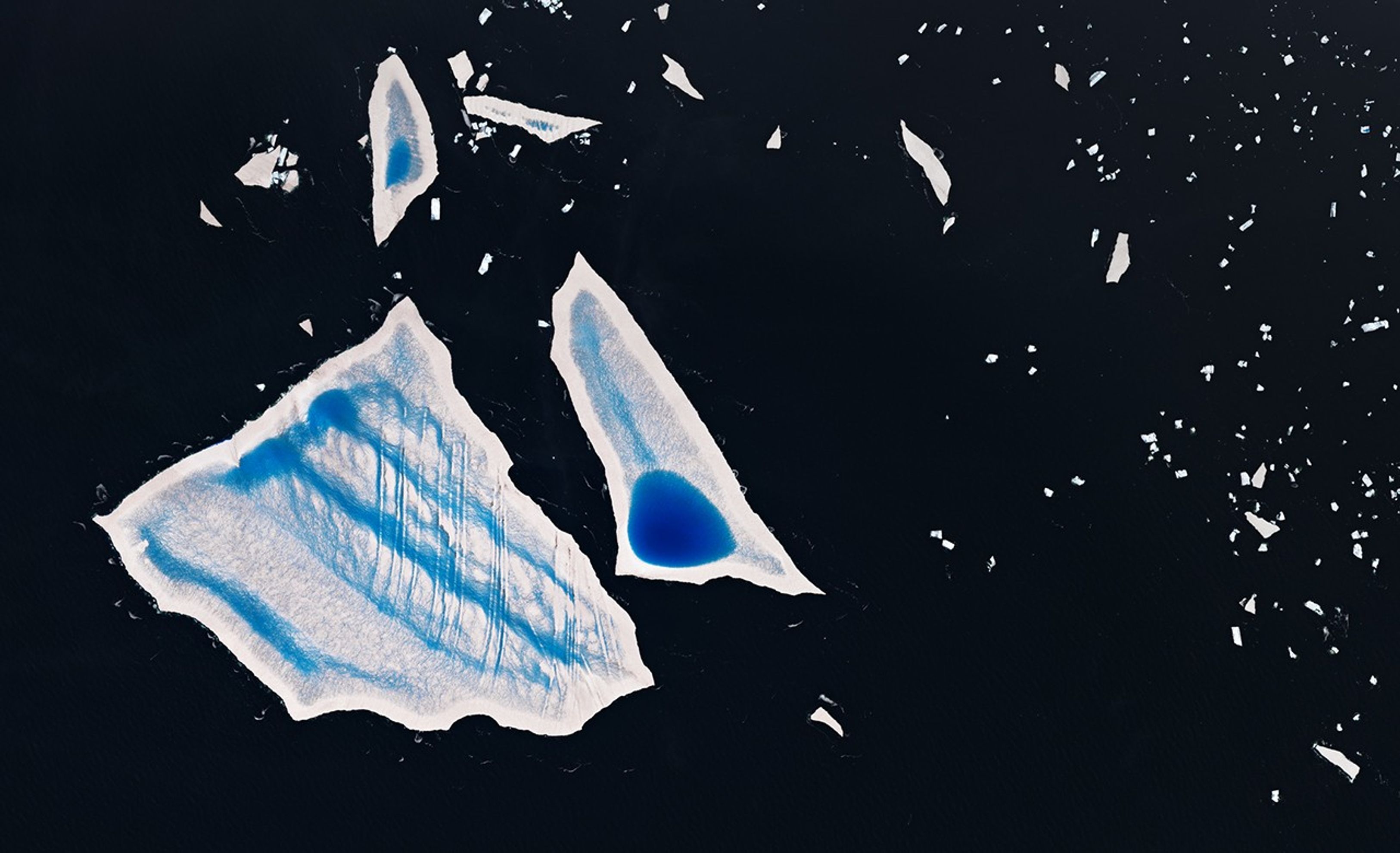
The Landsat 8 image above, captured by the OLI (Operational Land Imager) on January 25, 2026, shows blue meltwater pooling on several of the larger fragments. The linear patterns are likely related to striations that were etched hundreds of years ago when the ice was part of a glacier moving across Antarctic bedrock. Brown staining, perhaps soil or sediment, is visible on some of the bergs.
Bigg also noted that the phytoplankton signal appears to be more concentrated near the smaller bergs, possibly because these are melting faster, releasing nutrient-rich material at a higher rate. Dierssen added that it’s also possible that chlorophyll concentrations may be higher near the largest bergs than they appear because algorithms sometimes overcorrect for “adjacency effects” near bright surfaces, like ice, when processing chlorophyll data.
Ivona Cetinić, a researcher on NASA’s PACE science team, checked a database for clues about the smallest, or “pico,” phytoplankton swirling around the bergs. The tool, called MOANA (Multiple Ordination ANAlysis), taps into hyperspectral satellite observations of ocean color from PACE.
MOANA indicated that picoeukaryotic phytoplankton—microscopic eukaryotic organisms that respond quickly to changes in temperature or nutrient availability—were thriving in these waters when the image was captured. The swirls to the west of the berg were made of a slightly larger group of cyanobacteria called Synechococcus, she said. The PACE team is currently developing additional tools that will help identify communities of larger types of phytoplankton, which were likely present as well.
Some research suggests that icebergs may have contributed significantly to phytoplankton blooms in this region in recent years, possibly accounting for up to one-fifth of the Southern Ocean’s total carbon sequestration. Other research teams have concluded that surface waters trailing icebergs were about one-third more likely to have increased amounts of phytoplankton compared to background levels.
How long iceberg A-23A will enhance phytoplankton productivity before and after disintegrating completely remains an open question. NASA scientists watching the berg say it continued to shrink and shed mass in February, but as of March 3, 2026, it remained just slightly above the size threshold required for naming and tracking by the U.S. National Ice Center.
Past research indicates that icebergs can sustain elevated chlorophyll concentrations for more than a month after passing through in trails that stretch for hundreds of kilometers. Icebergs and the blooms surrounding them have also been known to attract fish, seabirds, and other types of marine life, highlighting the important ecological role they play.
NASA Earth Observatory images by Michala Garrison, using VIIRS data from NASA EOSDIS LANCE, GIBS/Worldview, and the Suomi National Polar-orbiting Partnership, PACE data from the NASA Ocean Biology Distributed Active Archive Center OB.DAAC, and Landsat data from the U.S. Geological Survey. Story Adam Voiland.
Suomi NPP, January 25, 2026
Landsat, January 25, 2026
- Duprat, L. et al. (2016) Enhanced Southern Ocean marine productivity due to fertilization by giant icebergs. Nature Geoscience, 9, 219-221.
- Eos (2016, January 15) Icebergs Fertilize Southern Ocean, Sequester Carbon. Accessed March 5, 2026.
- Knowable Magazine (2018, March 15) The base of the iceberg: It’s big and teeming with life. Accessed March 5, 2026.
- Krause, J. et al. (2024) The macronutrient and micronutrient (iron and manganese) content of icebergs. The Cryosphere, 18, 5735-5752.
- Lucas, N., et al. (2025) Giant iceberg meltwater increases upper-ocean stratification and vertical mixing. Nature Geoscience, 18, 305-312.
- NASA (2026) Plankton, Aerosol, Cloud, ocean Ecosystem. Accessed March 5, 2026.
- NASA Earth Observatory (2026, January 8) Meltwater Turns Iceberg A-23A Blue. Accessed March 5, 2026.
- NASA Earth Observatory (2025, September 25) A Giant Iceberg’s Final Drift. Accessed March 5, 2026.
- Raiswell, R., et al. (2008) Bioavailable iron in the Southern Ocean: the significance of the iceberg conveyor belt. Geochemical Transitions, 9, 7.
- Schwarz, J.N. & Schodlok, M.P. (2009) Impact of drifting icebergs on surface phytoplankton biomass in the Southern Ocean: Ocean colour remote sensing and in situ iceberg tracking. Oceanographic Research Papers, 56(10), 1727-1741.
- Wu, S. & Hou, S. (2017) Impact of icebergs on net primary productivity in the Southern Ocean. The Cryosphere, 11, 707-722