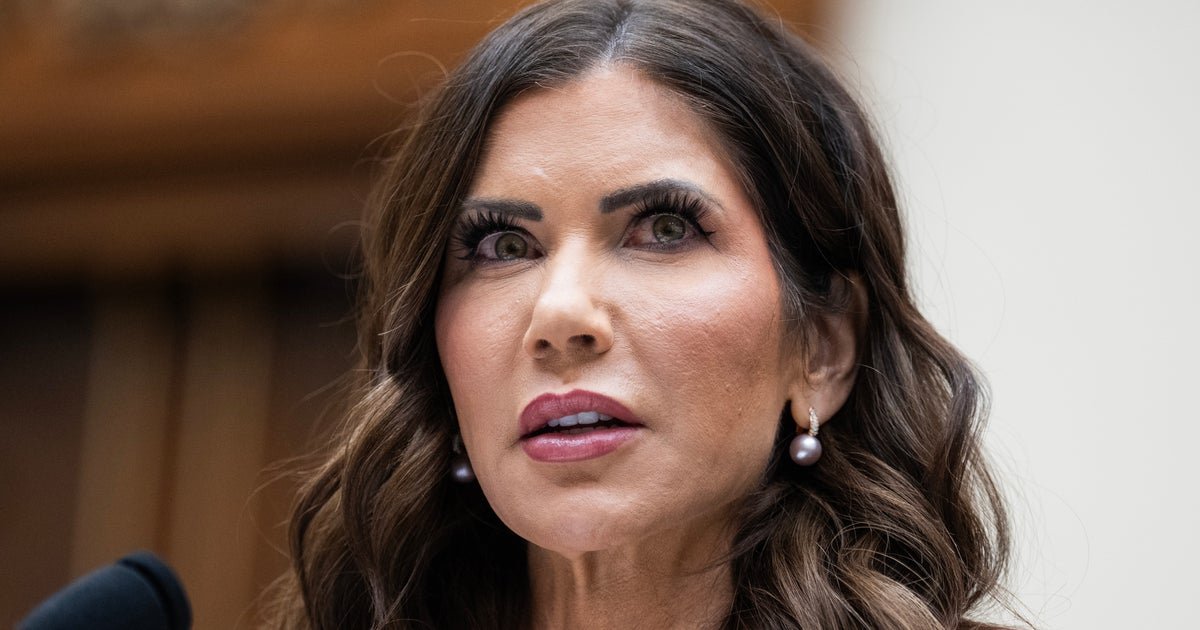

Kristi Noem sparked outrage online this week after she refused to retract or apologize for publicly smearing Renée Good and Alex Pretti after they were killed by immigration officers.
A behavior, one historian explained, that was pulled from a familiar “playbook.”
Then-Homeland Security Secretary Noem faced a bipartisan grilling at a Senate Judiciary Committee hearing on Tuesday for, among several things, the department’s violent handling of its immigration enforcement operations.
She was also grilled by several representatives at a House Judiciary Committee hearing on Wednesday for falsely suggesting that Pretti and Good, two Minneapolis residents killed by federal immigration enforcement agents, were domestic terrorists. Noem’s description of events has been widely disputed by video footage taken from both incidents.
In the wake of the hearings, President Donald Trump announced on Thursday that he fired Noem and is tapping Sen. Markwayne Mullin (R-Okla.) to replace her, effective March 31.
In January, Noem claimed in a press conference that Good, a 37-year-old mother who was shot and killed by a U.S. Immigration and Customs Enforcement officer, appeared to commit an “act of domestic terrorism.” And when Pretti, a 37-year-old ICU nurse, was shot and killed by federal agents weeks later, Noem told the public that Pretti “committed an act of domestic terrorism.”
Noem refused to retract or apologize for her statements about the two American citizens each time she was given the opportunity during the hearings Tuesday and Wednesday.
Speaking about the immigration crackdown in Minneapolis, Sen. Thom Tillis (R-N.C.) on Tuesday asked Noem: “Why can’t we just say, ‘We made a mistake?’”
Sen. Amy Klobuchar (D-Minn.) told Noem that calling Pretti a “domestic terrorist … the day after he was killed” was, for his parents, “one of the most hurtful things” said about their son.
“Do you have anything you want to say to Alex Pretti’s parents?” Klobuchar asked.
“We were relying in the hours after that incident, that was so horrific, on information we were getting from the ground from our agents,” Noem responded.
Noem then moments later denied describing Pretti as a “domestic terrorist.”
“Ma’am, I did not call him a domestic terrorist,” she said. “I said it appeared to be an incident of.”
On Wednesday, when Rep. Jamie Raskin (D-Md.) slammed Noem for her statements about Pretti and Good, and said he was giving her a chance to correct her “false and defamatory claim,” Noem responded: “Congressman, what happened in Minnesota in those two incidents was an absolute tragedy.”
“Were they domestic terrorists, as you said to the country?” Raskin questioned.
“I offer my condolences to their families, because I know that their lives will never be the same after that happened,” she responded, before later saying that there were “ongoing investigations” when Raskin pressed her again to say whether she now thought Pretti and Good were domestic terrorists.
Raskin later noted to Noem that Todd Lyons, acting director of ICE, had testified last month before a Senate panel that he had no knowledge that Good and Pretti were domestic terrorists. But Noem, again, did not retract her own statements and repeated that the “investigation is still ongoing.”
Matthew Dallek, a historian and professor at The Graduate School of Political Management at The George Washington University, said that Noem’s refusal to retract or apologize comes down to a familiar playbook.
“She’s doing what Trump does,” he said. “She’s basically pulling a page from the Trump playbook — which is, you never admit a mistake … you double down on the whys …you change the subject … you attack your opponents as being horrible.”
“This is pretty standard fare for the Trump administration,” he continued, adding that he doesn’t think her conduct was “surprising.”
Tom Williams via Getty Images
Noem’s testimony was particularly ‘egregious’ compared to tense hearings held during past administrations, Dallek said.
Dallek said that, in fairness, Cabinet secretaries in past administrations don’t exactly have a history of acknowledging mistakes when they get hauled before Congress.
He said that hearings typically have a “partisan dynamic” and that they are often “less about fact-finding than they are about fear, public performances.”
But, Dallek said, like everything else with the current administration, there are aspects about this week’s hearings that were unusual.
In addition to the fact that Noem faced some bipartisan pushback, he emphasized that Noem’s previous statements about Pretti and Good were “so at odds with reality.”
“The difference in how this administration has approached congressional hearings — and Kristi Noem’s testimony is an example of that — is [that it’s] a more egregious form of denial and deflection, and of turning reality often on its head,” he said.
“It’s more egregious, I think, than other administrations have done,” he continued.
Dallek said he believes Noem’s messaging about ICE operations in Minnesota during her testimony “comes from the top.”
“The message has been ICE has done nothing wrong … there’s no problem with how they’ve conducted their operations … they’re under threat and that’s why they have to mask up and that the problem is really the ‘radical left,’” he said. “So that’s been the message from the top, from the president, and that, of course, is filtered down to Cabinet secretaries, spokespeople.”
While members of the Trump administration won’t admit wrongdoing over immigration enforcement operations, Dallek said, their actions show there’s been some form of acknowledgement about the need to “correct course.”
He pointed to the Trump administration announcing last month that it was reducing the number of immigration enforcement officers in Minnesota, and Border Patrol chief Gregory Bovino’s departure from the state.
Overall, Dallek emphasized that Noem’s initial remarks about Pretti and Good were “deeply disturbing on many levels.”
“She just flat-out lied, multiple times,” he said. “She called them terrorists; they clearly are not. She claimed that the agents who killed them were in imminent danger — they obviously were not.”
“It was a series of flat-out, provable falsehoods, and it involved some of the greatest abuses, frankly, imaginable from federal law enforcement — the killing of American citizens in more or less cold blood,” he continued.
Dallek said that so many people are outraged over Noem’s testimony because “the stakes are quite high.”
“The reaction is partly fueled by a widespread sense of outrage that what happened was wrong, it was fatal and it was sickening to a lot of Americans,” he said.