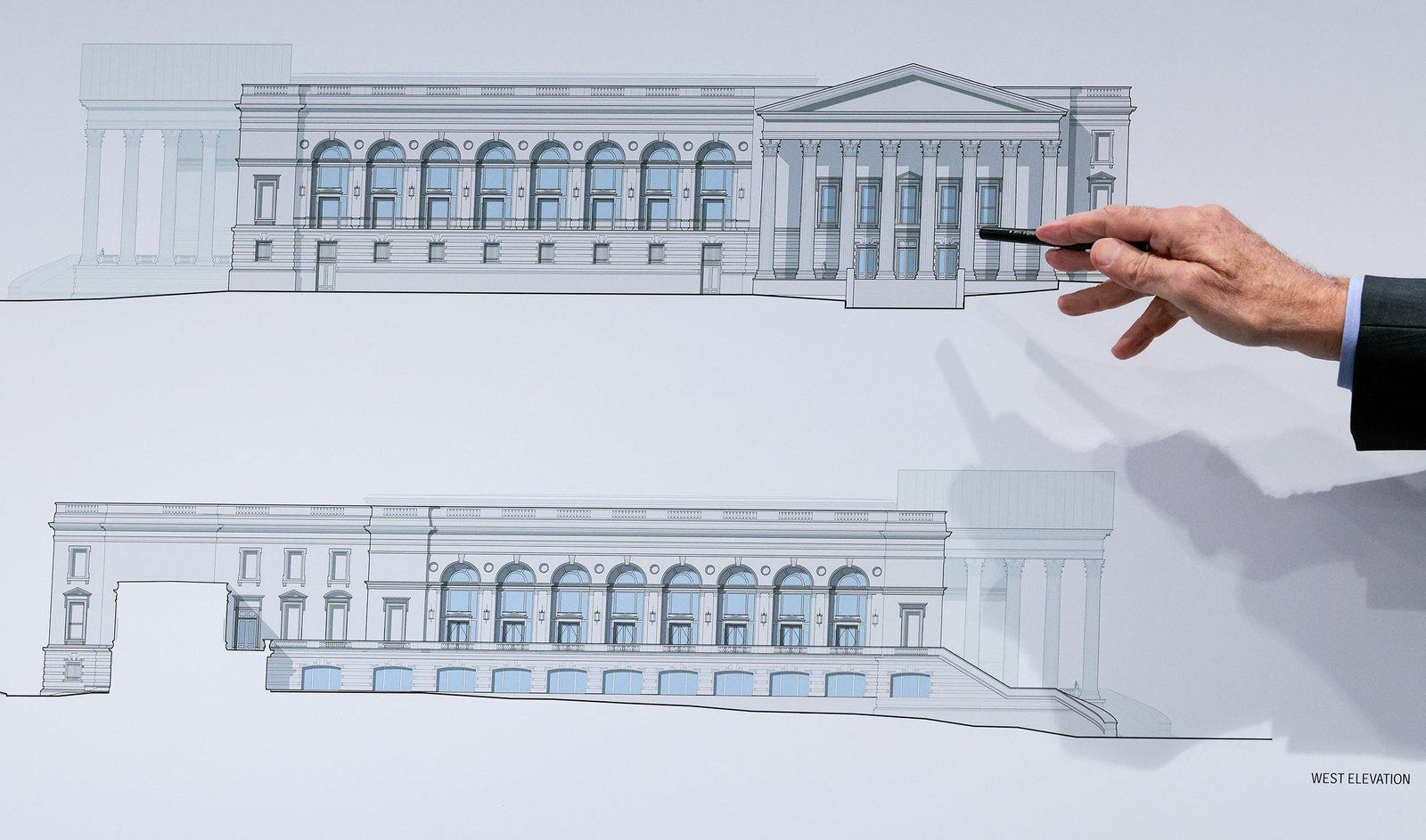

The National Capital Planning Commission is expected to greenlight construction plans for President Donald Trump’s $400 million White House ballroom as soon as Thursday, after the Commission of Fine Arts panel — hand-picked by Trump — approved plans for the new build two weeks earlier.
But the approval will come over strong objections from preservationists and the public. The planning commission has received more than 32,000 public comments with the vast majority of them opposing the ballroom.
And, over 100 individuals are registered to speak Thursday, including the president of the National Trust for Historic Preservation, which sued to stop the ballroom’s construction. A federal judge has, for now, allowed construction to continue.
The chair of the Society of Architectural Historians, another registered speaker, sent a letter Sunday to NCPC chair and White House aide Will Scharf cautioning the massive size of the ballroom would cause disruptions to the aesthetics of the People’s House and neighboring landmarks.
Despite the opposition, construction on the ballroom has already begun. During a Medal of Honor ceremony on Monday, the president drew attention to golden drapes covering a set of doors along the wall of the East Room that will eventually lead to the ballroom.
“When I hear that sound — that beautiful sound behind me, it means money, so I like it,” Trump said, referring to construction noise audible inside the East Room.
First ballroom donor voluntarily discloses contribution
The president has repeatedly said that the ballroom will be funded through private donations rather than with taxpayer money. The White House has estimated the cost at $400 million, but has declined to release a full list of donors.
A recent lobbying disclosure showed that Vantive U.S. Healthcare, an organ therapy company, donated $2.5 million to the fund — the only ballroom donor to have voluntarily disclosed its contribution so far. Bloomberg Government first reported the donation.
Vantive provided the seven-figure donation after retaining two prominent Trump-connected operatives: his former co-campaign manager, Chris LaCivita, and Brian Ballard, a longtime fundraiser for the president. The donation was made on Oct. 13, just days before Trump hosted ballroom donors at the White House for a private dinner.
Preserving the East Wing
The White House Historical Association, an independent organization founded by first lady Jacqueline Kennedy to preserve and protect public access to the history of the White House, said it was notified in advance of the White House’s plan to demolish the East Wing.
Upon learning of the plan, the association commissioned a detailed 3D scan of the entire East Wing and the Jacqueline Kennedy Garden. The scan was so detailed, an association staff member with direct knowledge said, that “if there was a cobweb in the corner of the room, it caught that cobweb.”
The staff member, granted anonymity to discuss private matters, expressed it “was still very jarring” to see the images of the demolition on the news despite knowing of the plans ahead of time, and said they had presented the president with options that did not include making physical changes to the Executive Mansion.
Instead of bulldozing the East Wing, the association had proposed building it south of the White House, advocating for the construction of a free-standing ballroom experience in place where tents are usually set up for outdoor events.
Recommended
“You can imagine a beautiful terrace on that looking out over the monuments where you could have had a reception,” the staffer said. “So, several opinions like that were given, and yet at the end of the day, the president made the determination that this is what he wanted to do.”
The White House did not respond to MS NOW on why Trump did not go with the historical association’s suggestion to build a stand-alone structure.
Trump’s “natural sweet spot”: construction
Although the ballroom is the most significant alteration the president is making to the White House, it’s not the only one. In October, he announced on Truth Social that he had remodeled the Lincoln bathroom in the residence, and posted photos of its new appearance, which he described as “very appropriate for the time of Abraham Lincoln.”
The WHHA staff member told MS NOW that one day during his first term, Trump shook his finger with disapproval while in the Lincoln Bedroom.
“You redid the bedroom, but you didn’t redo the bathroom,” Trump said, according to the staffer’s account. “You should have redone the bathroom just like Abraham Lincoln.” The Lincoln Bedroom underwent a major renovation under first lady Laura Bush, but the bathroom was untouched.
When Trump returned to office for his second term, the staff member recounted, he followed through on his complaint and oversaw the bathroom renovation himself, with the result featuring marble finishes more reminiscent of a five-star hotel than the 19th century.
“You have in this dynamic, a president who is a builder, is a developer. That is his natural sweet spot — what he likes to do, what he finds comfort in doing. He’s also a person that makes sort of comparative decisions on how he wants to do it,” the WHHA staffer said. “There has never been a president this involved with the cosmetic and the environmental aspects of the work of the interior to the White House as this president.”
Soorin Kim contributed to this report.
Emily Hung is an associate White House producer for MS NOW.