
www.theguardian.com
Zelenskyy: No agreement on key issues in Geneva talks
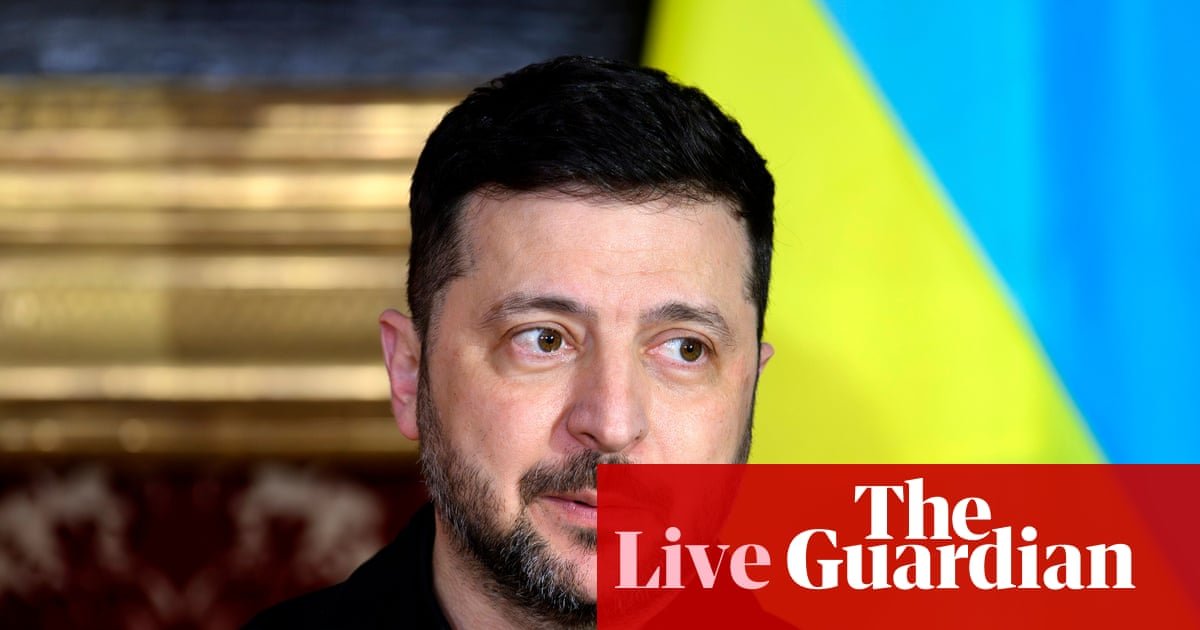
Zelenskyy said there has been no agreement between Ukraine and Russia on the key issues at the US-mediated talks in Geneva.
“We can see that some groundwork has been done, but for now the positions differ, because the negotiations were not easy,” the Ukrainian president told reporters after the talks had finished, according to the AFP news agency.
He listed the fate of occupied territories in Ukraine’s east and the future of the Zaporizhzhia nuclear power plant, which Russia has taken control of, as the unresolved “sensitive” issues in the peace talks.
Key events
‘Not easy’: Russia-Ukraine peace talks in Geneva end with no breakthrough
The latest round of US-mediated peace talks between Russia and Ukraine in Geneva on Wednesday ended without a major breakthrough, as fighting continues in a war that will enter its fifth year next week.
Ukraine’s president, Volodymyr Zelenskyy, said no agreement had been reached on the thorniest questions at the negotiations in Switzerland, accusing Moscow of “trying to drag out” the process.
“We can see that some groundwork has been done, but for now the positions differ, because the negotiations were not easy,” he told reporters after the talks.
Zelenskyy said the status of Russian-occupied territories in eastern Ukraine and the future of the Zaporizhzhia nuclear power plant, which remains under Moscow’s control, were among the most contentious unresolved issues.
The second day of talks ended after just two hours, signalling scant progress and underscoring how distant a deal still appears, despite Donald Trump’s promises to end the war on the first day of his presidency.
Read the full report by our Russian affairs reporter Pjotr Sauer here:
Slovakia warns Ukraine of reprisals over blocked pipeline
Back in Ukraine news, Slovakia has threatened to cut emergency electricity supplies to Kyiv if it does not reopen a pipeline that brings Russian oil to Slovakia and Hungary.
Slovakian prime minister Robert Fico, who is a close ally of Putin’s along with Hungary’s Viktor Orbán, declared a state of emergency over oil supplies. He said he had ordered the release of 250,000 tonnes of oil from emergency reserves in response to the interruption of oil supplies via the Druzhba pipeline.
Ukraine said the pipeline, which runs from Russia through its territory to Slovakia and Hungary, was shut down after being damaged during a Russian attack near the western Ukrainian city of Brody.
Fico claimed the repair work had finished and accused Ukraine of blocking oil supplies in order to “blackmail” Hungary, which opposes Kyiv from joining the EU. Orbán repeated this accusation, saying on social media that Ukraine was “trying to pressure us to support their EU membership”.
“Thankfully, Hungary has a government that doesn’t bow to blackmail,” he said.
Fico threatened to end electricity supplies to Ukraine, saying: “If the president (Zelenskyy) believes these supplies are not important, we can decide to withdraw from the electricity supply accord.”
Ukraine has been grappling with severe power outages in several cities including the capital Kyiv, which officials have blamed on delibate Russian attacks on energy infrastructure.
Danish king arrives in Greenland
Denmark’s King Frederik has arrived in Greenland for a three-day visit in show of support for the autonomous Danish territory after Trump repeatedly demanded control of the island.
AFP news agency reported that the king waved to well-wishers at Nuuk airport and was greeted by Greenland’s prime minister Jens-Frederik Nielsen.
France has launched wide-ranging investigations into human trafficking and financial fraud among contacts of the late convicted US sex offender Jeffrey Epstein following the release of a trove of files on his activities.
Paris prosecutor Laure Beccuau told France Info radio on Wednesday that the investigations will rely on publicly available material alongside complaints filed by child protection groups.
One will focus on human trafficking, the other on crimes including money laundering, corruption and tax fraud.
Russia and Cuba on Wednesday criticised the US energy blockade of the Caribbean island in a show of solidarity in Moscow, where Havana’s foreign minister was due to meet with president Vladimir Putin.
Cuba’s top diplomat Bruno Rodriguez travelled to traditional ally Russia seeking help as his country reels from a severe fuel crisis – intensified by Washington’s de-facto oil blockade.
US president Donald Trump cut off key supplies of Venezuelan oil to Cuba after ousting Venezuela’s Nicolas Maduro and has threatened sanctions on states that sell oil to Havana.
Rodriguez met with his Russian counterpart Sergei Lavrov ahead of seeing Putin, with the long-serving Russian diplomat using Soviet-era language to criticise Washington.
“We call on the US to show common sense and refrain from the military-maritime blockade of the island of freedom,” Lavrov said.
Ukraine officials to boycott Winter Paralympics opening ceremony over Russian athletes
Ukrainian officials will not attend the opening ceremony or other official events of the Winter Paralympics over the decision to allow six Russians and four Belarusians to compete under their nation’s flags, Ukraine’s sports minister said.
“We thank every official from the free world who will do the same. We will keep fighting,” Matvii Bidnyi said.
The Guardian’s chief sports reporter, Sean Ingle, has more on this story here:
Russia demands proof of Navalny poisoning
Russia has demanded for evidence after five European countries accused Moscow of poisoning the outspoken Russian opposition leader Alexei Navalny with a dart frog poison.
The UK, France, Germany Sweden and the Netherlands said on Saturday that laboratory testing of samples from Navalny’s body had confirmed the presence of epibatidine, a toxin found in poison dart frogs in South America and not found naturally in Russia. In a joint statement, the five countries said Russia “had the means, motive and opportunity” to administer the poison to Navalny, who was in a remote Arctic penal colony serving a 19-year sentence. He died in February 2024 which the Kremlin said at the time was of natural causes.
Russia’s foreign ministry spokesperson Maria Zakharova said: “All the accusations against Russia were of the ‘highly likely’ variety. There were no specific details. It was purely a proclamation to become the opening act of the Munich (security) conference and to overshadow the Epstein files.
“We demand they hand over concrete data on this issue.”
Merz open to social media ban for children in Germany
In Germany, chancellor Friedrich Merz said he was open to a social media ban for children.
“If children today, at the age of 14, have up to five hours or more of screen time a day, if their entire socialisation takes place only through this medium, then we shouldn’t be surprised by personality deficits and problems in the social behaviour of young people,” he said in an interview with the podcast Machtwechsel.
He said he was generally sceptical of bans but saw the consequences of mobile phone use. “I think the priority must be how to protect children at an age when they also need time to play, learn, and concentrate at school,” he added.
Merz said his government is considering “various ways of handling it in a more restrictive manner”, including an age limit and forcing platforms to verify users’ ages.
It follows moves made by several countries to ban social media to children under the age of 16. The first to introduce such a measure was Australia, where platforms such as TikTok, YouTube and Snapchat were required to remove accounts held by under-16s or face heavy fines since December.
India said it was discussing age restrictions with social media firms, while France’s National Assembly backed a bill that would ban social media access for under-15s.
Earlier this week Keir Starmer pledged action on young people’s access to social media in “months, not years”, but said that it did not necessarily mean a complete ban on access for under-16s.
Paris prosecutors open two new probes on Epstein and call for victims to come forward
Outside of Ukraine, prosecutors in France have opened two new investigations linked to Jeffrey Epstein as they urged potential victims to come forward.
Paris prosecutor Laure Beccuau said the probes were launched to examine the alleged sexual offences and possible financial crimes connected to the convicted sex offender. The investigations are seeking to use the millions of files released by the US government related to Epstein, Beccuau added.
“All that data … some will shed light on others to be able to get a well-informed, very broad, panoramic view,” Beccuau told the French broadcaster France Info.
Beccuau called on all potential French victims to come forward, saying: “We want to stand with these victims. We will receive all statements they wish to make.”
Beccuau also said some material from old investigations is to be revisited in the light of new revelations. She was referring to the investigation into French modelling agency executive Jean-Luc Brunel, a close associate of the US financier, who died in custody in 2022.
Brunel was found dead in his cell in a Paris prison in 2022 after having been charged with raping minors. The case against him was dropped in 2023 in the wake of his death, with no other person charged.
Zelenskyy: No agreement on key issues in Geneva talks
Zelenskyy said there has been no agreement between Ukraine and Russia on the key issues at the US-mediated talks in Geneva.
“We can see that some groundwork has been done, but for now the positions differ, because the negotiations were not easy,” the Ukrainian president told reporters after the talks had finished, according to the AFP news agency.
He listed the fate of occupied territories in Ukraine’s east and the future of the Zaporizhzhia nuclear power plant, which Russia has taken control of, as the unresolved “sensitive” issues in the peace talks.
Sean Ingle
Ukraine sports minister slams Russia’s Winter Paralympics entry as ‘deeply outrageous’
Ukraine’s sports minister has condemned the decision to allow six Russians and four Belarusians to compete under their nation’s flags at next month’s Winter Paralympics as “disappointing and outrageous”.
“The flags of Russia and Belarus have no place at international sporting events that stand for fairness, integrity, and respect,” said Matvii Bidnyi in response to the International Paralympic Committee’s decision on Monday.
“These are the flags of regimes that have turned sport into a tool of war, lies, and contempt. In Russia, Paralympic sport has been made a pillar for those whom Putin sent to Ukraine to kill – and who returned from Ukraine with injuries and disabilities,” he added.
Read the full report here:
Geneva peace talks ‘intensive’ and there is ‘progress’ – Umerov
News agencies have reported some comments from Rustem Umerov, the head of the Ukrainian delegation.
He told reporters that the talks were “intensive and substantive” and that a number of issues were clarified, without providing further details.
“There is progress but no details can be disclosed at this stage,” he was quoted as saying.