
One of the unexpected joys of following the Olympics in the age of smartphones is watching athletes’ TikTok videos and Instagram reels sharing life behind the scenes in the village. When the Games came around this time, I was excited to see more intimate peeks inside the life of an elite athlete, from team kits and opening ceremony fits to … how their homemade sweater was coming along?
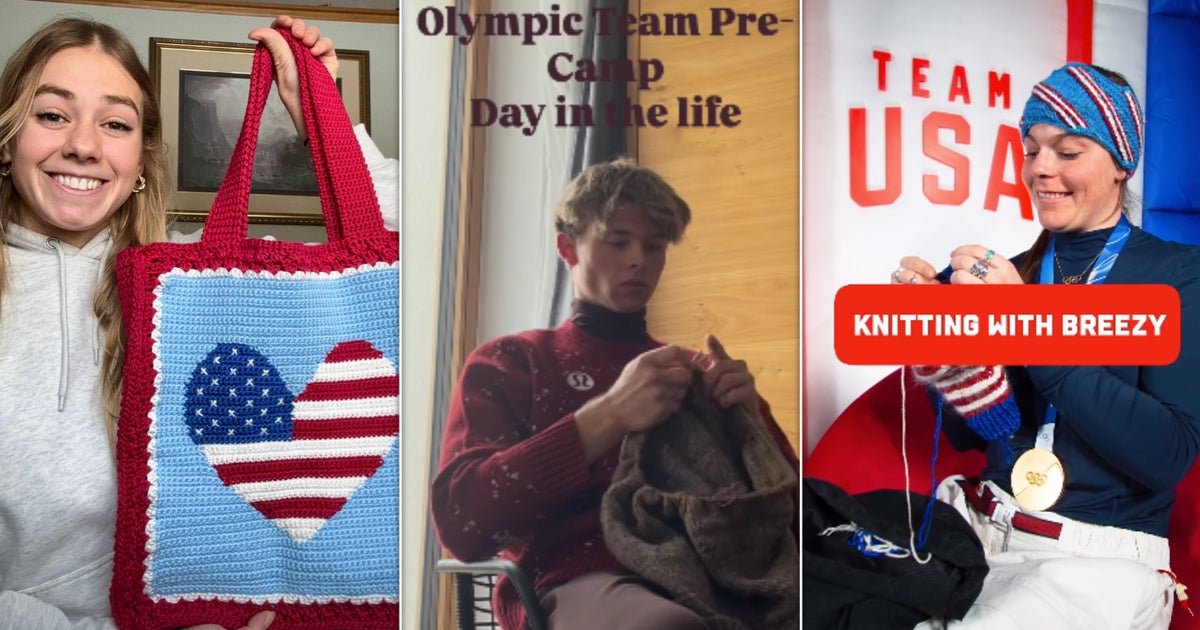
It turns out Tom Daley isn’t the only Olympian to pick up a pair of needles or a crochet hook. On Team USA, silver medalist skiers Breezy Johnson and Ben Ogden have shared their love of knitting. Snowboarder Maddie Mastro gave a tour of her latest knits before the Games. Speedskater Greta Myers showed off an American flag bag she crocheted for her mom to carry in Milan. Canadian biathlete Adam Runnalls — who cheekily dubbed himself the “2026 official knitter” on Instagram — told SportsNet his followers ballooned after he started sharing updates on his sweater progress, and his teammate Jasper Fleming has also joined in. And those are just the athletes who happened to come across my algorithm.
“It’s been very therapeutic for me. It’s given me a good outlet outside of skating that I can just funnel my attention to,” Myers told HuffPost of her crocheting. “You have to trust the process, and you have to accept sometimes it’s not going to turn out perfect.”
Courtesy of U.S. Ski & Snowboard
For Johnson, her knit objects became a kind of good-luck charm for her races.
“I got really into it during COVID and when I was first podiuming in races, and I started realizing anytime I had a new headband or hat in the finish, I would do really well,” she said in a video for Team USA.
Aside from being a way to make a unique souvenir or pass the time, hobbies like knitting and crocheting have been shown to help people with mindfulness, focus and relaxation — all key tools for someone in a high-pressure environment like the Olympics.
Experts say there are multiple benefits from taking up a hobby like knitting, from finding a community to having a sense of accomplishment from something where a gold medal isn’t on the line.
Mental health can have a huge impact on performance — and picking yourself back up after a loss.
While most people think of the physical preparation that goes into an Olympic journey, one’s mental state is just as crucial to success — especially resiliency. Superstars like Simone Biles and Naomi Osaka have talked about needing to take time away from their sport for their mental health. Figure skater Ilia Malinin, who was seen as a favorite this year for the men’s gold, opened up on social media after a disappointing result: “Those who appear the strongest may still be fighting invisible battles on the inside … It all builds up as these moments flash before your eyes, resulting in an inevitable crash.”
“Obviously, you’ve got to have the physical skills and the abilities and talent and things like that. But if your brain is not in the right space, your brain is also what controls your body and tells it what to do,” said Ashley Samson, a professor in the department of kinesiology and health promotion at the University of Kentucky who works with athletes on regulating emotion and arousal.
“If we’re too dysregulated emotionally, then that means there are a lot of neurotransmitters sort of firing around our brain that are going to make it almost impossible to be able to think logically and strategically,” she added.
Having a way to cope with stress can take some of the pressure off an athlete.
Myers shared how she was going through a difficult period last year after a pair of her blades broke while trying to earn a qualifying spot for the Olympics. She was skating on new blades, which take time to break in and get used to.
“I had a lot of anxiety about how I was going to do. And [my American flag bag] project that I was working on for my mom kept me very grounded in that process,” she said. “I’d be stressed at the rink, butI would come home and just be like, ‘OK, I’m gonna get done the handle today, or I’m gonna sew the stars on today.’ And step by step, doing that process just kind of took my mind off of things, and I feel like it gave me a positive outlet for my stress.”

The nature of competition means not everyone will go home a winner — and handling a loss can be more difficult when the whole world is watching. Having things they care about outside of their sport can help athletes cope better.
“There’s a lot of research in athletic identity. The bigger the piece of pie our athletic identity is, in terms of how we define our whole selves, the more problems that athletes can face,” Samson explained. “Because if your whole identity is wrapped up in being an athlete, that means you sort of live and die by every performance that you have.” She added that it can contribute to more serious mental health issues like depression and anxiety.
“For athletes who have a more well-rounded sense of self, it’s like, ‘Oh, OK, well, maybe today my golf game or my skiing or whatever didn’t go as well as I wanted. But then there are all these other parts of me that I find worth and value in, so it’s not going to completely tear me down.’”
What makes knitting or crochet so beneficial?
There are a few factors that contribute to why athletes might find comfort in the fiber arts.
Paula Redmond, a UK-based clinical psychologist who runs courses and events on the therapeutic benefits of knitting, said that the hobby can help with what she termed “down regulation.” “That’s about helping us access mindfulness, so kind of calming our minds, being able to interrupt rumination … activating the relaxation response,” she told HuffPost. A 2024 study from the University of Gothenburg found that knitters reported being able to think more clearly and manage stress.
Both knitting and crochet require a person to do small, repetitive movements in order to create an object or garment. While there can be a bit of a learning curve at first, a seasoned crafter can easily zone out while completing a row.
“It’s kind of linked to the activation of the relaxation response,” which Redmond said is linked to soothing rocking motions — think about how babies are put to sleep or the steady sway of a train. “I think there is this mind-body connection that is important. It is partly the kind of rhythmic, repetitive physical movements, the fact that you are requiring an element of focus. It becomes a mindful activity where you are needing to attend to the present moment.” Teasing out a tricky part of a pattern or trying a new design element requires focus on your craft, which can help quiet outside stressors.
On the other hand, crafts like these can provide “up regulation” in terms of offering a sense of accomplishment, a space for play and creativity, and a mode of self-expression, Redmond said. She pointed to behavioral activation, a technique used in cognitive behavioral therapy that focuses on pleasure — something that gives an individual joy or satisfaction — and mastery — developing a skill and overcoming a challenging task — that activities like knitting combine nicely.
“The stakes are low,” she said. “If something goes wrong, you can unravel it, and you’ve got what you started with.”
“Having opportunities in your life to make mistakes that aren’t so threat-activating is really important,” she added. “It allows us to try different ways of being with those mistakes. Like, do you want to just leave it? Is that part of the story, or is it something you want to unravel and go back and fix?”
“I really struggle with perfectionism,” Myers said. “I think a lot of athletes do. We just have such high standards, and it’s hard to forgive little mistakes. But you know, when you’re doing fiber arts and just painting and different crafts, mistakes are common.”

Instagram @j.fleming9/Getty
One reason Redmond recommends knitting to her clients is that it’s accessible and portable.
“You can access it in all sorts of different spaces, which you can’t do with a sewing machine,” she said. “So even if you only have five minutes, you can do something, and it builds toward a bigger project.”
Samson echoed that finding accomplishment outside of sports can positively impact someone who’s struggling in competition.
“For athletes, even just having those little boosts — you know, it’s not obviously the same thing as winning a gold medal, but every little deposit into the confidence bank account counts,” she said.
In an environment like the Olympics or any high-stakes situation where so much can be out of your control, it helps to have an activity where you are in charge of every aspect — what kind of yarn you’re using, what you’re making, whether you’ll go back and fix a mistake.
“Exercising autonomy is really important when we lose that sense of control in our lives,” Redmond said.
Finally, taking up a hobby can lead to finding like-minded people who share the same interests and provide the mental boost linked to strong social ties.
“It can tap into heritage, making gifts for people, kind of expressing care in our relationships,” Redmond said.
Fleming, the Canadian biathlete, said his coach bought the team knitting supplies as a way for them to keep busy while touring for competitions.
“Our Canadian team is very right knit (pun intended), and having something that ties us all together even further is pretty cool!” he wrote in a message to HuffPost. Indeed, the Canadian biathlon team’s Instagram account shared a snap of Fleming, Runnalls and their teammates knitting among a prodigious amount of yarn.
Of course, the benefits of taking up knitting or crocheting aren’t limited to the athletes competing in Italy this month. Anyone can find joy in the sense of community and accomplishment that comes from sporting a self-made garment — even one with a dropped stitch or wonky tension. It’s refreshing to see even athletes at the top of their game embrace an activity anyone could pick up this afternoon with a couple of supplies from the craft store.
“It just brings kind of a sense of peace, and it’s nice to just have a choice that I can do something that makes me feel happy while I’m outside of skating. ’Cause, I don’t know, sometimes skating can go well. Sometimes it doesn’t go well. It’s just how elite sports are. And crochet’s just ― it’s always there if I need to do it.”