
There’s nothing President Donald Trump loves quite like a grandiose-looking building with the “Trump” brand on it.
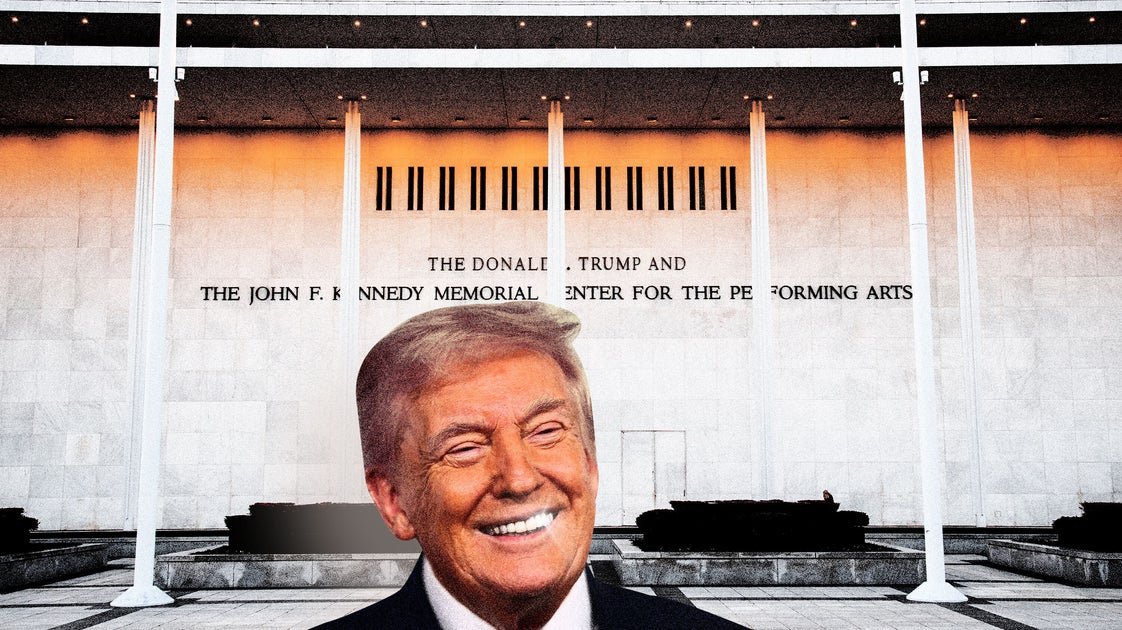
Since taking office, the Trump administration has affixed the Trump name to several prominent federal buildings and institutions in Washington, D.C. In December, it appended the words “The Donald J. Trump” to the front of the John F. Kennedy Center for the Performing Arts, above the name of the assassinated president it memorializes.
That same month, the State Department renamed the U.S. Institute of Peace the Donald J. Trump U.S. Institute of Peace ― despite the administration having tried to dismantle the organization earlier in the year. The department described the rebranding as a tribute to the “greatest dealmaker in our nation’s history.”
While there is no official name for the East Wing White House ballroom Trump is building, ABC reported in October that ingratiating staffers have taken to calling it “the President Donald J. Trump Ballroom.”
Then there’s the proposed Arc de Trump, later rebranded as the “Independence Arch,” a massive 250-foot-tall memorial that would be sandwiched in a grassy circle between the Lincoln Memorial and Arlington National Cemetery.
He reportedly has rebranding designs on non-federal buildings, too: On Tuesday, White House press secretary Karoline Leavitt was asked why the president had asked Senate Minority Leader Chuck Schumer to help him rename New York’s Penn Station and Dulles International Airport near D.C. in his honor.
“Why not?” Leavitt responded.
Well, for starters, presidents typically wait until after leaving office before accepting the honor of having a government building or transportation hub named after them.
It’s considered so uncouth, sitting presidents have even gone so far as to deny such renaming efforts: In 1975, President Gerald Ford vetoed legislation that would have called a new federal office building and courthouse in Grand Rapids, Michigan, the “President Gerald R. Ford Federal Office Building,” arguing in a letter that naming federal buildings after sitting presidents was not a proper precedent to establish.
Ford wasn’t alone in feeling this way, said Thomas Balcerski, a professor of history at Eastern Connecticut State University
“Way back to George Washington, he refused to allow the new federal city to be named after him, insisting on the District of Columbia instead,” Balcerski told HuffPost. “Harry Truman explicitly declined to have roads or buildings named after him while in office.”
Several federal buildings have been rebranded for presidents in recent history ― the George Bush Center for Intelligence in Virginia, for example, or John F. Kennedy International Airport in New York ― but no government buildings or airports have been named for a sitting president. Outside of presidential library designs, no federal buildings are currently named, or are planned to be named, for Barack Obama or Joe Biden.
The closest thing we’ve seen to a major federal project being named after a sitting president is the Hoover Dam, but President Herbert Hoover wasn’t responsible for initiating that. Bills passed by Congress during its construction referred to it as “Hoover Dam,” but at completion, Franklin D. Roosevelt’s administration named it the Boulder Dam. (In 1947, Congress restored the name Hoover Dam.)
Sitting presidents naming federal buildings for themselves “violates the norms.”
Sen. Bernie Sanders (I-Vt.) believes there’s a reason Trump is so intent on affixing his name to federal buildings.
“It’s no secret that President Trump is undermining democracy and moving this country toward authoritarianism,” Sanders said in a statement earlier this year. “Part of that strategy is to create the myth of the ‘Great Leader’ by naming public buildings after himself — something that dictators have done throughout history.”
In January, Sanders and other Democratic senators introduced a bill to prohibit naming federal property after sitting presidents: The aptly named Stop Executive Renaming for Vanity and Ego (SERVE) Act.
Illustration: HuffPost; Photo: Getty Images
So how does the business of renaming a building for a presidential usually work? Michael J. Allen, an associate professor of history at Northwestern University, told HuffPost that such honors are usually bestowed by an act of Congress or state or local officials.
“Earlier presidents would have deemed renaming it yourself more suited to a monarch than a democratic leader,” said Allen, who’s the author of the forthcoming book “The Center Ring: The Making and Breaking of the Liberal Presidency.”
In this way ― as in so many others ― Trump “violates the norms and customs his predecessors established over centuries,” Allen said.
Michael Kazin, a professor of history at Georgetown University, thinks all this building renaming reveal just how much Trump wants to be remembered as the greatest president the U.S. has ever had.
“I think that makes him long to have one or several monuments with his name on them in neoclassical design: Washington, Jefferson, FDR, and Lincoln have such monuments ― FDR’s is not in that style ― as does MLK, Jr.,” Kazin said. ”[Trump’s] grandiosity betrays a profound insecurity about how popular he is and how he stacks up against the ‘greats.’”
It hardly matters that Trump played no part in designing said buildings.
“Trump has always managed to have his name affixed to hotels, casinos, and other buildings that his own company did not build, as well as to best-selling books he did not write, like ‘The Art of the Deal,’” Kazin said.

Bloomberg via Getty Images
All this said, it’s fair to say that U.S. presidents, especially those interested in history, as many have been, thought about their legacy and their place in history while in office, said Ellen Fitzpatrick, a professor of history, emerita at the University of New Hampshire. At the very least, they’ve probably envisioned their presidential libraries while still in the White House.
“There’s nothing wrong with wanting to be recognized for greatness, but most presidents have, I think, understood they could not crown themselves, and create their own bed of laurels while in office,” she said. “I don’t know of any former president who made it a high priority to speed up the process of honoring their legacy [like this].”
Still, renaming anything is tricky business. Just because you rename a building in your honor doesn’t mean the public will take to it, Balcerski said.
Take the fate of the Tappan Zee Bridge in New York, the professor said. When the original structure was demolished and rebuilt, it became the Governor Mario M. Cuomo Bridge, but most New Yorkers still refer to the bridge by its old name.
“Can you imagine how New Yorkers would feel about Penn Station being named Trump New York Station, Trump New York Penn Station, or some variant therein?” Balcerski said. “I doubt the city would take kindly to the effort.”