
As files associated with the disgraced former financier and noted pedophile Jeffrey Epstein trickle out, critics of the Justice Department’s handling of the case — particularly its liberal use of redactions to protect those in power, rather than victims — are beginning to name what’s going on.
“We were told that MAGA was for working-class Americans. But this is a government of, by, and for the ultra-rich. It is the wealthiest Cabinet ever,” Sen. Jon Ossoff (D-Ga.) said in a speech on Feb. 7. “This is the Epstein class.”
“They are the elites they pretend to hate,” Ossoff continued, later adding: “If you’re Steve Bannon … how do you sell any of this? Trump was supposed to fight for the working class. Instead, he’s literally closing rural clinics and hospitals to cut taxes for George Soros and Elon Musk.”
The term “the Epstein class” has appeared in comment sections everywhere from X to Instagram Reels and Threads over the years, to attempt to name a deeply uncomfortable class dynamic on display: The self-protective circle of wealth, favors and information that kept enterprises (and crimes) involving Epstein afloat for so long.
And in 2026, it seems to have thoroughly worked its way into the public consciousness — enough to make it into official speeches of politicians like Ossoff and his peers.
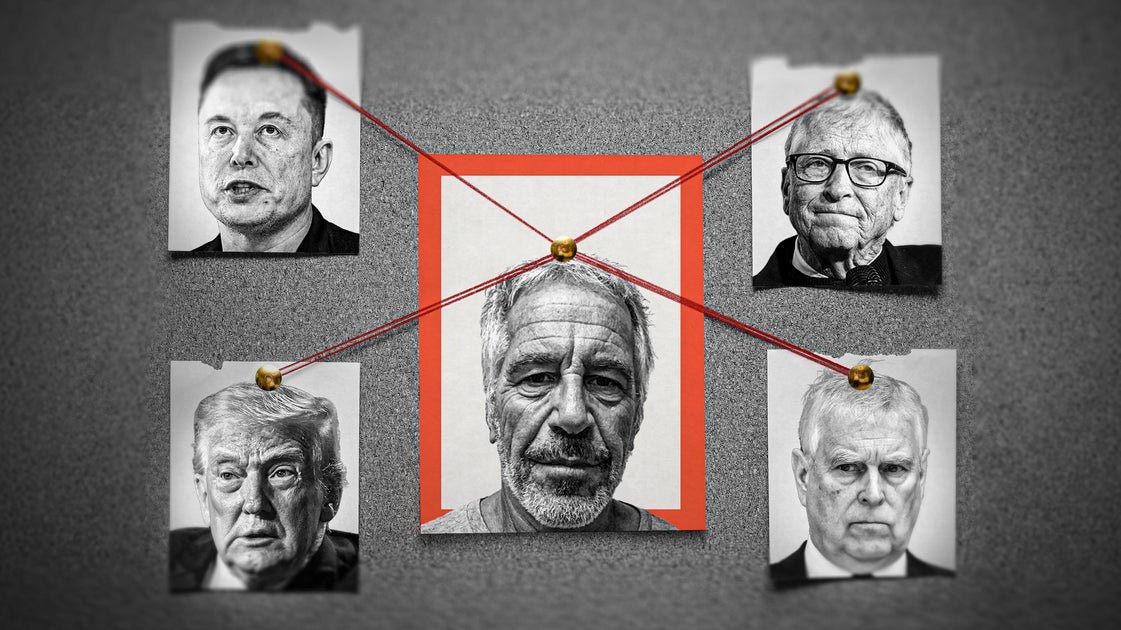
Illustration: HuffPost; Photos: Getty
Rep. Ro Khanna (D-Calif.), one of the American politicians who was early to use the term, told HuffPost in a statement that he began using it to challenge the “elite” — and largely unaccountable — wealthy individuals who, he says, believe they can “play by a different set of rules.”
“Americans are sick of elite impunity. There cannot be two tiers of justice, where wealthy men who abused young girls are protected while survivors are silenced,” Khanna told HuffPost. “That is what the effort to release the Epstein files has been about, and why I started calling it the ‘Epstein class.’”
“They want us to move on, but people need to keep speaking out,” Khanna continued. “That’s why I’m doing media on the left and right — like Shawn Ryan’s podcast — to keep the pressure up. We need to form a committee to haul everyone who emailed Epstein about abusing young girls in front of Congress.”
There’s power in naming this social circle in a grounded way.
“Every time the Epstein case comes up, I feel like [the term “Epstein class”] reemerges more and more,” said Josephine Lukito, a professor of digital communication at the University of Southern Denmark who studies political language in the public sphere. “I haven’t done, like, a systematic analysis of how often it comes up, but I think it has a sort of catchy quality to it that seems to resonate with people when they talk about the Epstein case.”
Lukito notes that the term, “meme-like” as it is, has all the makings of something that concerned individuals can rally around based on what we know about similar movement-adjacent phrases.
Phrases that catch on with the public tend to be pretty short, Lukito explained, citing “Me Too” and “Black Lives Matter.” She notes that Americans, in particular, really like adjective-noun combinations, particularly those involved in politics.
“I don’t know if I’d go so far as to say bring people together,” Lukito said, “but it certainly resonates with a lot of people and can help motivate a movement.”
Class can be a complicated subject to broach in the U.S., and these terms can be “loaded,” Lukito said. However, that may be part of the term’s power.
“Historically, we talk about the ruling class, the wealthy class, the bourgeoisie class — and so, a lot of times when we do talk about class, it’s a really quick indicator for wealth,” Lukito said. “I think that really speaks to the uniqueness of the Epstein case in particular.”
“Certainly the U.S. has seen many abuse cases, often involving multiple people, but I think what kind of brings the abusers and the Epstein case together is their wealth, right?” Lukito said. “They kind of vary by partisanship and by profession, but a lot of the Epstein case itself is really surrounded by an egregious amount of wealth and the ability to use that wealth to exploit children.”
“Americans recognize that wealth is bipartisan, and wealth contributes to abuse. And ‘Epstein class’ encapsulates a lot of that.”
– Josephine Lukito, professor of digital communication at the University of Southern Denmark
Terms like “the Epstein class” can also work to break through some of the Americans’ resistance to talking and thinking about class, as “it’s not just critiquing power, but, like, wealth and power: economic power,” Lukito said.
“Historically, a lot of terms that are related to kind of wealth and power tend to be silenced,” she continued, citing Martin Luther King Jr.’s less-discussed activism around poverty and wealth. However, there’s a hunger to hear these topics discussed more plainly, particularly among Americans who are struggling and furious, she said.
“A lot of Americans, especially given economic disparity right now, they have a lot of anger and frustration towards the wealthy and the ruling class,” Lukito explained. “The Epstein case certainly is an encapsulation of that, right? We see that rage coming out in so many other contexts: in health care, in frustration towards tech bros and seeing a lot of the relationships between the wealthy and politicians.”
“Americans recognize that wealth is bipartisan, and wealth contributes to abuse. And ‘Epstein class’ encapsulates a lot of that. It continues to be a big reason why it resonates,” she said. “I don’t know if I would go so far as to call it class consciousness, but there’s certainly a widespread frustration, hatred, anger towards those who extract wealth and keep it for themselves.”
How do we know when a term like this starts to matter?
For Lukito, who has studied numerous catchphrases and terms that catch on in the political world (online and off), there is something unique about this particular case.
“In past examples of catchphrases and terms that I’ve studied, a lot of them have appeared on text-based social media platforms, something like Twitter, right? We talk about, like, hashtag activism or hashtags being this important rallying point for people — and this is the one that’s kind of different,” Lukita said. “I would say that Epstein class as a term is more in the nascent stage. I haven’t necessarily seen it used as a specific hashtag. It’s appearing more in comments of videos as opposed to more of a text-based platform.”
She notes that a real marker of a term having staying power is when you can see it “move across multiple different platforms” and “not existing within just one community, but it’s salient or popular enough that it’s moving across a lot of different social media platforms and a lot of different internet users.”
And the staying power of the news story can play a role in how this term — and the larger class criticism it carries — will fare.
“I think when catchphrases are really powerful, it’s because there’s a sort of staying power when it comes to the news story that’s being covered, whether it’s police brutality or sexual assault,” Lukito said. “Certainly, this is not going to be even the last time we hear about the Epstein case.”
“I suspect that this news story will emerge over and over again — this year, next year. I would gander that every time it emerges, that term ‘Epstein class’ will also emerge,” she said. “And it’ll be interesting to see whether it grows in popularity or traction.”
Lukito spoke with HuffPost prior to Ossoff’s speech. And she argued that voices like Khanna’s and those of other political figures embracing the term will be key in whether it takes hold with the American people.
“I think when we see that sort of adoption, especially by larger public figures, those are all signs that a term like ‘Epstein class’ is gaining momentum,” she said.