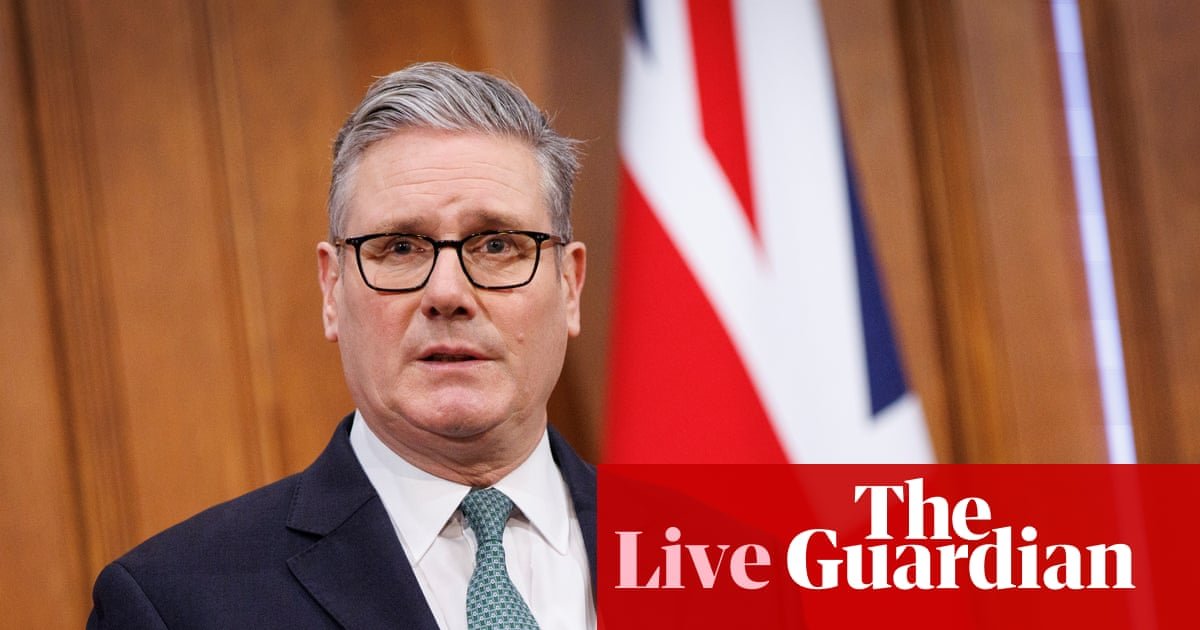

Farage says Trump’s tariffs threat ‘wrong’ and he will be ‘having words’ with US officials about it at Davos
Nigel Farage, the Reform UK leader, is normally proud of his friendship with Donald Trump, and he rarely criticises him in public. But on Saturday, after Trump announced tariffs on eight Nato countries not supporting his proposed purchase of Greenland, Farage said he did not support the move, which he said would “hurt” the UK.
Today, speaking to journalists as he unveiled his latest defector (see 12.56pm), Farage said that Trump’s proposal was “wrong” and that he would be said he would be “having some words with the American administration” about it in Davos.
Key events
Voters would back retaliatory tariffs against US in response to Trump’s Greenland tariffs by more than 4 to 1, poll suggests
Keir Starmer said this morning that he did not favour retaliatory tariffs against the US in response to any tariffs imposed by Donald Trump on the UK and other Nato countries opposing his plan to buy Greenland (see 9.36am), and Jenny Chapman, the development minister, defended this approach in the Lords this afternoon (see 4.05pm).
But the public thinks differently. By a margin of more than four to one, voters would support retaliatory tariffs, a YouGov poll suggests. Some 67% of people would either strongly (45%) or somewhat (22%) support the idea; only 14% of people would be opposed, either strongly (6%) or somewhat (8%).
Kalyeena Makortoff has more on the potential economic impact of the new tariffs proposed by Donald Trump on our business live blog.
Proposed Trump tariffs could cost the UK £15bn by June, leading business group says
In the Lords the former Tory Foreign Office minster Lord Ahmad of Wimbledon asked Jenny Chapman during the PNQ on the Greenland tariffs threat (see 4.05pm) if the government had assessed the impact the proposed tariffs might have.
Chapman said they would be “extremely damaging, not least to our car industry, to aerospace, life sciences, to steel”. But she not put a figure on that.
But the British Chambers of Commerce has tried to estimate the potential damage.
After a meeting this morning about the crisis with Chris Byrant, the trade minister, Shevaun Haviland, the BCC director general, said:
Throughout tariff developments, the government has kept a cool head and continued to negotiate. That’s seen us establish a competitive advantage over many other countries in the US market for goods like steel and pharmaceuticals.
We are still in the foothills when it comes to these new tariff proposals from the President and there is some way to go before we will have final clarity on them.
But should the worst-case scenario come to pass, then the impact would be significant. A £6bn hit at the end of January, rising to £15bn in June.
If that happens, orders will drop, prices will rise, and global economic demand will be weaker as a result. That would be a lose-lose situation for everyone.
Minister defends government’s decision not to hit back at Trump over tariffs threat, saying ‘aim is to de-escalate’
Jenny Chapman, the development minister, has defended the government’s refusal to hit back at the US over President Trump’s latest threat to use tariffs against the UK.
She was responding in the House of Lords during a private notice question on the latest tariffs threat.
Lord Purvis, the Lib Dem leader in the Lords, said that the threat showed something “obvious to everyone”, that Trump was an “unserious person”.
He went on:
The threat from the US to, not only a very close ally in the European Union, but a Nato partner, and then to punish us for standing with them, is utterly reprehensible.
The PM said the actions are completely wrong. But the government refuses to raise a formal complaint to the WTO [World Trade Organization], whose rules these are trashing.
He said that they’re completely wrong because they’re economic coercion, but has refused to put in place protective anti-coercion measures.
What is the point of saying something is completely wrong when you do completely nothing? As a result of it?
Chapman replied:
I think it’s called diplomacy. And our aim is to de-escalate the situation and not to take measures which would inevitably cause this to escalate and get more damaging for our manufacturers and for people’s jobs.
Jenrick tells female broadcaster she needs her ‘head checking’ after she suggests he’s patronising towards women
Robert Jenrick, the former shadow justice secretary, told a female broadcaster “you need your head checking” after she asked him about his attitude to women.
In an interview on Times Radio, Kate McCann put it to Jenrick that most of the former Tory colleagues he had been criticising were women. She also asked why, at his press conference with Nigel Farage last week, Jenrick made a point of repeatedly mispronouncing Kemi Badenoch’s name. (He pronounced the initial syllable “bad”, as in opposite of good, whereas it is meant to be “bade”, as in bade farewell.)
Jenrick replied:
I honestly have no idea what you’re talking about. If you, Kate, think that this is important, then you need your head checking. What matters here is the state of the country, and the country’s in a real mess.
When McCann said the press conference came across as “quite blokey”, Jenrick again said that he had no idea what she was on about. McCann said that most women would understand. Jenrick said, if she was suggesting he was sexist, that was “extremely offensive”, because he was a husband and father of three daughters.
Jenrick’s new colleagues in Reform UK are unlikely to side with McCann on this. Farage himself has been criticised for being patronising towards female journalists.
One of the women criticised by Jenrick, and mentioned by McCann, was Liz Truss, the former PM. In an article for the Times published this morning, Jenrick said Badenoch should have expelled Truss from the party.
He said:
Truss’s disastrous tenure as prime minister destroyed the savings of tens of thousands of people in this country. In 42 days, she single-handedly demolished the party’s reputation for fiscal credibility, undermined the country’s credit ratings and forced many to re-evaluate their retirement.
Since that time, Mrs Truss has embarked on an unrepentant, vainglorious global media tour in which she proudly declares that her unique blend of economic incompetence should be the model for fiscal policy worldwide. All this as a Tory member.
Why hasn’t she been removed? Well, because removing her would be difficult. She has friends in the party. It isn’t the done thing. It’s easier to let her just remain. Nobody has the gumption to face the issue, no matter how offensive it is to the victims of her ineptitude. And if the party doesn’t have the balls to kick out Truss, will it really have the gumption to take on the vested interests that stand in the way of all the change our country needs?
Nigel Farage, the Reform UK leader, has said that Keir Starmer’s response on Saturday to President Trump threatening to impose tariffs on Nato allies not supporting his Greenland plans was correct.
Starmer said:
Applying tariffs on allies for pursuing the collective security of NATO allies is completely wrong.
In an interview with Matt Chorley for Radio 5 Live, Farage said:
I felt the prime minister’s instinctive response, to say this was completely wrong, was actually the correct thing to say.
But let’s see how tough we can be. Let’s see how good a negotiator he is. Some of the evidence, when it comes to the EU reset and the Chagos deal, is our prime minister is not a born negotiator, and that would be my concern.
Yvette Cooper has held talks with her Danish opposite number, Lars Løkke Rasmussen, at Carlton Gardens, her official residence as the foreign secretary.
As Sky News reports, she told him:
The future of Greenland is for the Greenlanders and for the Danes alone. Greenland is a part of the Kingdom of Denmark and those principles around sovereignty are crucial.
She also said it was “completely wrong and counter-productive” for President Trump to threaten allies with tariffs to get them to support his plan to purchase Greenland.
The visit was arranged before the Trump tariffs were announced on Saturday.
In the Commons Bridget Phillipson, the education secretary, is taking questions.
After the government cancelled the debate on the Hillsborough law planned for this evening (see 11.30am), there was time to fill in the schedule today. With that in mind, the speaker, Lindsay Hoyle, has granted four urgent questions. And there will be two ministerial statements too.
Here is the list, with rough timings.
After 3.30pm: A Treasury minister answers an urgent question from Mel Stride, the shadow chancellor, on business rates.
Around 4.15pm: A Foreign Office ministers answers an urgent question from Priti Patel, the shadow foreign secretary, on Iran.
Around 5pm: A local government minister answers an urgent question from James Cleverly, the shadow housing, communities and local government secretary, about local elections being cancelled.
Around 5.45pm: A Foreign Office minister answers an urgent question from the Labour MP Sarah Champion about the proposed Chinese “super-embassy” in London.
Around 6.30pm: Yvette Cooper, the foreign secretary, makes a statement about Donald Trump’s tariffs threat relating to Greenland.
Around 7.30pm: Alex Davies-Jones, the victims minister, makes a statement about the Hillsborough law.
Mandelson says European leaders should follow Starmer in talking down prospects of trade war with US
Peter Mandelson, the former ambassador to the US, has said that European leaders should adopt the non-confrontational tone favoured by Keir Starmer in their response to Donald Trump’s threat to impose new tariffs until he is allowed to buy Greenland.
In an interview with the World at One, Mandelson said:
This is not a moment for grandstanding. It’s a moment for taking the heat out of the situation. It’s a time for sensible diplomacy and dealmaking.
And that’s why I think that there are some in Europe who could do worse than take a cue from our own prime minister this morning, who I thought was pitch perfect, not just in saying the trade war is in absolutely nobody’s interest – and he’s right on that – but also that it’s better to talk and discuss than indulge in rhetoric and commentary and gestures.
Mandelson was particularly critical of the French government, accusing them of grandstanding. But he also hit out at Bronwen Maddox, director of the foreign policy thinktank Chatham House, saying that in a speech last week she had argued for jettisoning the US alliance. That idea was “self-indulgent nonsense”, he said.
He said the UK needed to preserve its alliances with the US and Europe.
Asked if he thought Trump would end up getting control over Greenland, Mandelson said he thought there was “a deal to be made”. But he said that was “not the same as having a shakedown imposed on us by means of duress and threats”, which would be “completely unacceptable”.
The latest edition of the Guardian’s Politics Weekly podcast is out. It features Pippa Crerar and Kiran Stacey talking about Keir Starmer’s press conference this morning.
Reeves pulls out of event celebrating City as stock markets fall following Trump tariff threats
This morning Rachel Reeves pulled out of an event at the London Stock Exchange, marking a “new golden age” for the City, as concerns about Donald Trump’s fresh tariff threats sent global markets tumbling. As PA Media reports, stock markets in the UK, France and Germany were down sharply on Monday morning, while gold prices rose to hit a fresh record high.
Lauren Almeida has more on this on our business live blog.
Farage says Trump’s tariffs threat ‘wrong’ and he will be ‘having words’ with US officials about it at Davos
Nigel Farage, the Reform UK leader, is normally proud of his friendship with Donald Trump, and he rarely criticises him in public. But on Saturday, after Trump announced tariffs on eight Nato countries not supporting his proposed purchase of Greenland, Farage said he did not support the move, which he said would “hurt” the UK.
Today, speaking to journalists as he unveiled his latest defector (see 12.56pm), Farage said that Trump’s proposal was “wrong” and that he would be said he would be “having some words with the American administration” about it in Davos.
John Swinney, Scotland’s first minister, has described Donald Trump’s threat to impose tariffs on European countries that do not back his call for a US takeover of Greenland as “deeply damaging”. Swinney told PA Media:
The announcements made by President Trump over the weekend are deeply damaging and they are the wrong thing to do.
They have the risk of undermining the economy of Scotland and the United Kingdom because of the scale of the tariffs but they also risk undermining the security and the safety of the Nato alliance because of the steps, and the approach, that have been taken in relation to Greenland.
So, at an economic level, and at a security level, this approach being taken by President Trump is wrong and should not be pursued.
How Starmer declined to back Ed Davey’s call for king’s visit to US to be cancelled if Trump implements tariffs threat
And this is what Keir Starmer said at his press conference (see 9.49am) about not wanting to call off King Charles’s state visit to the US in retaliation over the Greenland tariffs. Starmer said:
In relation to the king and other issues, as I said in my speech I’m focused on the pragmatic response here, not the suggestion of others.
And my focus is on what’s in the national interest for our country, what is going to best protect workers, families, businesses, and I believe that’s the approach I’ve set out.
Yesterday Ed Davey, the Lib Dem leader, called for the state visit to be cancelled if the Trump tariffs go ahead. But Davey did not repeat the proposal in the statement he issued this morning. (See 9am.)
What Starmer said about UK’s nuclear deterrent being dependent on ‘good relationship with US’
In his response to a question from ITV’s Robert Peston at the press conference this morning (see 9.40am and 11.20am), Keir Starmer admitted that the effectiveness of Britain’s nuclear deterrent depended on having a good relationship with the US. He said:
I don’t want to lose sight of the central goal here, which is to avoid the seriousness that a trade war would bring.
In relation to your broader point, we do have to remember at all times that it is in our national interest that we continue to work with the Americans when it comes to defence, to security, and to intelligence.
Our nuclear deterrent is our foremost weapon, and deterrent, when it comes to, securing the safety of everybody in the United Kingdom, my primary duty.
And that requires us to have a good relationship with the United States.
But it doesn’t mean, as I said a moment ago, that we pretend we don’t have differences, We do have differences. And I’ve set out some of those differences here this morning in relation to Greenland.
In theory, the UK’s nuclear deterrent – which relies on one of the UK’s four Trident submarines always being at sea, undetected, ready to fire nuclear missiles at an enemy – is operationally independent. But the missiles (though not the warheads) are provided by the US, which also services them, which is what Starmer was referring to when he said the entire system depended on a good relationship with Washington.
This post was amended at 12.18 GMT to refer correctly to the UK’s Trident nuclear deterrent, not its predecessor, “Polaris”.