
Ceramic and porcelain tiles are still the most popular backsplash choice, according to a new trend report from the National Kitchen & Bath Association. But the same research points to another trending option that requires even less upkeep: solid surface backsplashes.
Grainy stone countertops have been the standard for years, and now the look is climbing the wall for a more cohesive kitchen design. To understand why, we asked several interior designers to weigh in on what’s driving the shift, which materials they recommend, and the potential pros and cons of going all-in on the solid slab backsplash look.
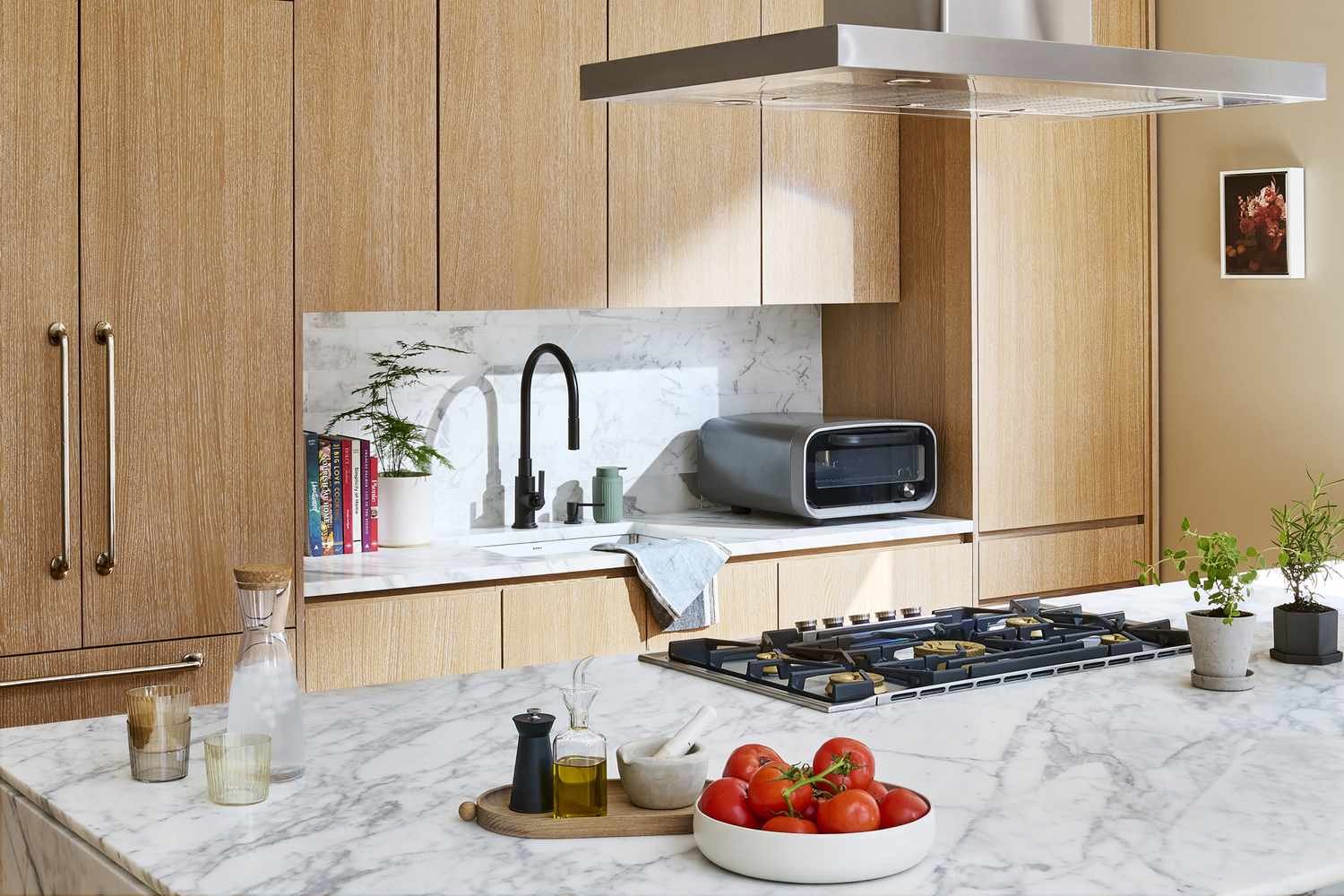
Erin White Photography; Design by Jordan Slocum and Barry Bordelon of the Brownstone Boys
Why Solid Slab Backsplashes Are Trending
“Solid slab backsplashes are having a major moment because they bring a sense of luxury and cohesion to a space,” says Jordan Slocum, co-founder of the Brownstone Boys. “They blur the line between function and form—by extending the countertop material up the wall, you create a seamless, sculptural surface that feels elevated and intentional.”
Another major draw is the practicality. “There are no grout joints, so it’s easier to clean, and there’s no grout staining over time,” says Sydney Davenport Katz, AIA, LEEP, AP, architect and founder of SDK Architecture, who also appreciates that fewer materials are being used in the kitchen.
And although the finished product appears high-end, the installation process is relatively straightforward (a big perk!). “Slab backsplashes make a statement: They look purposeful and they add elegance,” says Jennifer Beget, principal designer and founder at J Beget Designs. She loves that they are cohesive, seamless, and there are fewer trades to hire. “The same trade who installs the countertops will also install the backsplash, so there’s less material change.”
Beget says you shouldn’t limit yourself to just a backsplash and countertop. “In one kitchen, we draped the kitchen hood with the countertop slabs, so the pattern and beautiful colors bled from the kitchen hood to the backsplash to the countertops, and it was absolutely stunning.”
David A Land Photography; Styling by Pablo Olguin; Design by Alvin Wayne
Jennifer Hughes, Photographer; Design by Sydney Davenport Katz
Preferred Materials
When it comes to materials, all the designers agreed that nothing beats the authenticity of natural stone. “Real stone! Always go with real stone,” says Beget. “It may be polished, leathered, colorful, or muted, but there is nothing more beautiful than real stone.”
“It really depends on my clients’ priorities, but I love marble!” says Davenport Katz. “It has the most beautiful veining that you just can’t replicate with manufactured surfaces.
But this begs the question: Is a real stone slab backsplash cost prohibitive? Not necessarily, according to Davenport Katz. “It certainly costs more than off-the-shelf tile, but the actual stone you select will dictate the price.” Keep in mind that the more exotic the look, the more expensive the stone, but Davenport Katz insists there are beautiful slabs at all price points. “If you are going for this elevated look, it is worth the investment!”
Stone Alternatives
Alvin Wayne, principal designer for Alvin Wayne Designs, says you can get the look of Calacatta or Arabescato marble for less. “If clients want something lower maintenance but with a similar look, a porcelain slab or quartz with dramatic veining gives the same uninterrupted impact with added durability.”
For homeowners who need something more practical (and affordable) than natural stone, here’s a peek at the best options:
- Manmade stones like engineered quartz, sintered stone brands like Dekton and Neolith, and solid surface materials like Corian mimic the look of stone with nonporous surfaces and nearly invisible seams.
- Large-format porcelain slabs are durable, resistant to heat and staining, and available in thin profiles that can be easier to install yourself.
- Opaque glass panels are easy to clean, though they’re less common and can be costly to install.
- Laminate slabs are the most budget-friendly option, with designs that replicate stone or other finishes.
Installation Considerations
One of the biggest design decisions with a slab backsplash is deciding how high to take it when there aren’t upper cabinets limiting your height. You can stop just below open shelving or run the stone to the ceiling, especially behind a range hood. The higher you go, the more material you’ll need, so it’s worth deciding if the dramatic effect is worth the added cost and installation complexity. (If you’re working with a bold, high-contrast stone in a small kitchen, running the material too high can feel overpowering.)
For the edge itself, designers usually recommend a clean mitered edge if the backsplash ends short of the ceiling, and there’s no shelving to act as a natural endpoint. When the slab extends all the way up, skip the trim to keep the look clean. A good rule of thumb is to map out the slab height and edge treatment on paper or with painter’s tape on the wall before committing.
Stephanie Studer, Life Created Photography; Design by Jennifer Beget of J Beget Designs
Potential Cons of Solid Surface Backsplashes
Solid surface backsplashes (preferably in natural stone) are stunning, but they’re not without some trade-offs. From maintenance concerns to material waste, here are a few potential drawbacks to consider before committing to the style.
Staining or Etching
Stone slab backsplashes may be beautiful and require less grout cleaning, but they do come with extra upkeep. “Natural materials are susceptible to staining and etching if not properly sealed, resealed, cared for, and maintained,” says Davenport Katz. Homeowners considering light colored marble or quartz should be ready for ongoing sealing (typically once every 6 to 12 months) to prevent discoloration. You may be able to get away with sealing darker, polished slabs like granite once every few years.
High Cost
The designers we spoke to didn’t completely agree on how affordable slab backsplashes can be, but they both acknowledged that cost is a major consideration. “One potential con can be cost because you’ll be purchasing more slabs and paying for the additional cost of labor and fabrication,” says Beget. “Selecting slab stone countertops as a kitchen backsplash can get extremely expensive due to pattern matching the slabs.”
For the best end result, Beget says you’ll want to match the movement and colors within the stone slabs from the countertop to the backsplash. This adds to the cost, both in materials and installation, which you can offset by choosing a stone with less natural veining.
Wasted Material
Sometimes you may need to buy more slabs than the square footage indicates in order to get a clean match. “This comes with waste and remnants of the slabs that will not be used,” says Beget. “We’ve had to purchase upwards of ten quartzite slabs for one kitchen just to pattern match.” For someone looking for a sustainable design option, this may be a deal breaker.