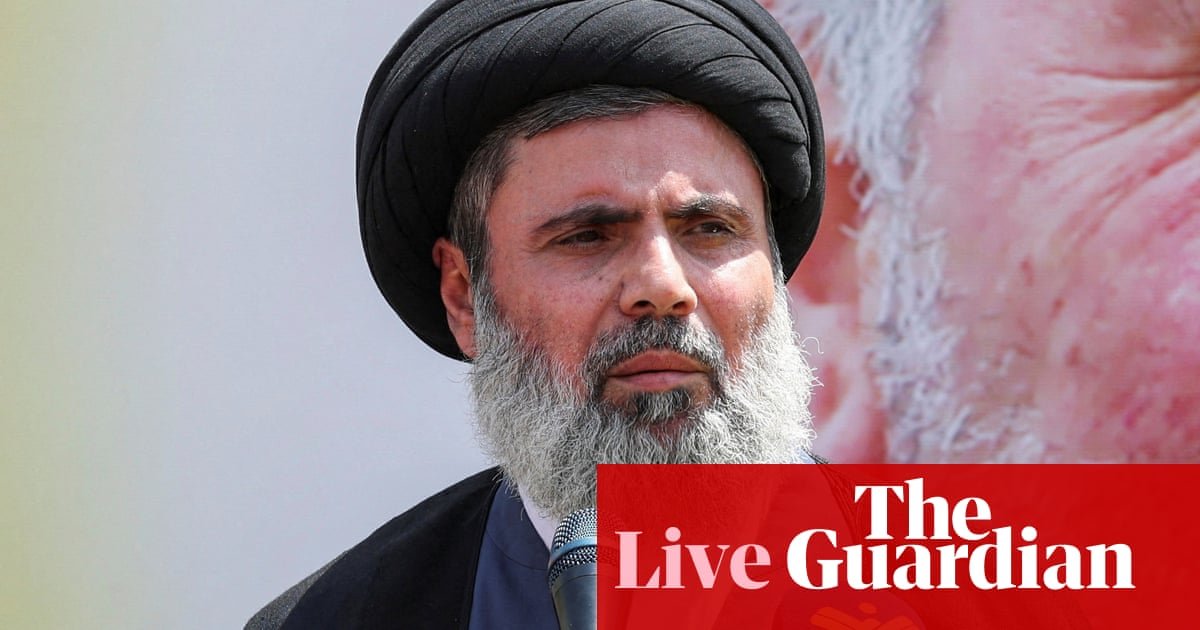

Hezbollah’s Hashem Safieddine killed in Israeli attack, group confirms
Hashem Safieddine, the top Hezbollah official widely expected to succeed slain secretary general Hassan Nasrallah, was killed in an Israeli attack, the group said on Wednesday.
Hezbollah confirmed that Safieddine was killed in an Israeli airstrike, reports Reuters.
According to Reuters, Safieddine had been running Hezbollah alongside its deputy secretary general Naim Qassem since Nasrallah’s assassination and was expected to be formally elected as its next secretary general, although no official announcement had yet been made.
A relative of Nasrallah, Safieddine had sat on the group’s Jihad Council – the body responsible for its military operations. He was also head of its executive council, overseeing Hezbollah’s financial and administrative affairs.
According to Reuters, Safieddine assumed a prominent role speaking for Hezbollah during the year of hostilities with Israel that ultimately led to his death, addressing funerals and other events that Nasrallah had long been unable to attend for security reasons.
His killing further erodes the group’s top leadership as Israeli strikes pummel Lebanon’s south, eastern Bekaa valley and southern suburbs of Beirut – all Hezbollah strongholds – and the group’s fighters seek to push back Israeli ground incursions.
Key events
China’s president, Xi Jinping, has said that “an early ceasefire and an end of war in Gaza are the key to easing regional tensions”, according to state media.
As we reported earlier, Xi met with his Iranian counterpart, Masoud Pezeshkian on the sidelines of a Brics summit in Russia on Wednesday.
Chinese state media Xinhua reported that Xi made the comments about a Gaza ceasefire during his meeting with Pezeshkian.
Pezeshkian, at a Brics plenary session, urged members to “use all their collective and individual capacities to end the war in Gaza and Lebanon”.
Turkey’s defence minister, Yaşar Güler, earlier also blamed the Kurdistan Workers’ party (PKK) for the deadly attack at the headquarters of the national aerospace company, Tusaş, outside Ankara on Wednesday.
Without giving evidence, Güler said:
We give these PKK scoundrels the punishment they deserve every time. But they never come to their senses. We will pursue them until the last terrorist is eliminated.
Death toll from Turkish attack rises to five, says interior minister
The number of people killed in an apparent terror attack on a Turkish defence facility in Ankara has risen to five, the country’s interior minister, Ali Yerlikaya, said.
A further 22 people have been injured, with two in critical condition, he told reporters.
Yerlikaya added that the perpetrators of the attack were “most likely” members of the Kurdistan Workers’ party (PKK).
US ‘strongly condemns’ attack on defence firm near Ankara, Turkey
The White House’s national security council spokesperson, John Kirby, has told reporters that the US “strongly condemns” the attack at the Turkish defence firm near Ankara on Wednesday. Kirby said:
While we don’t yet know the motive or who is exactly behind it, we strongly condemn this act of violence.
The Israeli military said air raid sirens were activated across central Israel after they were triggered by four rockets launched from Lebanon.
The Israel Defense Forces (IDF) said some of the projectiles were intercepted and several impacted, without specifying where.
There were no immediate reports of injuries
Rescuers recovered the bodies of a woman and her 7-year-old child two days after an Israeli airstrike near Lebanon’s largest public hospital in southern Beirut, according to a Lebanese official.
At least 18 people, including four children, were killed and more than 60 others wounded after the Israeli strike hit several buildings near the Rafik Hariri university hospital. The hospital suffered “major damage” from the blast.
Saad al-Ahmar, the commander of the Lebanese civil defence’s southern district fire and rescue unit, told Associated Press that the mother and child were from the Mokdad family, seven of whom were killed in Monday’s attack.
He added that four to five Syrians and one Sudanese individual remain unaccounted for.
The Israeli military said it hit a “Hezbollah terrorist target” near the hospital, without giving details, and insisted that the hospital was not targeted.
Germany has condemned what it called a “horrific terrorist attack” at the headquarters of the Turkish defence firm, Tusaş, near Ankara on Wednesday.
“We condemn all forms of terrorism in the strongest possible terms,” the German foreign ministry wrote in a post to X.
Germany has the largest Turkish population outside Turkey.
Four people killed in ‘terror attack’ at Turkish aerospace company
Away from Israel but in a sign of further instability in the region, here are some of the latest images from Ankara, after four people were killed and 14 others wounded in what Turkey’s president, Recep Tayyip Erdoğan, described as a “heinous terrorist attack” at the headquarters of the national aerospace company, Tusaş, on Wednesday afternoon.
Turkey’s interior minister, Ali Yerlikaya, blamed a terrorist attack for the explosion and assault at the building, and said two attackers had been “neutralised” and work was under way to determine their identities.
It was not clear who was behind the attack. Kurdish militants, Islamic State and leftist extremists have carried out attacks in the country in the past.
Four Palestinians have been killed after an Israeli airstrike targeted a house in the Tal al-Hawa neighbourhood, southwest of Gaza City on Wednesday evening, Palestinian news agency Wafa reported, citing medical sources.
There were additional injuries as a result of the Israeli strike, according to Wafa.
Summary of the day so far
It is 8pm in Gaza, Tel Aviv and Beirut. This blog will shortly be handed over to the US team. Here is a summary of the day’s news so far:
-
Hashem Safieddine, the top Hezbollah official widely expected to succeed slain secretary general Hassan Nasrallah, was killed in an Israeli attack, the group said on Wednesday. Israel had said on Tuesday that a strike carried out in Beirut three weeks ago had killed Safieddine, but Hezbollah did not confirm the news until today.
-
Heavy Israeli airstrikes have taken place on the historic Lebanese port city of Tyre. Israel began to bomb the Unesco-listed city roughly three hours after its military issued an order online for residents to flee central areas. Huge clouds of thick smoke were seen billowing above residential buildings.
-
The US secretary of state Antony Blinken said his country is tracking “very, very, very carefully” efforts by Israel to facilitate the delivery of humanitarian aid into Gaza. He accused Israel of previously having fallen back on promises of sustained deliveries. Blinken said Israel’s success against Hamas had come at “great cost” to Palestinian civilians.
-
The US believes there is a greater chance of a hostage release deal between Hamas and Israel now that the Hamas leader Yahya Sinwar has been killed in Gaza by Israeli forces, Blinken said. Having described Sinwar as “the primary obstacle” to reaching a deal, it was also announced that Blinken would be in London later this week in order to meet with Arab leaders.
-
Israeli defence minister Yoav Gallant has told pilots and aircrews at Hatzerim airbase “after we strike in Iran, everyone will understand what you did in the preparation and training process”, according to Israeli media reports. Gallant added: “Anyone who dreamed a year ago of defeating us and striking us has paid a heavy price and is no longer in that dream.”
-
There are no indications any employees from the Office of the Secretary of Defense are being investigated for the leak of US intelligence about Israel’s preparations to strike Iran, US defence secretary Lloyd Austin said on Wednesday. “There’s no OSD official being named as a part of this investigation,” Austin said while speaking to reporters in Rome. The FBI said on Tuesday it was investigating the public disclosure of a pair of highly classified documents describing Israel’s preparations for a retaliatory strike on Iran. Austin added that he did not have any indication that “any OSD official will be implicated as a part of this”.
-
Blinken and Jordan’s foreign minister Ayman Safadi discussed, during a call, “the importance of securing the release of all hostages in Gaza, alleviating the suffering of the Palestinian people, and ending the war in a way that provides peace and security for Israelis and Palestinians,” the US state department spokesperson, Matthew Miller, shared. He added that Blinken had thanked Jordan for its “leadership in facilitating the delivery of critical aid to Palestinian civilians in Gaza”.
-
Senior Hamas official Dr Basem Naim has suggested that Blinken had been wasting his time visiting Israel this week. The interview, shown on the Al Arabiya channel was one of the first interviews with a senior Hamas figure since the killing of Sinwar by Israel.
-
At least 28 people have been killed in Israeli strikes on Lebanon in the last 24 hours, bringing the total toll since October 2023 to 2,574, the Lebanese government said on Wednesday.
-
Humanitarian workers face surging violence and worsening working conditions, with intensifying global conflicts and respect for international law on the decline, top Red Cross officials warned on Wednesday. Speaking before the IFRC’s general assembly in Geneva, Forbes voiced alarm that 30 of the network’s volunteers had been killed since the beginning of this year alone.
-
The war between Israel and armed group Hezbollah is expected to wipe 9% off Lebanon’s national wealth as measured by GDP, the United Nations said on Wednesday, with the scale of hostilities and the economic fallout set to surpass the last war in 2006.
-
In a statement Hezbollah claimed on Wednesday that it had fired a rocket salvo at an Israeli army base in Haifa.
-
Israel’s military said in a statement on its official Telegram channel that on Wednesday, as of 3pm local time (noon GMT), it had recorded about 85 projectiles being launched towards Israel from the direction of Lebanon. One Israeli woman was lightly injured by shrapnel on Israel’s coast north of Tel Aviv and 50-year-old man was treated for a shrapnel injury to the head in the Nahariya area by the Magen David Adom ambulance service. Smoke, apparently from an intercepted projectile, could also be seen in the sky above the hotel where Blinken had been staying.
-
In the Israeli-occupied West Bank, the Palestinian Authority minister of health has said that Israel’s actions in Gaza were preventing children from receiving their second dose of the polio vaccine. Palestinian news agency Wafa reported that Majid Abu Ramadan “highlighted the significant risks faced by both children and healthcare workers, which impede their access to vaccination centres” due to “escalating Israeli aggression”, and “emphasised that the second dose of the vaccine is crucial for achieving full immunity against polio”.
-
Wafa reported that in the past 24 hours, according to medical sources, 74 civilians had been killed and 130 others injured in Gaza in what it described as six separate attacks by Israeli forces. It has not been possible for journalists to independently verify the casualty figures being issued during the conflict.
-
Western countries have floated the idea of deploying international forces to Lebanon alongside the country’s army in case of a ceasefire between Israel and Hezbollah, a western diplomat told Agence France-Presse (AFP) on Wednesday. “What is needed right now is a ceasefire and a presence trusted by both sides – this could be the Lebanese army with international forces,” the diplomat told AFP, requesting anonymity as the matter is sensitive.
-
China’s embassy in Lebanon has suspended passport, visa and other services.
-
Germany’s foreign minister said in Beirut on Wednesday that her country was “in a dilemma” when it comes to exporting weapons to Israel, and added that Israel has a responsibility to abide by international law. Annalena Baerbock added that all parties must protect the UN Interim Force In Lebanon (Unifil). Chancellor Olaf Scholz and Qatar’s Emir, Sheikh Tamim bin Hamad Al Thani, met in Germany yesterday, and called for intensified diplomatic efforts to achieve a lasting peace in the region
-
In parliament in London, the UK’s deputy prime minister Angela Rayner said that British support of Israel’s security remained “steadfast”, but that the government would always support Israel in “a manner consistent with our obligations to domestic and international law”. Describing the humanitarian situation in Gaza as “dire”, Rayner said this was a “really serious and important issue”.
-
Russia’s state-run news agency RIA Novosti reports that a Hamas official was visiting Moscow for talks with officials, according to a diplomatic source.
-
Iran’s president Masoud Pezeshkian on Wednesday urged members of the Brics grouping to help “end the war” in Gaza and Lebanon. “I call on all members of the influential Brics group to use all their collective and individual capacities to end the war in Gaza and Lebanon,” said Pezeshkian during a speech at a Brics summit in Russia.
-
Russian president Vladimir Putin on Wednesday told Pezeshkian that he wanted to further “strengthen” ties with Tehran, which has been widely accused of sending weapons to Moscow for use in Ukraine. Pezeshkian also met Chinese president Xi Jinping on the sidelines of a Brics summit in Russia, according to a report by the Chinese state news agency Xinhua.
-
Israel’s national security council called on Israelis on Wednesday to immediately leave some tourist areas in southern Sri Lanka over the threat of a possible terrorist attack. The agency said the warning pertained to the area of Arugam Bay and beaches in the south and west of Sri Lanka. The security council did not specify the exact nature of the threat and called on Israelis in the rest of Sri Lanka to be cautious and refrain from holding large gatherings in public areas.
Red Cross decries ‘surge in violence’ against aid workers
Humanitarian workers face surging violence and worsening working conditions, with intensifying global conflicts and respect for international law on the decline, top Red Cross officials warned on Wednesday, reports Agence France-Presse (AFP).
“Today, our work is increasingly difficult,” said Kate Forbes, president of the International Federation of the Red Cross and Red Crescent Societies. She added:
Global conflicts have escalated, endangering civilians and our volunteers, making it even more difficult to deliver humanitarian aid.”
Forbes was speaking before the IFRC’s general assembly in Geneva, bringing together representatives of 191 Red Cross and Red Crescent national societies. Together, they count more than 16 million volunteers worldwide.
AFP reports that Forbes voiced alarm that 30 of the network’s volunteers had been killed since the beginning of this year alone. Many of those were victims of the war Israel is waging against Hamas in Gaza, while others died in Sudan’s civil war.
“Each loss is a deep one for both the communities we serve and for our global network, weakening our ability to support those in need,” Forbes said.
She warned that “the surge in violence against humanitarian workers underscores a decline in the adherence to international humanitarian law and poses a direct threat to our mission”.
According to AFP, Mirjana Spoljaric, president of the International Committee of the Red Cross, agreed, arguing the movement was being “confronted with unprecedented challenges to our principles”.
“As we come together today, intense armed conflicts and political turmoil shape the world we operate in,” she told the assembly. She added:
The relevance of impartial, neutral, and independent humanitarian action – which ensure we can reach those most in need – are being tested at an alarming rate.
This is exactly when our commitment to these principles matters most.”
Spoljaric’s ICRC will co-organise an international conference with the IFRC next week in Geneva, due to focus heavily on how to boost compliance with international law. She said the planet’s largest humanitarian network was seeing “the world standing by, allowing for dehumanisation of entire populations”.
“This is precisely when we must work together to put humanity at the centre,” she said.
Faced with the rising death toll, Forbes on Wednesday announced the establishment of “the Red Family Fund”, aimed at providing financial support to the families of those who have died in the line of duty, reports AFP.
“This is a tangible step that demonstrates our commitment to honour those who care for others,” she said.
The war between Israel and armed group Hezbollah is expected to wipe 9% off Lebanon’s national wealth as measured by GDP, the United Nations said on Wednesday, with the scale of hostilities and the economic fallout set to surpass the last war in 2006.
Reuters reports that the UN Development Programme’s (UNDP) rapid appraisal of the conflict’s impact on Lebanon’s gross domestic product was released a day ahead of a summit hosted by France to help drum up international support for Lebanon.
UNDP said it expected the conflict to last until the end of 2024, leading to a 30% jump in the government’s financing needs in a country in dire straits even before violence began.
“GDP is projected to decline by 9.2% compared to a no-war scenario, indicating a significant decline in economic activity as a direct consequence of the conflict (around 2 billion dollars),” the report said.
UNDP said that even if the war ended in 2024, the consequences would persist for years, with GDP likely to contract by 2.28% in 2025 and 2.43% in 2026.
Lebanon was already suffering a four-year-old economic downturn and a political crisis when Hezbollah began firing rockets at Israel last year in support of its Palestinian ally Hamas.
In late September, Israel dramatically ramped up its bombing across Lebanon, with strikes now regularly hitting Beirut’s southern suburbs, major cities in southern Lebanon and parts of the eastern Bekaa valley, including the border with Syria.
Hezbollah and Israel last fought in 2006, when a month-long conflict left much of Lebanon’s south and the capital’s southern suburbs in ruins and required international help to rebuild.
According to Reuters, the UNDP said the damage to physical infrastructure, housing and productive capacities like factories would probably be close to that estimated for the 2006 war, which was between $2.5bn and $3.6bn. But it warned of larger overall damage to Lebanon.
“The scale of the military engagement, the geopolitical context, the humanitarian impact and the economic fallout in 2024 are expected to be much greater than in 2006,” it said.
UNDP’s report said the closure of border crossings critical for trade would bring a 21% drop in trade activities, and that it expected job losses in the tourism, agriculture and construction sectors. It said Lebanon had already sustained “massive environmental losses” over the last year, including due to unexploded ordnance and contamination from possibly hazardous material, particularly the use of white phosphorus across southern Lebanon.
Government revenue is expected to fall by 9% and total investment by more than 6% through both 2025 and 2026.
As a result, increased international assistance will be essential for sustainable recovery in Lebanon, UNDP said – not only to address the spike in humanitarian needs but to stem the long-term social and economic consequences of the conflict.
Lebanon’s minister in charge of its crisis response told Reuters that the country needed $250m a month to help more than 1.2 million people displaced by Israeli strikes.
In southern Lebanon, Agence France-Presse (AFP) correspondents reported several Israeli airstrikes on the coastal city of Tyre, after the military told people to flee before it targets Hezbollah.
The warning sparked a new exodus from the city, where AFPTV footage showed plumes of thick black smoke rising after strikes.
“The situation is very bad, we’re evacuating people,” said Mortada Mhanna, who heads Tyre’s disaster management unit.
“You could say that the entire city of Tyre is being evacuated,” said Bilal Kashmar, the unit’s media officer.