
www.theguardian.com
Sources confirm that Jingye executives were blocked from Scunthorpe plant on Saturday
Jasper Jolly
Earlier we reported on an article by the Times that said steelworkers at Scunthorpe had blocked a group of Chinese executives who were trying to access critical parts of the plant on Saturday morning (see 2.27pm BST).
Sources have now confirmed to the Guardian that this was the case. Workers feared Jingye executives might sabotage the works, according to a person briefed on events.
A union source confirmed that police were called this morning at about 8am after Jingye executives tried to enter the Scunthorpe plant. The executives left shortly after.
Key events
Communities “pay the price” when foreign governments and private capital are “in charge” of steel and oil, a Labour MP has warned.
Brian Leishman described “stunning similarities” between job losses at the Grangemouth oil refinery and negotiations affecting the Scunthorpe steelworks.
Asked whether he agreed with business secretary Jonathan Reynolds that they are not “comparable”, Leishman told the PA news agency that he would “contest this”.
He added:
In so many different industrial examples that we’ve had over the last sort-of 40 years, when private capital and/or foreign governments are in charge of key pieces of vital infrastructure, then workers in communities and our national security pay the price. So, there’s stunning similarities really between what’s happening at Scunthorpe and Grangemouth.
The Alloa and Grangemouth MP claimed Ineos and the Chinese state-owned PetroChina company which run the Petroineos refinery “are dictating Scotland’s energy and fuel security, and that’s not right”.
Asked whether he would seek to table similar legislation to the steel industry (special measures) bill, Leishman replied:
I’m basically doing what the prime minister [Keir Starmer] said we should all do as Labour party MPs in government, and that is to put constituency and country above party.
My constituency and my country and all of Scotland rely on the Grangemouth oil refinery and it really should be saved.
Commenting on the steel industry (special measures) bill with regard to British Steel, Stephen Phipson, chief executive of trade body Make UK, said:
Steel is the most used material in a modern economy so this is welcome and decisive action by the government.
It shows a commitment to maintaining this vital strategic national asset, which will help safeguard many highly skilled jobs, and play a key role in maintaining our national security. However, the issue with regard to steel is a symptom of the significant problems with the UK’s approach to its industrial economy and government must now move as a matter of urgency to fix these for the long term.
The first step must be the introduction of a wide ranging, modern industrial strategy which has national resilience in wider manufacturing sectors at its core, as well as the development of and, investment in, advanced manufacturing. This must include as a priority acting on the underlying factors critical to industries such as steel, in particular our uneconomic industrial energy costs which have placed the UK at a significant competitive disadvantage for some time.

Daniel Lavelle
For the millions of people in the UK employed in industries where weekend working is the norm, the X feeds of MPs in Westminster may be a little hard to stomach.
For while doctors, nurses, hospitality workers and, yes, journalists regularly put in the hours while others are enjoying their weekends, they rarely feel the need to take a selfie on the commute to prove it.
But hardworking parliamentarians, recalled to the Palace of Westminster for a rare Saturday session to debate the future of British Steel, couldn’t resist.
Looking flushed and slightly windswept, the Reform MP Richard Tice filmed himself marching across Lambeth Bridge on his way to the Commons, criticising the Labour government’s slow reaction to the crisis and urged them to have some “mettle” and “completely” renationalise British Steel in the process.
“We urge the government to do the job properly and fully nationalise British Steel this weekend. Don’t do half a job,” Tice posted on X, adding: “This can be a great opportunity done well. Let’s go for it.”
Anna Turley, the Labour MP for Redcar and a government whip, posted a video from a sunny train platform saying she would have been on the terraces cheering on her local football team Redcar Athletic if she hadn’t been heading into work. “If I wasn’t going down for this important vote, I would have been at Green Lane to support the mighty Steelmen who could win the league today!”
Turley took the train down to the capital “for something that should have been done back in 2015 for the steelworkers and families of Redcar. So pleased to have a government that believes in steel and believes in our industrial future”.
Sources confirm that Jingye executives were blocked from Scunthorpe plant on Saturday

Jasper Jolly
Earlier we reported on an article by the Times that said steelworkers at Scunthorpe had blocked a group of Chinese executives who were trying to access critical parts of the plant on Saturday morning (see 2.27pm BST).
Sources have now confirmed to the Guardian that this was the case. Workers feared Jingye executives might sabotage the works, according to a person briefed on events.
A union source confirmed that police were called this morning at about 8am after Jingye executives tried to enter the Scunthorpe plant. The executives left shortly after.
Starmer meets British Steel workers on visit to Scunthorpe
The prime minister met British Steel workers near Scunthorpe shortly after the steel industry (special measures) bill passed the House of Commons unopposed.
Keir Starmer told the steelworkers:
You are the people who have kept this going.
You and your colleagues for years have been the backbone of British Steel, and it’s really important that we recognise that.
And I felt it was really important today, having been in parliament this morning, to come straight up here to see you face to face to have that discussion with you.
Because this shouldn’t be a remove thing that’s happening down in Westminster, in parliament, it should be something that’s living and breathing. It’s your jobs, your lives, your communities, your families.
The PA news agency reports that the steelworkers thanked the prime minister for the government’s action, with one adding:
We’re not there yet, we’ve still got a lot of hard work to do.
Reform UK’s leader, Nigel Farage, said Labour had acted on British Steel because they were “terrified” of his party in its traditional northern heartlands, reports the PA news agency.
Speaking outside Westminster, he said his message to the government was:
Half a thank you for doing something. I was out with those Scunthorpe steelworkers on Tuesday. I bet the ‘Spoons’ tonight in Scunthorpe will be absolutely rammed.
I wish I could go and join them again because they were so anxious and they are proud working people. So there’s half a thank you for that but frankly you can’t work with Jingye, you have got to nationalise it and try and plan a future.
He added:
Saviours of the world! Suddenly we are now an industrial powerhouse! Well talk about leaving it a bit late. I was in Scunthorpe on Tuesday and it was pretty obvious when we came out. There were literally three working days left to save primary steel production in Britain.
They’ve done it on a Saturday because they wanted it to be dramatic and they wanted to say ‘Look we’re the Labour party, we’re on the same side as workers’ and they are terrified of what the Reform vote is doing to the north-west, the north-east, areas like that. So that’s why they’ve done it.
He added:
It’s just a sticking plaster. Frankly if Jingye, the Chinese owners, are bad faith actors, which I have believed them to be for five years, and today the business secretary said they are not acting in good faith, they should have just done the whole hog today, nationalised it and then tried to find a way of selling it on.
Labour peer Prem Sikka said the government was trying to avoid explicitly saying it would nationalise British Steel, but said it should be the long-term outcome, reports the PA news agency.
He said:
My lords, the minister said that the government seeks to take control of blast furnaces at Scunthorpe, without taking control of British Steel.
It’s really trying to avoid the words nationalisation and public ownership, but that is really where we are heading. British Steel’s most recent accounts show falling turnover, increasingly losses and negative net worth. It is bankrupt and the compensation should be very little, if any.
Steel is essential for civil and defence industries. In a world of trade wars, we need to be self sufficient. We need permanent public ownership of the steel industry.
He added:
One of the reasons for the current crisis is that privatisation of essential industries has failed.
The 1988 privatisation of steel by the Conservative government was completely divorced from any industrial strategy, need for jobs and self reliance.
House of Lords adjourned for an hour to allow peers to put forward bill amendments
The bill has received its second reading and the House of Lords has been adjourned for an hour to allow time for peers to put forward amendments.
Emergency legislation arrived in the House of Lords after clearing the Commons earlier on Saturday.
The Conservatives said it was “deeply regrettable” MPs were unable to vote on amendments to the steel industry (special measures) bill.
There was no time left for MPs to debate amendments tabled on Saturday, with the deputy speaker, Caroline Nokes, adding:
Amendments which are not debated are not subsequently selected for separate decision.
The shadow chancellor of the duchy of Lancaster, Alex Burghart, on a point of order, said:
It is obviously deeply regrettable that the government wasn’t prepared for the eventualities that it has faced.
We know they weren’t because the bill wasn’t ready until 9.30am and an obvious omission from the bill is a sunset clause and many members here today have spoken in favour of a sunset clause and indeed ministers opposite have suggested they want this legislation to be time limited.
Consequently it’s deeply regrettable that it sounds as though the house will not have an opportunity to vote on a sunset clause.
The House of Lords will consider the bill on Saturday afternoon and any changes made to it by peers would then be sent to the House of Commons for MPs to consider.
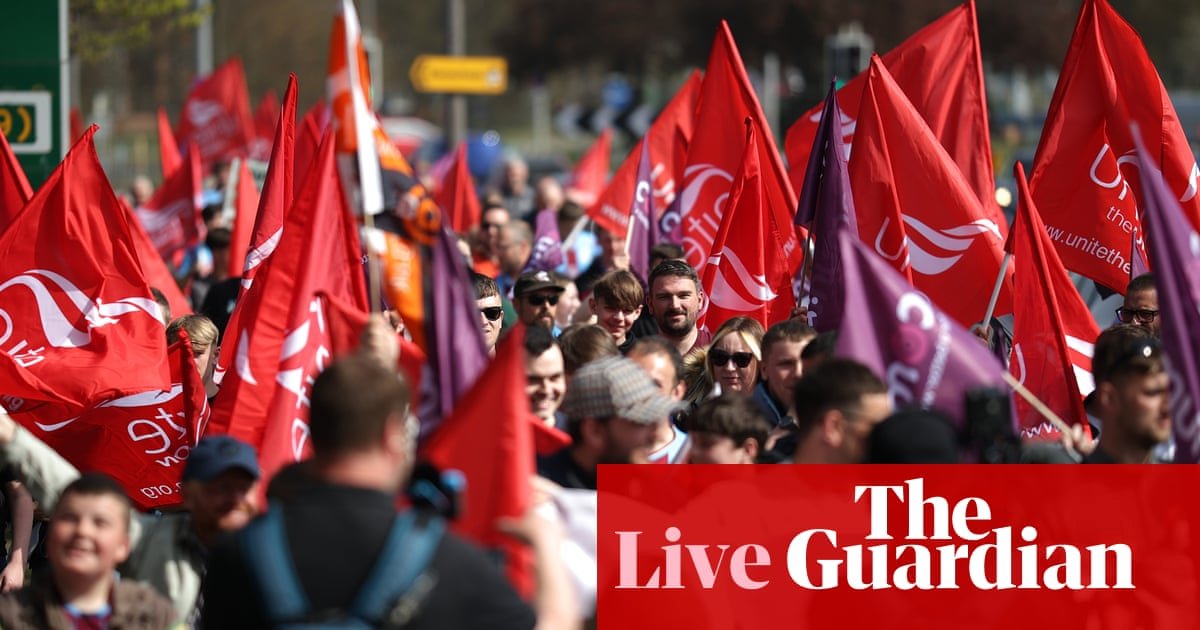
While the steel industry (special measures) bill is being debated in parliament, a march to save British steel has taken place this afternoon in Scunthorpe. Here are some images via the newswires: